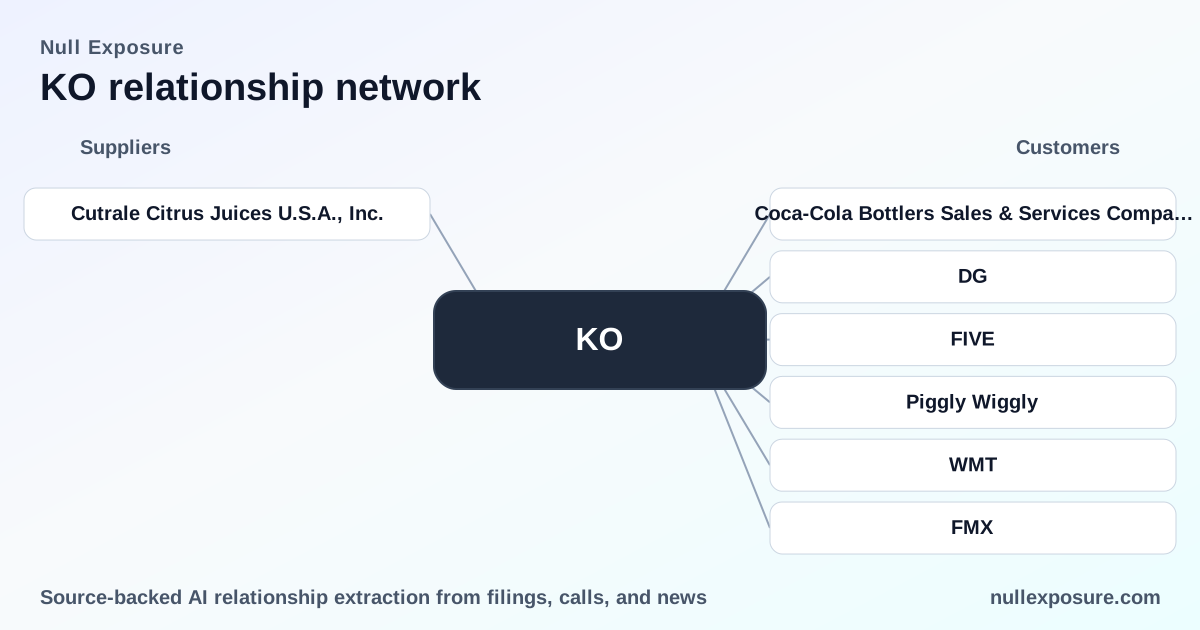
Coca‑Cola’s Customer Map: Who Buys, Bottles and Sells the Brand — and Why it Matters to Investors
Thesis: The Coca‑Cola Company (KO) operates as a global concentrate and brand owner that monetizes primarily by selling concentrates, syrups and finished beverages to a network of franchise bottlers, distributors and large retail partners, while also selling finished goods into retail and foodservice channels; this hybrid model generates stable, high‑margin concentrate revenue and recurring volume exposure through short‑term commercial contracts with highly distributed counterparties. For a quick view of signal coverage, visit https://nullexposure.com/.
How revenue flows and what that implies for risk and resilience
KO’s commercial architecture is a classic franchisor/franchisee split: KO is the concentrate seller and brand steward; independent bottlers produce, bottle, market and distribute locally. Company disclosures and market commentary show four operating implications investors should treat as base case:
- Contracting posture: short‑term customer obligations — KO discloses that customer performance obligations generally have original durations of one year or less, signalling flexible, transactional commercial terms rather than long‑dated take‑or‑pay contracts (company filings, FY2024).
- Global, highly distributed counterparty footprint — KO sells into more than 200 countries and divides its operations into regional segments, reducing single‑market concentration but increasing reliance on local bottlers for execution (company filings; FY2026).
- Role diversity: KO is buyer/seller/manufacturer/reseller in different flows — the firm functions as seller of concentrate, purchaser of ingredients (e.g., HFCS), and counterparty to bottlers and retailers; this creates commercial criticality concentrated around franchise economics, not owned bottling (10‑K and operating segment disclosures).
- Counterparty types include both institutional partners and direct consumer retail via Costa — KO also sells directly through retail operated by Costa under its Global Ventures segment, which introduces retail‑level sales exposure alongside franchised distribution (company filings).
These characteristics produce stable top‑line cash generation with operational execution risk concentrated in franchise bottlers and large retail partners. For more signal depth on counterparties and constraints, see https://nullexposure.com/.
Customer relationships: the practical roster investors must track
Below I list every customer/bottler/retailer relationship that appears in the compiled results, with a concise plain‑English summary and the cited source.
Coca‑Cola Bottlers Sales & Services Company LLC
KO uses this entity to coordinate ingredient purchases such as high‑fructose corn syrup for the U.S. system, reflecting an internal procurement/coordination role within the bottling network (KO 10‑K, FY2024).
Walmart (WMT)
Walmart is a major retail outlet participating in new product rollouts (for example, the Mr. Pibb relaunch in Georgia), illustrating KO’s reliance on national retailers for fast in‑market scale (11Alive, March 2026).
Piggly Wiggly
Regional grocer Piggly Wiggly is listed among participating retailers in product relaunches, showing KO’s mix of national and local retail distribution points (11Alive, March 2026).
Five Below (FIVE)
Five Below is cited as a participating retailer in product relaunch activity, underlining KO’s targeted retail channel strategy across price points (11Alive, March 2026).
Dollar General (DG)
Dollar General appears in retailer lists for brand relaunches, reflecting KO’s penetration into value and convenience channels in the U.S. (11Alive, March 2026).
Coca‑Cola Consolidated, Inc. (COKE)
Coca‑Cola Consolidated is the largest U.S. bottler by territory and handles manufacturing, marketing and distribution across 14 states and DC; corporate disclosures consistently describe it as an exclusive regional execution partner (GlobeNewswire / MarketScreener releases, FY2025–FY2026).
Costco (COST)
Costco is referenced in food‑service rollout notes (food court beverage partnerships), representing KO’s embedded placement in large wholesale and membership retail foodservice channels (Costco earnings call transcript, Q4 2025).
Coca‑Cola FEMSA (KOF)
Coca‑Cola FEMSA is one of KO’s largest Latin American franchise bottlers, responsible for concentrate procurement, production and distribution across multiple countries and subject to concentrate‑pricing discussions in public transcripts (Investing.com, Q3 2025; MarketWatch / TipRanks summaries, FY2026).
Embotelladora Andina (AKO‑A / AKO‑B)
Embotelladora Andina operates as a major South American bottler for KO across Chile, Argentina, Paraguay and Brazil; press and filings document its franchise agreements and regional investments (CNBC profile / MarketScreener, FY2017–FY2026).
Coca‑Cola Europacific Partners (CCEP / CCEPY)
CCEP is a large European and Asia‑Pacific bottler operating under long‑standing franchise arrangements where KO supplies concentrate and CCEP executes local production, marketing and distribution (ad‑hoc‑news and Global Banking & Finance coverage, FY2026).
Coca‑Cola HBC (CCH)
Coca‑Cola HBC is identified as a major bottler for Europe (and adjacent markets), serving multiple countries and executing local distribution under franchise terms (IndexBox coverage, FY2026).
Swire Coca‑Cola
Swire is listed as a significant bottler in Asia (and some U.S. operations), confirming KO’s reliance on regional bottlers with deep logistics footprints (IndexBox, FY2026).
Tingyi Holding Corp.
Tingyi is cited as a master Coca‑Cola bottler in China, reflecting KO’s franchise footprint in Greater China through local partners (IndexBox, FY2026).
Brinker International (EAT)
Brinker (parent of Chili’s) is referenced for menu partnerships that include Coca‑Cola drinks, reflecting KO’s embedded relationships in casual dining foodservice (InsiderMonkey, FY2026).
Monster Beverage Corporation (MNST)
Monster leverages KO’s bottling and distribution network in many markets as part of strategic distribution partnerships, expanding energy‑drink reach via KO’s channels (InsiderMonkey / trading commentary, FY2026).
McDonald’s (MCD)
McDonald’s is a long‑standing, high‑visibility foodservice partner; KO’s Q1 2026 earnings call reiterates the enduring partnership and its contribution to on‑premise volume (KO earnings call transcript, Q1 2026).
Fomento Económico Mexicano (FMX / OXXO)
FMX (Oxxo) is the largest Coca‑Cola bottler and retail operator in Mexico and operates convenience and bottling assets under franchise arrangements with KO (InsiderMonkey and MarketBeat coverage, FY2026).
Molson Coors Beverage Company (TAP / TAP‑A)
Molson Coors partners with KO on alcoholic and hard‑seltzer extensions (e.g., Topo Chico Hard Seltzer and other co‑branded products), demonstrating KO’s licensing and joint‑innovation paths outside core soft drinks (SahmCapital / Brewbound reports, FY2022–FY2026).
Shake Shack (SHAK)
Shake Shack’s transcript notes that it sells Coca‑Cola branded beverages chain‑wide, an example of KO’s foodservice penetration into premium fast‑casual segments (The Globe and Mail / Motley Fool transcript, FY2026).
Coca‑Cola Beverages Africa (CCBA)
CCBA is discussed in KO materials as a bottling segment with lower margin relative to concentrate operations, highlighting the profitability split between KO’s brand/concentrate business and bottling (KO earnings commentary via InsiderMonkey, FY2026).
Brown‑Forman (BF‑B)
Brown‑Forman partnership examples (e.g., premixed Jack & Coke) show KO’s strategic brand licensing into premixed alcoholic RTD categories (Winnipeg Free Press / Brew reports, FY2022–FY2026).
What this roster tells investors about concentration and execution risk
- Concentration is structural and regional, not single‑counterparty: KO’s partner list is long and geographically diverse (Europe, Latin America, Asia, North America), which dilutes single‑counterparty revenue risk but concentrates execution risk in the handful of very large franchise bottlers (KOF, CCEP, COKE, FMX).
- Contract maturity is short and commercial leverage remains with KO on brand/ concentrate pricing, but operational execution (bottling, distribution) is outsourced, making bottler financial health and local retail conditions a key second‑order risk.
- Criticality of relationships is high where bottlers control last‑mile distribution; retailers (Walmart, Dollar General, Costco) are commercially critical for scale campaigns and launches.
Bottom line: focus areas for monitoring
- Track large bottler earnings and strategic moves (Coca‑Cola FEMSA, CCEP, Coca‑Cola Consolidated, FMX, Embotelladora Andina).
- Monitor concentrate pricing discussions and tax/excise developments in major markets (public transcripts and filings reference these dynamics explicitly).
- Watch retail rollout execution for new SKUs and premiumization plays with partners like Walmart, Five Below and Costco.
For an interactive signal view and to integrate these relationship insights into due diligence, visit https://nullexposure.com/ — our coverage consolidates filings, transcripts and market commentary into actionable counterparty intelligence.