KORE: IoT connectivity with recurring revenue and a private-equity exit underway
KORE Group Holdings operates as an independent global IoT enabler, monetizing through monthly recurring connectivity charges, usage-based data fees and services-based IoT solutions for enterprise customers in transportation, logistics, retail and industrial verticals. The company combines a high-margin connectivity platform with professional services, occasional device sales/leases and long-lived device economics to generate recurring cash flow; that model attracted a definitive all-cash acquisition at $9.25 per share that values the business at roughly $726 million. For a concise dossier of KORE’s customer and strategic relationships, see NullExposure.
Private-equity buyers consolidate control — why it matters to customers and investors
The recent transaction dynamics shift KORE from a public equity story into a privately held strategic play under specialist investors. Searchlight Capital Partners and Abry Partners are the named buyers in the definitive merger, offering $9.25 per share in an all-cash deal that aggregates the stock KORE did not already own, with the transaction headline value reported at about $726 million. This is sourced from company announcements and subsequent market coverage in March–April 2026. According to multiple press notices and investor-alert news releases in March–April 2026, Halper Sadeh and other plaintiffs’ counsel circulated investor inquiries about the fairness of the consideration, underscoring activist and stakeholder attention around the sale process. (See Accesswire and GlobeNewswire coverage, March–April 2026.)
What private-equity ownership implies for customers
Private-equity ownership typically compresses public reporting and focuses on margin expansion and contract upsell. Under Searchlight and Abry control, expect active portfolio management: cost rationalization, cross-sell of connectivity into Abry/Searchlight portfolio companies, and potential emphasis on higher-margin IoT Solutions over low-margin transit data.
All relationships captured in the coverage — clear, sourced takeaways
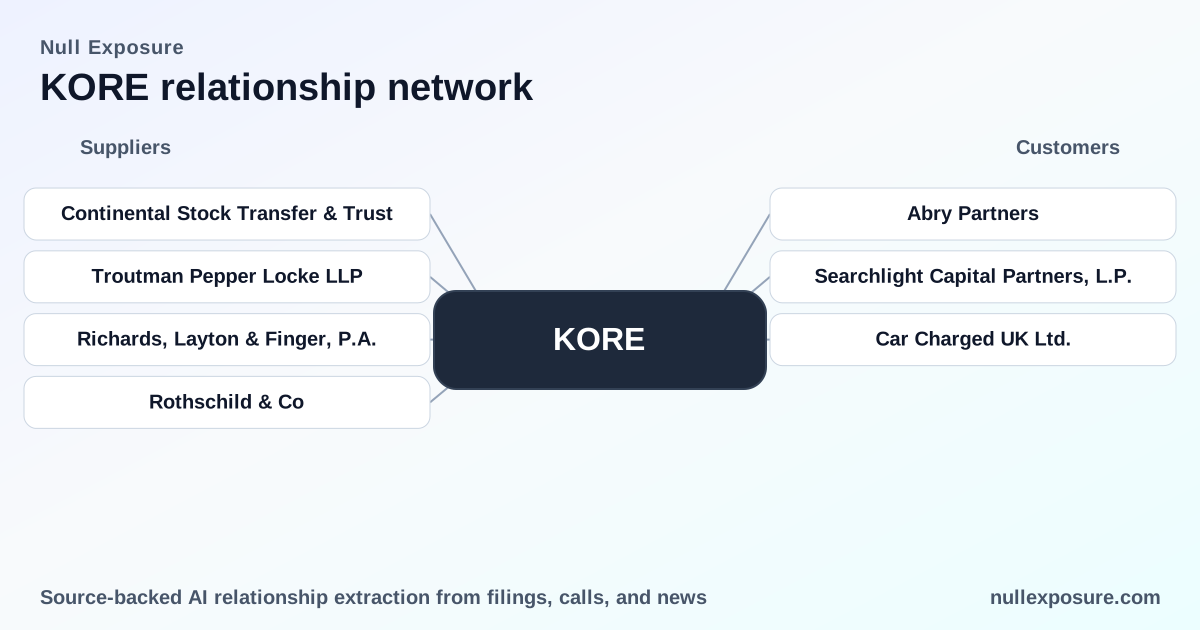
Below are every relationship referenced in the collected coverage, presented with plain-English summaries and source context.
-
Searchlight Capital Partners, L.P. — Searchlight is the lead financial buyer in the February 27, 2026 definitive merger agreement to acquire KORE at $9.25 per share as part of a $726 million transaction; this was announced in KORE’s merger filing and repeated in market press in March–April 2026. Source: company merger announcement and GlobeNewswire/Accesswire reporting (Mar–Apr 2026).
-
Abry Partners — Abry Partners is the co-buyer alongside Searchlight in the all-cash transaction for KORE, forming the private-equity consortium that will take KORE private at $9.25 per share; press notices and investor alerts documented the buyers and the transaction value. Source: Accesswire and multiple news releases summarizing the definitive agreement (Feb–Apr 2026).
-
Car Charged UK Ltd. — Car Charged UK selected KORE to support a UK program to expand home-adjacent EV charging access for approximately eight million drivers without off-street parking, illustrating KORE’s role as a solutions integrator for mobility and energy use cases; this relationship was reported during KORE’s NYSE debut materials and PR coverage in 2021. Source: PR Newswire release tied to KORE’s post-merger NYSE communications (FY2021).
Operating-model constraints and what they reveal about business quality
KORE’s contract mix and revenue geography create a distinct profile for investors evaluating durability, growth levers and risks.
-
Contracting posture — blended short-term and subscription economics. KORE recognizes monthly recurring charges (MRCs) and overage/usage fees as the core of IoT Connectivity revenue; much of this business is month-to-month, which increases near-term churn exposure but enables rapid customer onboarding and pricing agility. At the same time, the company reports subscription-like lifetime economics for devices (7–10 years) and multi-year arrangements with automatic renewals for some customer classes, which provide a longer-duration revenue stream.
-
Pricing mechanics — usage-led plus subscriptions. Revenue is a combination of subscription (recurring MRCs), usage-based overage fees, and bundled services. That structure incentivizes upsell and delivers higher lifetime value when device deployments scale.
-
Contract maturity and hardware economics. KORE documents at least one 36-month sales-type lease that transfers device ownership at lease end, signaling that some deals are structured as longer-term capital arrangements rather than pure-monthly services. The coexistence of short-term access contracts and longer hardware/installation arrangements creates diversified cash-flow profiles.
-
Geography and concentration — US-centric but global footprint. The company derives roughly 85% of revenue from the United States while describing itself as a global IoT enabler; this is a company-level signal indicating operational concentration risk in North America despite a broader service capability.
-
Customer concentration — dispersed, not single-customer dependent. KORE reports no single customer accounted for more than 10% of total revenue for recent fiscal years, which positions the company as commercially diversified across enterprise clients.
-
Segment orientation — services-first. Revenue mix is connectivity plus IoT Solutions, with the latter encompassing installation, device support and analytics for five verticals including Connected Health and Fleet Management. This services orientation increases gross margin potential relative to pure SIM-resale models.
Risk vectors that investors should prioritize
-
Churn and pricing pressure from short-term contracts. Heavy reliance on month-to-month arrangements concentrates churn risk and increases sensitivity to competitive price moves.
-
Geographic concentration in the U.S. leaves the business exposed to U.S.-specific macro and regulatory cycles, even as global capability provides expansion optionality.
-
Transaction execution risk and stakeholder scrutiny. The reported all-cash sale at $9.25 per share generated investor-lawyer notices and fairness inquiries in March–April 2026, signaling that governance and transaction process transparency are active investor concerns. Source: GlobeNewswire and Finviz reporting of investor-lawyer notices (Mar–Apr 2026).
If you want a deeper read on KORE’s commercial footprint and the investor implications of the transaction, NullExposure has a full service page covering KORE and comparable IoT platforms. Visit https://nullexposure.com/ to access the dossier and monitoring tools.
Investor takeaway — concise and actionable
KORE combines recurring, usage-driven connectivity revenue with higher-margin IoT solutions, producing a revenue profile that is both flexible and monetizable through device lifecycles. Private-equity ownership under Searchlight and Abry accelerates margin focus and potential portfolio synergies, while the business-level constraints — short-term contract exposure, U.S.-centric revenue and dispersed but small customer concentration — define the principal operational risks. For investors tracking post-deal performance and customer retention metrics under the new ownership, NullExposure provides ongoing situation monitoring and relationship intelligence at https://nullexposure.com/.