Kosmos Energy (KOS): Customer Relationships That Drive Near-Term Cash and Strategic Portfolio Rotation
Kosmos Energy operates as a deepwater oil and gas exploration and production company focused on Atlantic margins and the Gulf of America; it monetizes hydrocarbons by selling produced gas and liquids under a mix of short‑term field sales and long‑term LNG sale-and-purchase agreements, while recycling capital through asset disposals. For investors, the company’s customer mix is a balance of sovereign counterparties for spot or interim gas sales and global energy traders/major oil companies for contracted LNG offtake, and recent asset sales to third‑party buyers are material to near‑term cash flow and reserve strategy. Learn more at https://nullexposure.com/.
Business model in one paragraph Kosmos is a single‑line E&P operator that recognizes revenue when hydrocarbons are delivered to purchasers, selling into both domestic/host‑government markets and international LNG buyers. Revenue drivers are production volumes and contract type — short‑term field sales deliver immediate, lower-margin cash; long‑term SPAs provide predictable volumes and price structures. The company actively manages portfolio concentration by divesting non‑core, non‑operated interests and locking long-term offtake where possible.
How Kosmos contracts and why that matters Kosmos’s contracts show a dual posture: short‑duration, government‑linked field sales for domestic supply and long‑dated LNG SPAs for export volumes. This structure reduces short‑term price exposure on critical projects where long-term financing and infrastructure are required, while interim government sales support cash flow when long-term terms are unresolved. The company also acts primarily as a seller of hydrocarbon volumes rather than a marketing counterparty.
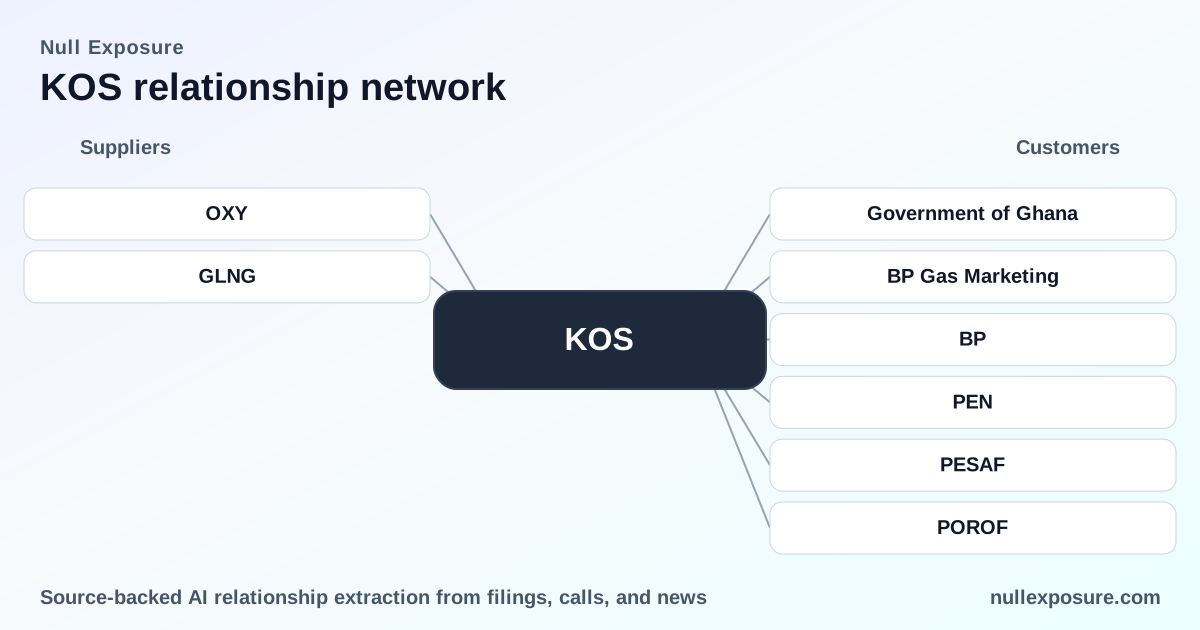
Counterparty relationships: what investors should know Below are the customer relationships disclosed across Kosmos’s filings and recent market reports; each entry gives a concise investor‑facing summary with source.
Government of Ghana
Kosmos and its Jubilee partners executed an interim gas sales agreement to sell Jubilee Field gas to the Government of Ghana, originally through May 2024 and subsequently extended to November 2025 while discussions on a long‑term contract continue. This is a short‑term, government‑facing supply arrangement that supports domestic demand and immediate cash generation. According to Kosmos’ 2024 Form 10‑K (FY2024), the interim agreement and its extension are explicitly documented.
BP Gas Marketing / BP (BPGM)
Kosmos, together with co‑venturers in the Greater Tortue Ahmeyim (GTA) project, selected BP Gas Marketing (BPGM) as the LNG buyer for Tortue Phase 1 and executed an SPA in February 2020 with an initial term through the end of 2033 plus a seller option to extend for 10 years; the offtake size is 2.45 mtpa under contract language cited in company and media reports. This is a long‑term, export‑grade commercial relationship that underpins financing and project economics for Tortue Phase 1. The selection of BPGM and SPA terms are recorded in Kosmos’ 2024 Form 10‑K (FY2024) and discussed in industry coverage (Energy Chamber, March 2026).
Panoro Energy (and related buyers referenced in market reports)
Kosmos entered into a sale agreement to divest its 40.375% non‑operating interest in the Ceiba Field and Okume Complex offshore Equatorial Guinea to Panoro Energy for an initial cash consideration (reported at $180 million) plus contingent payments up to roughly $39.5 million, a transaction widely reported across financial news outlets. The sale converts a non‑operated producing interest into immediate cash and reduces operational concentration in Equatorial Guinea. Market reports and Kosmos sale announcements are summarized in Research‑Tree’s newsfeed and corroborated by other outlets (March 2026).
Constraints and what they signal for investors Kosmos’s disclosed constraints provide insight into contract maturity, counterparty type, and geographic spread — and these are best read as company‑level operating characteristics rather than isolated facts.
- Contracting posture: mixed (short and long term). The Tortue Phase 1 SPA with BP is explicitly a long‑term offtake (initial term to 2033 with a 10‑year extension option), demonstrating Kosmos’s ability to secure multi‑decade export contracts that support project finance. At the same time, Jubilee gas sales to the Government of Ghana have been structured as interim, short‑term agreements, signaling ongoing negotiation toward a durable solution but providing near‑term liquidity (source: company 10‑K).
- Counterparty concentration and type: diversified by counterparty class but geographically concentrated. Kosmos sells to both sovereign purchasers (Ghana) and international energy marketers/majors (BP/BPGM), which spreads counterparty risk across public and private buyers. The company’s operations and sales remain concentrated in four regions — Ghana, Equatorial Guinea, Mauritania/Senegal and the Gulf of America — so geographic or political events in those corridors will have outsized portfolio impact (company disclosures).
- Relationship criticality and segment focus: core product seller. Kosmos is in a single line of business (exploration, development and production) and recognizes revenues on volumes sold; LNG SPAs are core product contracts critical to project returns, while field sales are tactical cash generators (company filings).
- Maturity and predictability: long‑dated SPAs provide price and volume visibility; interim sales are inherently transitory. The Tortue SPA provides long‑dated contractual backbone for export volumes; interim government sales provide short‑term certainty but not the same predictability for long‑term valuation.
Major investment implications
- Cash and de‑risking via asset sales: The Panoro transaction converts non‑operated production into cash, improving liquidity and portfolio focus; investors should treat such disposals as material to near‑term balance‑sheet repair and capital allocation.
- Counterparty quality and project finance: The BP BPGM SPA is a high‑quality offtake that supports Tortue’s export economics and underwrites longer‑dated asset value. Long‑term SPAs materially reduce execution risk on high‑capex projects.
- Sovereign exposure requires active management: Interim gas sales to Ghana support domestic supply and cash flow, but the absence of a long‑term agreement leaves a portion of volumes subject to renegotiation and price reset risk. Resolution of long‑term terms with Ghana is an operational priority.
Actionable next steps for analysts
- Reconcile projected production and contract volumes: model both the 2.45 mtpa Tortue commitment under the BPGM SPA and the interim Jubilee volumes sold to Ghana at the quoted per‑MMBtu prices when forecasting revenue. (Company filings and market reports provide the contract sizes and interim prices.)
- Treat asset‑sale proceeds as one‑off liquidity that should be modeled separately from recurring cash flow, and update reserves/production forecasts following the Panoro closing disclosures.
For deeper diligence on counterparties and sale terms, visit https://nullexposure.com/ for our consolidated coverage and source aggregation.
Key takeaway Kosmos monetizes through a disciplined mix of long‑dated LNG contracts with majors for export stability and shorter‑term government field sales for immediate cash, while actively reducing non‑core exposure through asset sales. The BP SPA gives project backbone; the Ghana agreements supply short‑term liquidity; and the Panoro disposal materially improves near‑term balance sheet flexibility.