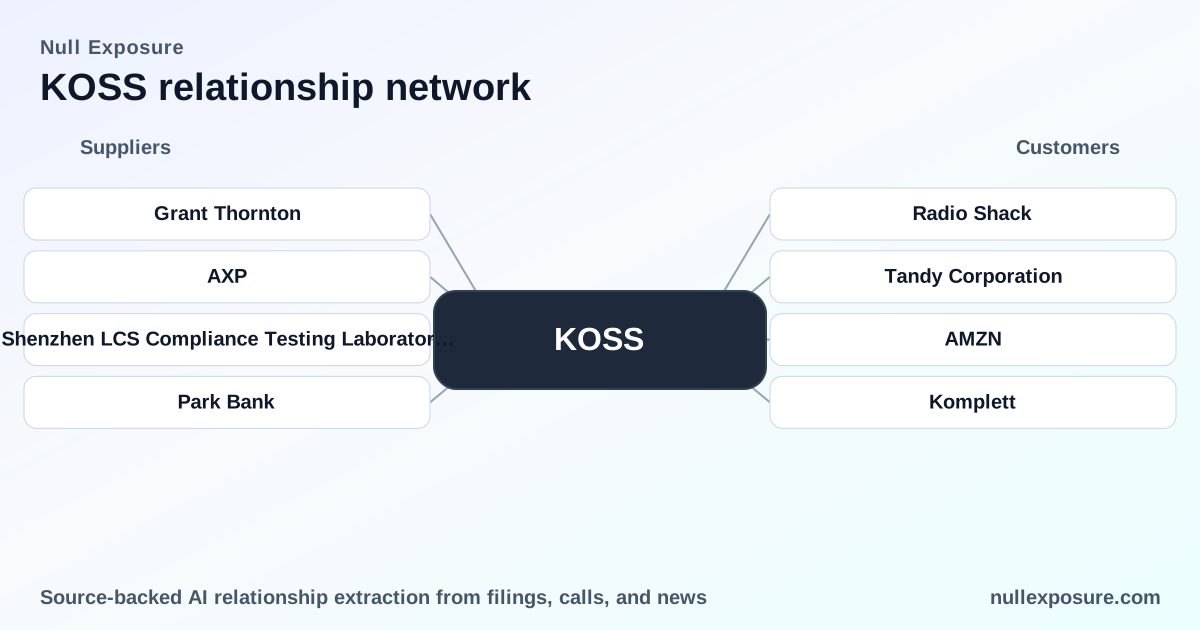
Koss customer relationships — channel concentration, legacy partnerships, and what investors should price in
Koss Corporation designs and manufactures stereo headphones and accessories and monetizes through a mix of direct-to-consumer (DTC) sales on marketplaces and traditional retail/distributor channels. The company reports a single operating segment focused on hardware audio products, with DTC via the Amazon portal representing more than 19% of net sales in fiscal 2025 and the five largest customers accounting for roughly 50% of net sales — a concentrated revenue profile that drives both upside from scale and outsized counterparty risk.
Explore deeper company relationship analytics at https://nullexposure.com/.
Channel concentration is the dominant commercial story
Koss runs a two‑pronged go‑to‑market model: it sells directly through online marketplaces and also supplies retail partners and distributors both domestically and internationally. The materiality of a handful of large customers and the outsized role of Amazon for DTC sales are the central commercial risks and levers for value creation.
-
Koss’s FY2025 Form 10‑K states that DTC sales via the Amazon portal were approximately 19% of net sales in fiscal 2025 and 17% in fiscal 2024, making Amazon the company's largest single sales concentration. (Source: Koss Form 10‑K, fiscal year ended June 30, 2025.)
-
The 10‑K also reports that the five largest customers accounted for about 50% of net sales in FY2025, highlighting high counterparty concentration that requires active account management and contingency planning. (Source: Koss Form 10‑K, FY2025.)
Relationship snapshot — every partner in the record
Below are concise, plain‑English summaries of each customer relationship mentioned in available records, with source context.
-
AMZN — Koss’s 2025 Form 10‑K identifies its DTC offerings via the Amazon portal as the company’s largest sales concentration, accounting for more than 19% of net sales in fiscal 2025. This establishes Amazon as a critical commercial channel for revenue and customer reach. (Source: Koss Form 10‑K, year ended June 30, 2025.)
-
Amazon — A separate, older media reference highlights the consumer pricing and review presence of Koss products on Amazon (for example, the Porta Pro listing and customer reviews), supporting the view that Amazon is both a distribution and reputation channel for Koss product lines. (Source: Ars Technica, April 2018.)
-
Tandy Corporation — Historical reporting documents that Koss signed a deal with Tandy Corporation under which headphones sold under the Radio Shack name were manufactured by Koss for an extended period; this points to legacy OEM/white‑label manufacturing relationships that established Koss’s distribution footprint. (Source: A Journal of Musical Things, March 2026.)
-
Radio Shack — The same account notes that many headphones sold under the Radio Shack brand were actually built by Koss, corroborating a long‑standing manufacturing and supply relationship with Radio Shack/Tandy legacy channels. (Source: A Journal of Musical Things, March 2026.)
-
Komplett — An example referenced in consumer tech press surfaced a listing for Koss products on Komplett (a Norwegian e‑commerce site), illustrating how Koss products also flow through international retail listings and third‑party online storefronts beyond the U.S. market. (Source: Ars Technica, April 2018.)
What the constraints tell investors about operating posture
The public filings and evidence create a compact view of how Koss operates commercially:
-
Geography and market footprint: Net sales remain concentrated in North America; Koss reported U.S. net sales of roughly $8.97 million out of $12.62 million in FY2025, though the company also sells internationally through retailers and distributors. This means domestic revenue predominates, but international channels provide scope for incremental growth. (Source: Koss Form 10‑K, FY2025.)
-
Concentration and materiality: The top five customers represent roughly half of revenue — a clear concentration risk that elevates negotiation leverage of a small set of buyers and increases earnings volatility if any single relationship falters. (Source: Koss Form 10‑K, FY2025.)
-
Contracting posture and channel mix: The company combines DTC marketplace sales (platform‑driven, subject to fees and platform rules) with wholesale/retailer supply agreements and legacy OEM-like relationships; this hybrid posture is operationally efficient for reach but exposes margin and control to marketplace policies and large retail partners. (Company‑level signal derived from FY2025 10‑K disclosures.)
-
Segment and maturity: Koss reports as a single reporting segment in consumer audio hardware; product and channel maturity are reflected in legacy retail relationships (e.g., Radio Shack/Tandy) alongside contemporary marketplace reliance — the business is small, concentrated, but with well‑established product heritage. (Source: Koss Form 10‑K.)
-
Spend band and counterparty scale: The company’s largest sales concentration falls in a partner revenue band consistent with mid‑single to low‑double digit percentage contributions to company revenue, implying individual partner volume in the $1M–$10M range for Koss’s current scale. (Source: Koss Form 10‑K, FY2025.)
Strategic implications for investors and operators
-
Upside drivers: Stability or growth in Amazon DTC sales accelerates revenue without proportionally increasing fixed costs; international retailer listings create optionality for margin expansion if Koss shifts mix toward higher‑margin channels.
-
Key risks: High customer concentration and dependence on marketplace policy create single‑point-of‑failure scenarios for revenue and margin. Legacy OEM manufacturing relationships (Tandy/Radio Shack) demonstrate historical breadth but do not offset near‑term concentration metrics.
-
Operational priorities for management: Formalize contingency plans for major partner attrition, diversify channel mix (direct channels beyond a single marketplace), and negotiate terms that protect margin amid retailer and platform fee pressure.
Bold takeaways for a prospective investor: Amazon is a critical revenue engine, the top five customers represent half of sales, and U.S. demand dominates the revenue base. Balance potential upside from marketplace scale against the concentrated counterparty risk that can rapidly swing short‑term earnings.
For operators conducting due diligence, focus on contract terms with Amazon and the company’s strategy for shifting mix toward owned channels or alternative marketplaces to reduce concentration risk.
Learn more about partner exposure analysis and risk scoring at https://nullexposure.com/.
Bottom line
Koss is a small, heritage consumer‑audio manufacturer with a concentrated customer base centered on Amazon DTC and several large retail relationships that together account for a meaningful share of revenue. Investors should price in both the leverage that a dominant marketplace can deliver and the fragility that follows from concentrated counterparty exposure. The company’s single‑segment hardware focus simplifies comparability but increases sensitivity to channel dynamics and retail partner negotiations.