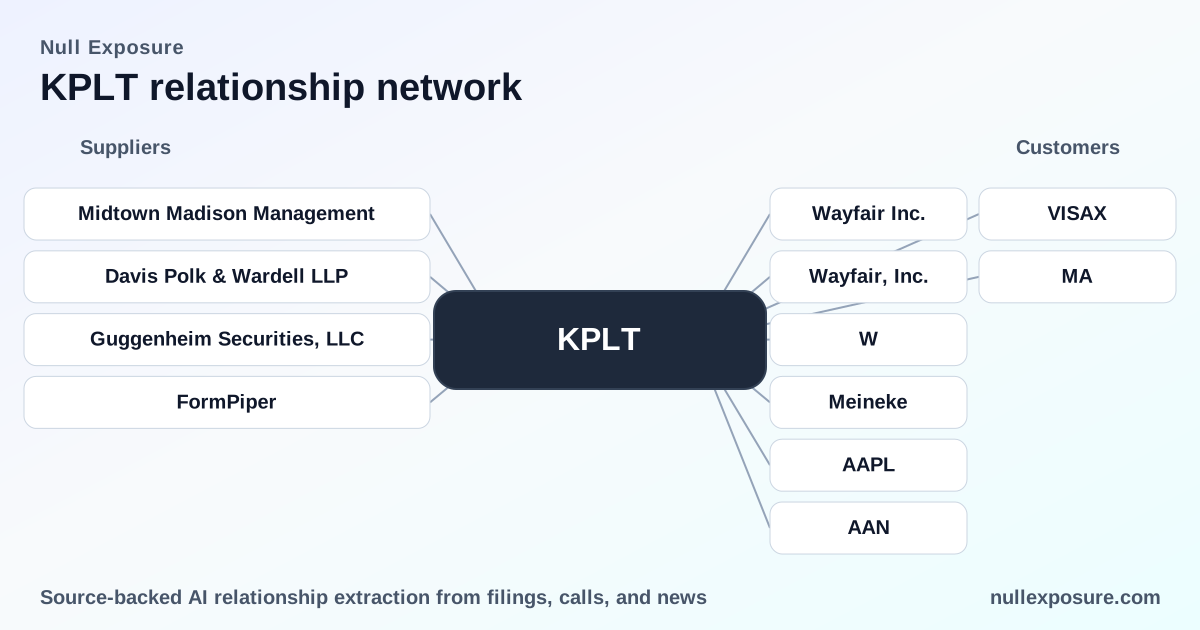
Katapult Holdings (KPLT): Merchant relationships drive originations — concentration and payment rails are the strategic levers
Katapult operates a technology-driven lease-to-own (LTO) platform that integrates directly with omnichannel retailers and marketplaces to originate short-term lease-purchase agreements to largely nonprime U.S. consumers. The company monetizes by collecting non‑refundable lease payments, early buyout fees and merchant integration/processing revenue through its Katapult Pay and marketplace channels; risk and opportunity both center on merchant originations and payment-rail access. For an at-a-glance vendor intelligence view, visit the NullExposure homepage: https://nullexposure.com/.
How to read Katapult’s merchant relationships—what matters to investors
Katapult’s economics are transaction-driven: merchant partnerships supply originations, and originations convert through short-duration lease contracts into recurring rental revenue or early buyouts. The firm’s operating posture is therefore characterized by:
- High merchant concentration risk: a small number of large merchants deliver a disproportionate share of volume.
- Short initial contract tenor with recurring renewal optionality: leases are typically weekly-to-monthly at inception with renewal corridors up to 12–18 months, creating fast cash conversion but leaving lifetime value dependent on retention and early buyout behavior.
- Consumer counterparty focus: contracts are executed with individual consumers in the U.S., predominantly nonprime, which imposes credit-performance sensitivity tied to macro and employment cycles.
- Critical third-party rails: compliance with Visa, Mastercard and other processors is operationally critical; loss of registration or fines would materially disrupt payments and originations.
- Platform maturity and marketplace expansion: merchant additions (Apple, Kay Jewelers, Meineke, Aaron’s) reflect active distribution growth and KPay marketplace scaling.
These are company-level characteristics drawn from Katapult’s filings and recent press; they shape the valuation sensitivity to merchant concentration, underwriting performance and payment-processor relationships.
Every reported customer relationship — concise investor notes
Below are each of the reported relationships in the shared results, with plain-English takeaways and source references.
Wayfair Inc. (10‑K disclosure on concentration)
Katapult reports that leases from property purchased at Wayfair accounted for more than 10% of total revenue in the years ended December 31, 2024 and 2023, signaling pronounced customer concentration and dependence on a major retail partner. This disclosure comes from Katapult’s FY2024 Form 10‑K.
Wayfair, Inc. (10‑K describing the commercial agreement)
Katapult has a formal merchant agreement with Wayfair, dated November 24, 2020, which embeds Katapult lease-purchase options directly into Wayfair’s customer checkout experience—this is a strategic distribution anchor for originations. The agreement specifics are described in the FY2024 Form 10‑K.
Wayfair (TradingView summary of SEC filing: FY2025 originations mix)
A March 10, 2026 TradingView summary of Katapult’s SEC filing states that Katapult Pay comprised 41% of gross originations, while Wayfair accounted for 25% of gross originations excluding Katapult Pay flows—underscoring Wayfair’s continued importance to originations mix in FY2025.
W (duplicate TradingView mention)
The same TradingView note reiterates the FY2025 originations split—Katapult Pay at 41% and Wayfair at 25% of gross originations (excluding Katapult Pay)—confirming the public market narrative on channel concentration (TradingView, March 10, 2026).
Meineke (press release via Yahoo/PR distribution)
Katapult announced that Meineke, the automotive repair franchise network, added Katapult to its consumer application process (“Meineke Payment Solutions”), expanding Katapult’s vertical reach into automotive services and franchise channels (press release distributed on Yahoo Finance, March 10, 2026).
Apple / AAPL (GlobeNewswire marketplace launch)
Katapult launched Apple in its Katapult app marketplace during FY2025, bringing the KPay merchant count to approximately 40—this indicates expansion into high‑value consumer electronics and a step toward broader marketplace diversity (GlobeNewswire press release, November 12, 2025).
AAN / The Aaron’s Company (press release on strategic combination)
Katapult’s technology was cited in a December 12, 2025 GlobeNewswire release announcing The Aaron’s Company’s combination with CCF Holdings; the release stated that Katapult’s digital capabilities will help unlock growth across Aaron’s store footprint—signaling large-format retail interest in Katapult’s tech.
The Aaron’s Company, Inc. (duplicate release)
The December 12, 2025 release again emphasizes that Aaron’s expects Katapult’s platform to provide omnichannel and in-store digital capability, positioning Katapult as a partner for legacy rent-to-own retailers (GlobeNewswire, December 12, 2025).
Kay Jewelers (GlobeNewswire FY2026 marketplace update)
Katapult reported in its FY2025 results release (March 11, 2026) that Kay Jewelers was launched in the Katapult app marketplace and that the KPay ecosystem contained approximately 40 enabled merchants—this extends Katapult’s presence into jewelry and specialty retail categories.
Apple (duplicate GlobeNewswire marketplace mention)
The earlier GlobeNewswire note (Nov 12, 2025) highlighting Apple’s inclusion in the marketplace is reiterated in company communications as evidence of merchant quality and marketplace expansion.
VISAX (10‑K — Visa/payment-processor dependency)
Katapult’s FY2024 10‑K discloses reliance on card issuers and payment processors and warns that failure to comply with Visa, Mastercard or other processors could lead to fines, suspension or termination of registrations with material adverse impact—this frames payment‑rail compliance as a critical operational dependency.
Visa (10‑K duplicate processor mention)
The 10‑K specifically names Visa among the payment processors on which Katapult depends and reproduces the compliance risk language, underscoring the same operational constraint reported in the FY2024 filing.
Mastercard (10‑K processor dependency)
Mastercard is similarly identified in the FY2024 10‑K as a principal payment processor; Katapult notes that non‑compliance with processor requirements could result in penalties or loss of service, which would materially impair business operations.
Investment implications and risk-reward checklist
Katapult’s merchant relationships drive the company’s top-line engine. Wayfair’s role as a revenue anchor (>10% historically and ~25% of originations in FY2025 channels) creates meaningful concentration risk, which amplifies both upside (if Wayfair expands Katapult placements) and downside (if the partnership contracts). Simultaneously, growth via marketplace signings—Apple, Kay Jewelers, Meineke, Aaron’s—reduces unit concentration and increases cross‑category diversification, but those merchant wins must scale to meaningfully offset the Wayfair concentration.
Payment-rail dependency on Visa and Mastercard introduces operational and regulatory risk that is binary in nature: compliance failures could disrupt settlement and origination flows. The lease-to-own product design—short initial lease terms with longer renewal corridors (12–18 months) and early buyout economics—delivers rapid cash collection yet ties lifetime value to consumer retention and early purchase behavior among nonprime borrowers.
Key takeaways for investors:
- Concentration: material; Wayfair is an originations and revenue anchor.
- Distribution strategy: marketplace growth is tangible and accelerating (40 KPay merchants reported in FY2025), which diversifies channels.
- Operational fragility: payment-processor compliance is critical.
- Business model: transaction-based, short-tenor leases with recurring renewals and buyout fees.
For deeper background and structured vendor intelligence on Katapult’s merchant footprint, see the NullExposure research hub: https://nullexposure.com/.
Overall, Katapult’s trajectory is clear—merchant partnerships determine scale, and payment rails determine execution. Investment value will track originations growth outside Wayfair, underwriting performance on nonprime credits, and sustained processor compliance.