Katapult (KPLTW) — The Wayfair Dependency and What Investors Should Price In
Katapult is a technology-driven lease-to-own (LTO) platform that underwrites and services consumer lease-purchase contracts for durable goods sold through omnichannel and e-commerce retailers. The company monetizes by originating non-prime consumer lease contracts, recognizing payments and fees over the life of those leases, and by integrating its payment options directly into merchant checkouts — a model that generates interest-like return streams and fee income while bearing credit risk on the consumer side. For investors assessing customer relationships, the most consequential fact is merchant concentration: a single retail partner contributes material revenue and operational scale to Katapult’s platform. Learn more about the company’s relationship map at https://nullexposure.com/.
How the business actually earns money (and why merchants matter)
Katapult sells lease-purchase options through merchant partners and captures revenue when consumers make lease payments and purchase options are exercised. The company’s economics combine:
- Merchant distribution — Katapult’s product is integrated into a retailer’s checkout or website, generating originations tied to merchant traffic.
- Lease economics — revenue flows as periodic non-refundable lease payments and eventual buyout options; Katapult bears credit and collections risk.
- Scale effects — larger merchant partners drive higher originations, spreading fixed platform costs and improving unit economics.
Because revenue is generated through merchant-originated leases, merchant relationships are not peripheral: they are the distribution channel and effectively the growth engine. This is why the identity and concentration of key partners directly inform credit and operational risk for investors.
The customer relationships in Katapult’s filings (every item in the results)
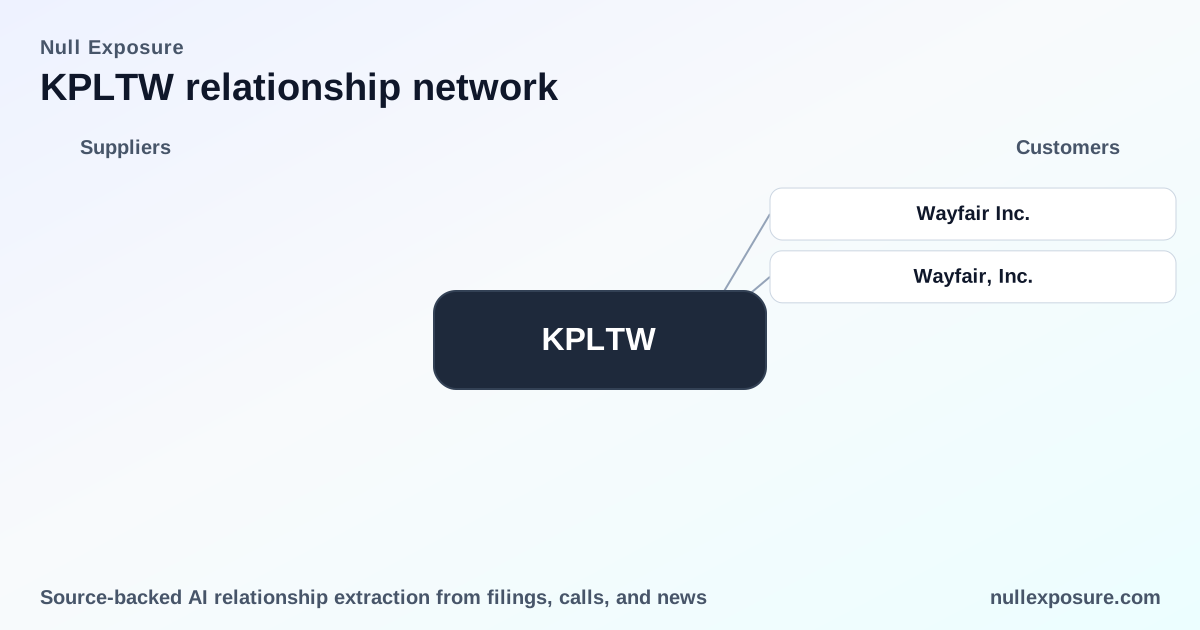
The filings returned two closely related entries; both refer to the same counterparty, Wayfair, but are distinct excerpts from Katapult’s FY2024 disclosure. Below are plain-English summaries for each item returned in the search results:
- Wayfair Inc. — Katapult discloses that customer leases from property held for lease purchased at Wayfair account for more than 10% of the company's revenue, and that lease activity tied to Wayfair represented more than 10% of total revenue for the years ended December 31, 2024 and 2023. According to Katapult’s FY2024 Form 10‑K, Wayfair is a material revenue source for the company (Katapult FY2024 10‑K).
- Wayfair, Inc. — Katapult states Wayfair is its largest merchant partner and references a contractual agreement dated November 24, 2020, under which Katapult provides lease-purchase options directly on Wayfair’s customer website. This is documented in Katapult’s FY2024 Form 10‑K and establishes the commercial integration between the two companies (Katapult FY2024 10‑K).
These two disclosures together make the same point from different angles: Wayfair is both Katapult’s largest merchant partner and a revenue-concentrated source.
Contracting posture, customer profile, and the geography of exposure
Katapult’s 10‑K language contains multiple signals that shape investor assessment of the relationship risk profile:
- Katapult’s lease-purchase transactions include short initial tenancy terms (one week to one month) with non‑refundable payments, but customers commonly obtain title through promotional pricing, early buyouts, or completing renewals over 12 to 18 months. This combination is captured in the filing language and produces both short-term and longer-term contract characteristics across the portfolio (Katapult FY2024 10‑K).
- The company explicitly classifies its counterparty as individual, non-prime U.S. consumers, and operates in 46 states plus DC, concentrating geographic exposure in the U.S. market (Katapult FY2024 10‑K).
- Katapult also notes that many transactions are structured to fall outside certain regulatory scopes because initial terms can be month-to-month and shorter than 90 days — a legal posture that has implications for regulatory risk and product design (Katapult FY2024 10‑K).
Taken together, these company-level signals show a dual nature: product flows are integrated into merchant checkouts with short contractual touchpoints, while the economic life of many leases is extended through renewals and buyouts, creating a hybrid maturity profile for receivables and credit exposure.
(If you want a concise mapping of relationship concentration and risk drivers, see our platform at https://nullexposure.com/.)
Why Wayfair matters: concentration and criticality
Katapult reports that Wayfair accounted for over 10% of total revenue in 2023 and 2024 — a threshold investors use to flag material counterparty concentration. That single fact has several implications:
- Concentration risk: Revenue exposure to Wayfair is meaningful; a disruption to that partnership would create an immediate revenue shortfall and likely compress originations and unit economics. This is more than a diversification issue — it is a structural dependency.
- Operational criticality: Because Katapult’s product is embedded in Wayfair’s checkout, changes in commercial terms, traffic patterns, or integration arrangements would directly affect origination volumes and timing of revenue recognition.
- Negotiation leverage: A large merchant partner has bargaining power over pricing, placement, and promotional mechanics that affect Katapult’s conversion rates and realized yields.
These conclusions are drawn from the FY2024 10‑K language that identifies Wayfair as Katapult’s largest merchant and notes the greater-than-10%-of-revenue relationship (Katapult FY2024 10‑K).
Investor implications and monitoring checklist
For investors and operators evaluating Katapult’s customer relationships, several practical points should guide underwriting and ongoing surveillance:
- Monitor merchant concentration: Quarterly revenue disclosure against top merchants is essential; any decline in Wayfair-originated lease volume will be a first-order risk signal.
- Watch contract renewals and amendment cadence: The Wayfair agreement date (Nov 24, 2020) and any visible contract amendments or public commentary from Wayfair will be critical. Katapult’s disclosure of the agreement in the FY2024 filing is a baseline; subsequent filings or merchant statements will indicate contract stability.
- Assess receivables maturity mix: The mix of short initial terms versus longer renewal-driven cashflows determines liquidity and loss timing; investors should track trends in average lease duration and buyout rates.
- Regulatory posture: Transactions structured with initial terms under 90 days are positioned outside certain federal regulatory requirements, but evolving consumer-finance regulation could change that calculus and affect product economics. Katapult’s FY2024 10‑K documents this legal positioning.
Bottom line — what to price in now
Katapult’s merchant-centric distribution model generates valuable originations, but Wayfair is a material and strategic dependency that concentrates both revenue and operational risk. The company’s contract structure blends short-term placement with longer-term revenue realization, creating a hybrid maturity and credit profile that investors must model explicitly. Key monitoring items are top-merchant revenue breakdowns, changes to the Wayfair integration or commercial terms, and portfolio metrics (average lease life, buyout rates, delinquencies).
Bold takeaway: Katapult is not a broad-payments utility; it is a merchant-dependent originator whose valuation and credit risk are tightly linked to the commercial health and contractual stability of its largest partners — first among them, Wayfair (Katapult FY2024 10‑K).
For analysts who want a succinct visualization of merchant concentration and contractual signals, visit our research hub at https://nullexposure.com/ for an integrated view of counterparty mappings and disclosure-extracted relationships.