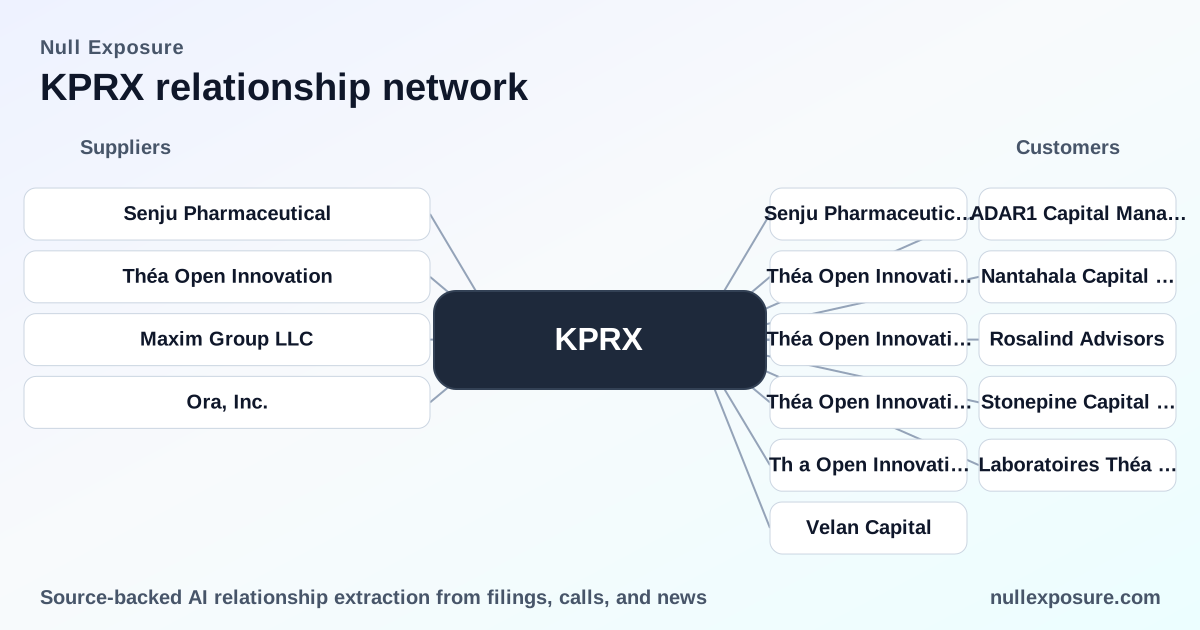
Kiora Pharmaceuticals (KPRX): Partner-led path to value capture in ophthalmics
Kiora Pharmaceuticals is a clinical-stage biotech that advances ophthalmic therapeutics through focused development and licensing partnerships. The company funds and de-risks early clinical work while monetizing through upfront payments, reimbursed R&D, milestone rights and option/license deals that transfer commercialization responsibility to larger regional partners. For investors, the thesis is straightforward: clinical progress plus partner option/license exercises drive meaningful non-dilutive financing and value realization. Learn how Kiora’s customer and partner footprint underpins that pathway at https://nullexposure.com/.
Why partnerships matter more than product sales today
Kiora reports negligible product revenue and negative operating margins while it advances KIO-301 and companion programs. The company’s commercial model is partner-centric: Kiora retains early development obligations (Phase 1–2) and uses upfront payments and reimbursed R&D to finance trials, then transfers or licenses later-stage development and commercial execution to established ophthalmic companies that assume Phase 3 and regulatory responsibilities. That structure preserves intellectual property exposure for Kiora while reducing the company’s go-to-market burden.
Capital and collaboration — how Kiora converts programs into liquidity
Kiora’s most material near-term monetization events are license agreements and structured financings. The TOI / Laboratoires Théa agreement delivered a $16 million upfront payment and ongoing reimbursables; receivables from Théa are a recurring cash signal in quarterly results. Separately, option agreements with regional partners such as Senju create deal-contingent upside (up to $110 million plus royalties) while smaller option fees provide immediate cash. Finally, private placements led by healthcare-focused investors have been an explicit funding route to support operations between milestone events.
All reported relationships, one-by-one
Perceptive Advisors led a private placement announced May 3, 2026, serving as one of the sole investors in a financing intended to provide growth capital to Kiora. Source: Newsfile press release (May 3, 2026).
ADAR1 Capital Management is a repeat venture/healthcare investor in Kiora financings, named as a sole investor alongside Perceptive in the May 3, 2026 private placement and as a participant in an earlier $45M placement (announced March 2024/2026 disclosures). Source: Newsfile releases (May 3, 2026; March 10, 2026).
Théa Open Innovation (TOI) executed a strategic development and commercialization agreement with Kiora that included a $16 million upfront payment and R&D reimbursement terms tied to KIO-301; TOI will share or assume later-stage responsibilities per the agreement. Source: Newsfile press release (March 10, 2026).
Laboratoires Théa shows up in Kiora’s receivables, with $1.5 million recorded as collaboration receivables for reimbursable R&D expenses related to KIO-301, reflecting active cost-sharing under the partnership. Source: Newsfile and bitget summaries of Kiora’s Q4/FY2025 report (2026).
Senju Pharmaceutical Co., Ltd. holds an option agreement covering key Asian markets (including Japan and China) for KIO-301, with potential deal value of up to $110 million plus royalties and an initial consideration reported at approximately $1.25 million. Source: Yahoo Finance company report and TradingView coverage (Q2/Q4 2025 disclosures; 2026 summaries).
Stonepine Capital Management participated as a new healthcare-dedicated investor in an earlier private placement that broadened Kiora’s investor base and provided non-dilutive capital support. Source: Newsfile financing announcement (March 10, 2026).
Velan Capital is listed among new healthcare-focused investors who participated in the private financing round intended to strengthen Kiora’s runway. Source: Newsfile financing announcement (March 10, 2026).
Nantahala Capital Management participated in the private financing round that expanded Kiora’s institutional shareholder mix and helped fund clinical programs. Source: Newsfile financing announcement (March 10, 2026).
Rosalind Advisors joined the private placement group that provided fresh capital to Kiora and signaled strategic investor interest from healthcare-specialist funds. Source: Newsfile financing announcement (March 10, 2026).
TOI (short reference) — mentioned again in filings and press — is the operating arm of Théa that executed the strategic deal granting exclusive rights and cost-reimbursement mechanics for KIO-301 development and commercialization in designated regions. Source: Newsfile press release (March 10, 2026) and subsequent company reports (Q1–Q3 2025 summaries).
Senju (short reference) — multiple mentions across trading reports confirm a modest upfront option fee and the strategic intent to localize development/commercialization in Asia pending option exercise. Source: TradingView and company press materials (2025–2026).
What the relationship signals and company-level constraints tell investors
Kiora’s extracted constraints read as a complementary company-level profile rather than transaction-level qualifiers:
- License-heavy contracting posture. Kiora operates under multiple license and option agreements that explicitly allocate milestone and royalty economics to the licensor/licensee construct — a deliberate model to convert clinical development into partner-funded value events.
- Global footprint oriented to NA / EMEA / APAC. Filings and operating statements confirm tax filings and subsidiaries across North America, EMEA and APAC, and partner agreements that allocate regional commercial rights (e.g., Senju for Asia, Théa for other territories). This is a sign of a deliberate regional licensing strategy to maximize partner reach.
- Single, focused operating segment. Kiora reports as a single reportable segment concentrated on ophthalmic pharmaceuticals, which concentrates program risk but simplifies valuation and partnership negotiations.
- Clinical-stage maturity. The company retains early-phase obligations (design and implementation through Phase 2) while partners assume Phase 3 and regulatory responsibilities — a structure that yields near-term reimbursables and upfront cash but leaves late-stage and commercialization upside contingent on partner decisions and option exercises.
Investment takeaways — what matters next
- Cash runway will be driven by partner reimbursements and selective financings. The Théa reimbursements and repeated private placements show Kiora’s reliance on partnerships and institutional backers for near-term funding.
- Upside is conditional on option exercises and milestone triggers. Senju’s option and Théa’s commercialization commitments create a defined upside path, but realization depends on clinical outcomes and partner commercial decisions.
- Concentration is a double-edged sword. Single-segment focus sharpens upside if KIO-301 succeeds, but it also leaves valuation sensitive to clinical readouts and the timing of partner milestone payments.
For a deeper look at how partner cashflows and investor syndicates are shaping Kiora’s runway, see additional analysis at https://nullexposure.com/.
Bold takeaways: Kiora converts program risk into cash through structured partnerships and targeted financings; the next 12–24 months of partner option exercises and reimbursed R&D receipts will determine whether the company’s market value re-rates to reflect commercial potential.
If you want a tailored briefing or transaction-level parsing of Kiora’s partner agreements, visit https://nullexposure.com/ for research services and signal-level access.