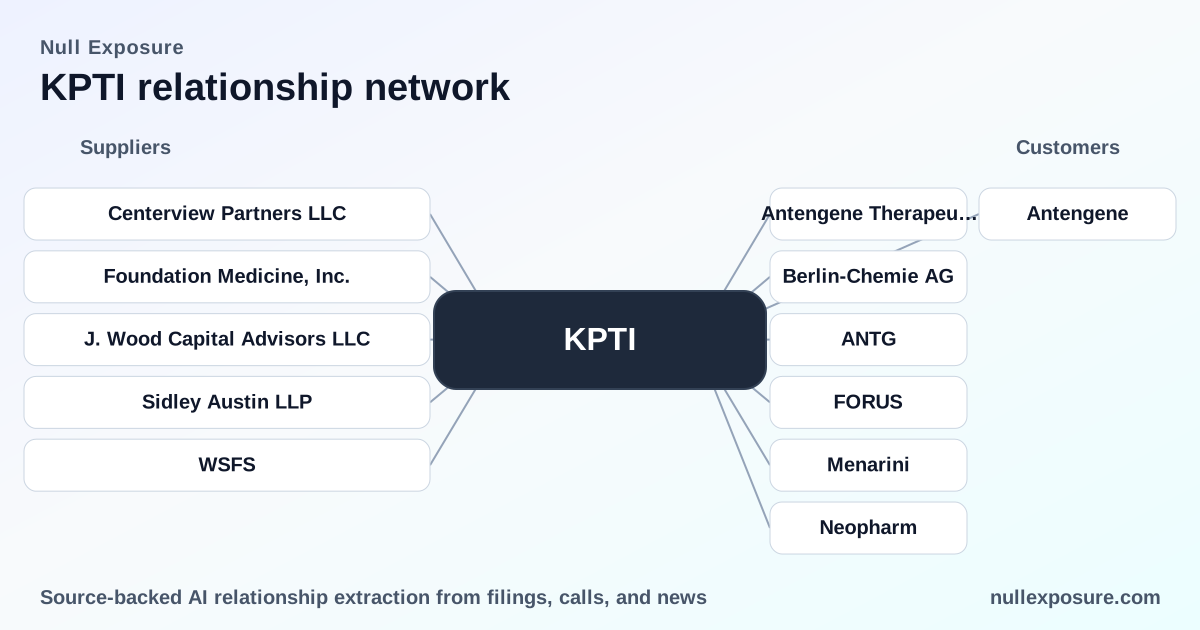
Karyopharm (KPTI) partner map: who sells XPOVIO outside the U.S. and who’s financing the company
Karyopharm develops and commercializes selinexor (XPOVIO/NEXPOVIO) and monetizes through direct U.S. product sales plus long-term licensing arrangements that grant regional development and commercialization rights to third parties; the company also supplements cash via equity financings. Revenue is concentrated in U.S. product sales, while international rollout is executed through licensees and distributors under multi-year agreements that transfer commercial responsibility and regional economics. For a consolidated view of counterparties and contract posture, visit https://nullexposure.com/.
How Karyopharm’s commercial engine is structured
Karyopharm’s operating model is hybrid: direct commercialization in the U.S. for its core product (XPOVIO) and territorial licensing overseas. The firm recognizes product revenue on delivery to customers in the U.S., and relies on specialty pharmacies and distributors to resell into healthcare channels. Licensing deals with third parties transfer development and commercialization obligations regionally, creating non-U.S. revenue exposure that is largely contingent on partners’ execution and regulatory timelines.
- Contracting posture: a mix of licensing (multi-year, exclusive in many territories) and spot product sales domestically.
- Concentration: material dependence on U.S. sales as the company’s primary product revenue source.
- Criticality: international partners are essential to global revenue scale because Karyopharm has limited direct commercial infrastructure outside North America.
- Maturity: license agreements include long tail terms (10–15 years plus patent/regulatory exclusivity) that align partner incentives with product lifecycle economics.
If you want a detailed, source-mapped roster of every partner and funding counterparty referenced by Karyopharm, see the relationship breakdown below or explore our portal at https://nullexposure.com/.
Every relationship mentioned in filings and headlines (source-by-source)
Below I list every relationship record in the provided results; each item is one result entry with a concise plain-English summary and its source.
-
Antengene Therapeutics Limited — Karyopharm amended its May 2018 license with Antengene in May 2020, expanding Antengene’s exclusive development and commercialization rights for selinexor and related compounds across a broad Asia‑Pacific territory. — Karyopharm 2025 Form 10‑K (FY2025).
-
Berlin‑Chemie AG — In December 2021 Karyopharm granted Berlin‑Chemie (an affiliate of Menarini) a license that is non‑exclusive for development but exclusive to commercialize selinexor in specified countries, establishing Menarini as a regional commercialization partner. — Karyopharm 2025 Form 10‑K (FY2025).
-
RA Capital Management — Karyopharm completed a private placement with RA Capital, raising approximately $30 million in gross proceeds. — Investing.com news report, May 3, 2026.
-
RA Capital Management — A CityBiz article reported the securities purchase agreement with RA Capital expected to generate ~$30 million and the potential for an additional ~$44 million if warrants are exercised. — CityBiz, May 3, 2026.
-
FORUS — Karyopharm’s investor release states FORUS is one of the ex‑U.S. partners marketing XPOVIO/NEXPOVIO under regional agreements. — Karyopharm investor announcement, March 24, 2026.
-
Menarini — Karyopharm lists Menarini among its ex‑U.S. marketing partners for XPOVIO/NEXPOVIO in the company’s March 24, 2026 investor release. — Karyopharm investor announcement, March 24, 2026.
-
Antengene — Karyopharm’s April 21, 2026 release reiterates Antengene as a partner that markets XPOVIO/NEXPOVIO in its licensed territories. — Karyopharm investor announcement, April 21, 2026.
-
Neopharm — Karyopharm’s March 24, 2026 release includes Neopharm among its ex‑U.S. marketing partners for XPOVIO/NEXPOVIO. — Karyopharm investor announcement, March 24, 2026.
-
RA Capital Management — Karyopharm press release announcing the securities purchase agreement with RA Capital projects gross proceeds of ~$30 million plus ~$44 million contingent on warrant exercise. — Karyopharm press release, March 24, 2026.
-
Antengene — ClinicalTrialsArena noted Karyopharm’s partners, including Antengene, are responsible for marketing the drug in relevant regions outside the U.S. — ClinicalTrialsArena, March 10, 2026.
-
Menarini — ClinicalTrialsArena reported Menarini as a regional marketing partner for Karyopharm’s drug outside the U.S. — ClinicalTrialsArena, March 10, 2026.
-
RA Capital Management — InsiderMonkey summarized the RA Capital securities purchase agreement and its expected proceeds for Karyopharm. — InsiderMonkey, May 3, 2026.
-
FORUS — Karyopharm’s April 21, 2026 investor communication again lists FORUS as a commercial partner marketing XPOVIO ex‑U.S. — Karyopharm investor announcement, April 21, 2026.
-
Antengene (ANTG) — Karyopharm’s February 12, 2026 financial results explicitly list Antengene/ANTG as an ex‑U.S. marketing partner for XPOVIO/NEXPOVIO. — Karyopharm earnings release, Feb 12, 2026.
-
ANTG — An entry with the ticker ANTG repeats that Antengene markets XPOVIO in its licensed territories per Karyopharm’s Feb 12, 2026 release. — Karyopharm earnings release, Feb 12, 2026.
-
FORUS — The Feb 12, 2026 financial release lists FORUS among partners marketing XPOVIO outside the U.S. — Karyopharm earnings release, Feb 12, 2026.
-
Menarini — Karyopharm’s Feb 12, 2026 release includes Menarini in the list of regional marketing partners. — Karyopharm earnings release, Feb 12, 2026.
-
Neopharm — The Feb 12, 2026 release lists Neopharm as a partner marketing XPOVIO in its respective ex‑U.S. territories. — Karyopharm earnings release, Feb 12, 2026.
-
Menarini — Karyopharm’s April 21, 2026 investor update again names Menarini as an ex‑U.S. commercialization partner. — Karyopharm investor announcement, April 21, 2026.
-
Neopharm — The April 21, 2026 investor communication lists Neopharm as a marketing partner for XPOVIO/NEXPOVIO. — Karyopharm investor announcement, April 21, 2026.
-
RA Capital Management (m.investing.com) — A mobile Investing.com summary reports the $30 million private placement with RA Capital. — Investing.com (mobile), May 3, 2026.
-
Menarini (PR Newswire) — A PR Newswire release reiterates that Menarini is among partners marketing XPOVIO in ex‑U.S. territories. — PR Newswire distribution, March 10, 2026.
-
Neopharm (PR Newswire) — PR Newswire lists Neopharm as a named ex‑U.S. partner marketing XPOVIO/NEXPOVIO. — PR Newswire distribution, March 10, 2026.
-
Antengene (PR Newswire) — PR Newswire includes Antengene in Karyopharm’s roster of ex‑U.S. partners. — PR Newswire distribution, March 10, 2026.
-
FORUS (PR Newswire) — PR Newswire repeats FORUS as an ex‑U.S. marketing partner for XPOVIO. — PR Newswire distribution, March 10, 2026.
-
RA Capital (TradingView) — TradingView reported Karyopharm closed a $30 million private placement with RA Capital and raised additional proceeds via its ATM program. — TradingView news, May 3, 2026.
-
Antengene (investors.karyopharm with alternate identifier) — An investor release (Mar 24, 2026) lists Antengene among partners marketing XPOVIO/NEXPOVIO; the entry includes an alternate identifier used in some feeds. — Karyopharm investor announcement, March 24, 2026.
Operational constraints and investor implications
The relationships above map to a clear set of company‑level operating constraints and strategic facts:
-
Licensing is the primary international commercial model. Karyopharm uses exclusive, long‑dated licensing for major territories (explicitly for Antengene and Menarini), which transfers development and commercialization responsibility overseas while preserving royalty and milestone economics for Karyopharm. — (Company license disclosures summarized in the 2025 10‑K).
-
U.S. sales are the core, immediate revenue source. Karyopharm recognizes product revenue upon delivery in the U.S. and has built a domestic commercial infrastructure to support XPOVIO, so near‑term cash generation is tied to U.S. performance. — (2025 10‑K).
-
Distribution and resale roles are split: specialty pharmacies resell directly to patients and specialty distributors resell to healthcare entities, meaning channel execution and payer coverage are material to realized sales. — (2025 10‑K).
-
Contracts are active and long‑lived. License terms commonly run for a decade or more and persist until patent or regulatory exclusivity lapses, which aligns partner incentives but limits short‑term renegotiation options. — (2025 10‑K).
-
Financing counterparties are part of the capital plan. The RA Capital private placement and ATM activity reflect ongoing reliance on capital markets to fund operations and scale, which affects dilution and balance sheet flexibility. — (March–May 2026 press coverage).
Key investor risks: high revenue concentration in a single U.S. product; execution dependence on licensees for international scale; and capital‑raising risk if product sales underperform. Key positives: established licensing footprint that accelerates global reach without immediate SG&A expansion and long license tenors that secure future territory economics.
Bottom line
Karyopharm’s model is a purposeful split: own the U.S. commercial engine and outsource international commercialization through exclusive licensees—Antengene, Menarini, Neopharm, and FORUS are repeatedly named across filings and press releases as the companies that will implement regional launches. Financing via placements (notably RA Capital) underpins near‑term liquidity. Investors should value Karyopharm as a U.S. revenue‑driven commercial biotech with structured, long‑dated international upside delivered by license partners.
For exhaustive partner and contract analytics, visit https://nullexposure.com/ for the full relationship dossier and source mapping.