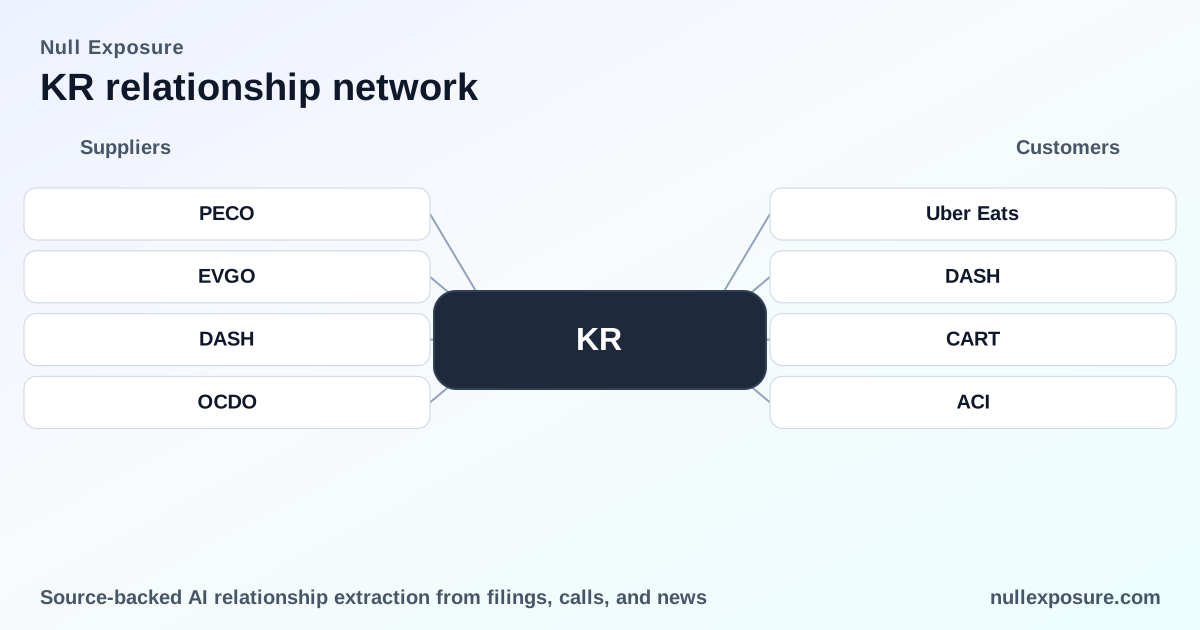
Kroger (KR): Customer relationships that anchor an omnichannel grocery franchise
Kroger operates a large, domestically focused grocery and pharmacy retail franchise that monetizes primarily through spot retail sales across stores, fuel centers, pharmacies and online channels, augmented by third‑party partnerships and selective asset sales. For investors evaluating counterparty risk and revenue durability, Kroger’s operating model combines high transaction volume with concentrated retail exposure (98% of sales) and active third‑party fulfillment relationships that shape both margins and customer access. Learn more about Kroger relationship intelligence at https://nullexposure.com/.
What the company-level signals tell investors
Kroger’s public disclosures and filings reveal a clear operating posture that affects how counterparty relationships matter:
- Contracting posture — predominantly spot retail. Kroger recognizes revenue when consumer products are sold in stores, fuel centers and online, signaling primarily transactional, high-frequency cash flows rather than long-term contracted revenue.
- Counterparty base — individual consumers at scale. Kroger serves roughly 63 million households annually, and loyalty program linkage means most transactions are direct retail interactions—not B2B contracts.
- Geography and concentration — domestic and material. Operations are entirely domestic across 35 states plus D.C., and retail operations account for 98% of consolidated sales, making partnerships tied to retail execution critical.
- Role and maturity — core seller with supporting manufacturing and services. Kroger is fundamentally a seller/retailer that also manufactures and processes food for its own channels while running adjacent services (pharmacies, fuel, online fulfillment).
These company-level constraints frame every customer relationship: most are execution-focused, active, and tied to Kroger’s core retail economics rather than long-duration recurring contracts.
Third‑party delivery partners: expanding in-store fulfillment
Kroger has deliberately broadened fulfillment through third‑party platforms to meet omnichannel demand. The company named three partners in its 2025 Q3 commentary:
-
Instacart (CART) — Kroger expanded its relationship to increase in-store fulfillment and broaden same‑day delivery reach; management discussed this in the 2025 Q3 earnings call (March 2026).
Source: Kroger 2025 Q3 earnings call (discussed March 2026). -
DoorDash (DASH) — DoorDash is another expanded third‑party delivery partner used to move more fulfillment into Kroger stores and accelerate online order throughput.
Source: Kroger 2025 Q3 earnings call (March 2026). -
Uber Eats — Uber Eats was added alongside other delivery platforms to diversify last‑mile options and scale on-demand grocery delivery from Kroger locations.
Source: Kroger 2025 Q3 earnings call (March 2026).
Key takeaway: Kroger’s approach is platform‑agnostic expansion of delivery partners to optimize fulfillment, not exclusive reliance on a single provider.
Retail co-tenants and anchor dynamics that stabilize centers
Kroger functions as a grocery anchor in numerous shopping centers; co-tenants and anchor dynamics provide foot traffic and leasing stability:
-
Home Depot (HD) — Industry commentary on shopping-center economics cites Home Depot as a complementary anchor that, together with grocery anchors, underpins retail footfall in many regions.
Source: Investing.com coverage of Kimco Realty earnings (May 2026). -
T.J. Maxx (TJX) — T.J. Maxx is likewise listed among anchor tenants that stabilize shopping-center portfolios where grocery anchors operate.
Source: Investing.com coverage of Kimco Realty earnings (May 2026). -
National Vision (EYE) — National Vision operates optical retail brands (including Vista Opticals) inside select Fred Meyer stores, representing a tenant relationship that embeds optical services in Kroger banners.
Source: CityBiz / MarketScreener reporting on National Vision operations (FY2025–FY2026).
Key takeaway: Kroger’s physical footprint benefits from and contributes to multi-anchor centers; co-anchors reduce vacancy and support consistent store-level traffic.
Strategic asset sales and third‑party acquirers
Kroger has moved non-core assets to focus on its retail franchise and strategic partnerships:
-
iHerb — Vitacost sale — Kroger announced the sale of Vitacost.com to iHerb, a transaction tracked in investment banking deal listings. This reduces Kroger’s direct exposure in standalone e‑commerce supplement retail.
Source: RBC Capital Markets transactions page (May 2026). -
Elevance Health (ELV) — specialty pharmacy sale — Kroger sold its specialty pharmacy business to Elevance Health in a $464 million transaction, reallocating capital away from vertically owned specialty pharmacy operations.
Source: RBC Capital Markets transactions page (May 2026). -
Western Union (WU) — retail distribution partnership — Western Union’s FY2026 commentary notes Kroger as a significant retail partner (listed as an exclusive retail sign). This positions Kroger as a distribution node for financial services in-store.
Source: Insidermonkey summary of Western Union FY2026 earnings call (May 2026).
Key takeaway: Kroger is actively reshaping its asset mix—disposing peripheral e‑commerce and specialty pharmacy assets while monetizing store footprint via third‑party distribution agreements.
Litigation and competitor mentions in the filings
- Albertsons (ACI) — Kroger’s FY2025 Form 10‑K discloses legal proceedings that could produce substantial losses and explicitly calls out uncertainty in outcomes; one of the named counterparty matters in public data references Albertsons. The company uses accruals where adverse outcomes are probable and quantifiable.
Source: Kroger FY2025 Form 10‑K (filed Feb 1, 2025).
Investor implication: Legal exposures tied to competitor litigation are a non-trivial risk to cash flows and should be monitored alongside operating performance.
How these relationships change the investment thesis
Kroger’s revenue base is transactional and consumer-facing, so partner relationships primarily influence distribution economics, fulfillment cost, and store traffic rather than long‑term contracted revenue. From an operational and risk perspective:
- Concentration risk remains high. With 98% of sales from retail operations in North America, macro consumer trends and local traffic dynamics dominate performance.
- Fulfillment partners affect margins and customer experience. Expansion with Instacart, DoorDash and Uber Eats increases convenience but shifts cost and control to platform economics.
- Asset sales and third‑party distribution reduce capital intensity for non-core services while preserving store-level utility for customers (e.g., Western Union services, in-store optical).
- Legal and competitive exposures (e.g., matters involving Albertsons) are material considerations that can create episodic cash outflows.
Bottom line and next steps
Kroger operates as an essential, domestically concentrated grocery retailer whose value hinges on store economics, fulfillment efficiency, and targeted partnerships. Investors should weight Kroger’s stable transaction volume against margin pressure from third‑party fulfillment and litigation risk when modeling near-term earnings.
For a structured view of Kroger’s counterparty map and ongoing relationship monitoring, visit https://nullexposure.com/ to explore how these partnerships feed into scenario models and counterparty exposure dashboards.