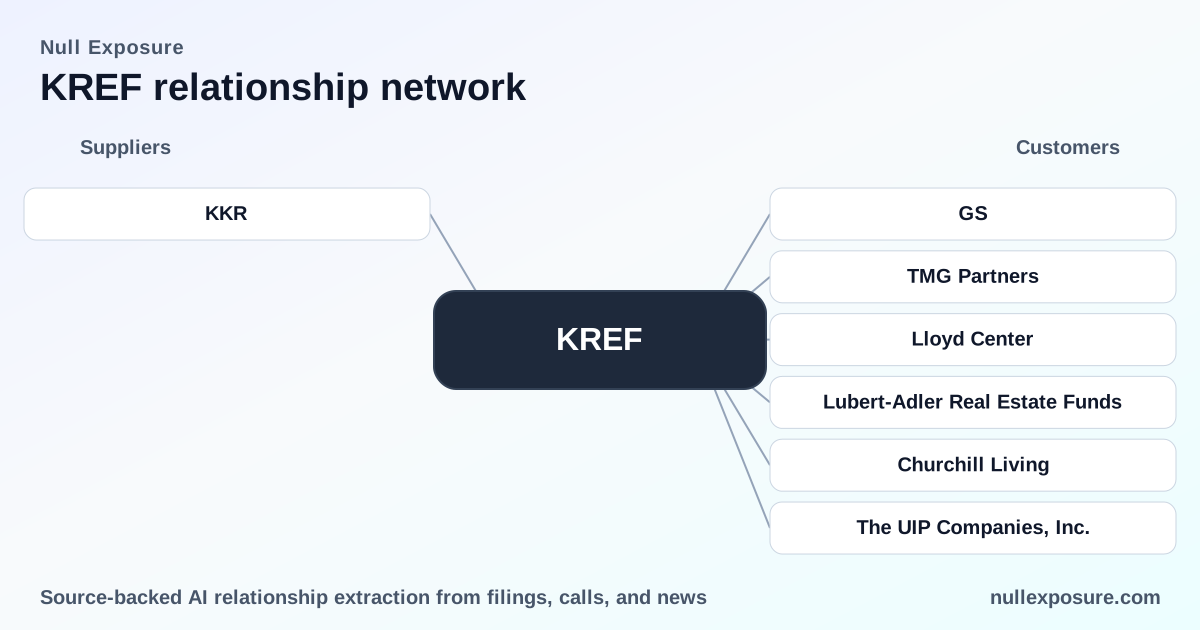
KKR Real Estate Finance Trust (KREF): Customer Relationships That Drive Credit and Optionality
KKR Real Estate Finance Trust originates and acquires senior, transitional commercial real estate loans, monetizing through interest income, fee income on loan originations, and capital recycling via loan workouts and asset dispositions; its business model is a lending footprint anchored in institutional sponsorships and large-market CRE collateral. Investor focus should be on counterparty quality, loan-to-value and market concentration, and the optionality embedded in workouts or tenant conversions. For an interactive map of these relationships, visit https://nullexposure.com/.
How KREF underwrites revenue and where customer relationships matter most
KREF operates as a mortgage REIT that structures first-trust mortgages and whole loans against office, retail, and multifamily assets in major markets. That underwriting posture produces three operational characteristics that drive investor outcomes: contracting posture is lender-centric and secured, with a bias toward long-tenor commercial loans; counterparty concentration skews toward large, institutional sponsors and major-market properties; and maturity profiles are transitional, creating both yield pick-up and higher workout activity. These company-level signals follow from KREF’s stated core strategy of targeting senior loans on large assets in major markets.
- Contracting posture: KREF acts as secured lender and, where necessary, takes control through foreclosure or lease arrangements rather than passive loss-given-default.
- Concentration and criticality: Relationships with well-capitalized sponsors and marquee tenants increase recoverability and optionality; a handful of large relationships can materially affect cash flow.
- Maturity and active management: Transitional loans produce nearer-term re-pricing and disposition events; portfolio health is therefore sensitive to office and retail market cycles.
Customer relationships that create near-term optionality and risks
Below I summarize every recorded customer relationship in the available coverage and link the reporting source for each entry. Each entry is a one- to two-sentence plain-English snapshot of how that relationship affects KREF’s credit profile or optionality.
-
OpenAI — InsiderMonkey (Q1 2026): KREF disclosed it signed a long-term full-property lease with OpenAI, converting an asset exposure into a single-credit tenant arrangement for the leased property, which materially changes cash flow stability for that asset. Source: InsiderMonkey earnings call transcript (Q1 2026) — https://www.insidermonkey.com/blog/kkr-real-estate-finance-trust-inc-nysekref-q1-2026-earnings-call-transcript-1745721/.
-
OpenAI — Finviz (business wire Mar 23, reported in 2026 coverage): KREF and TMG Partners formally announced that OpenAI leased the entire 350–380 Ellis office campus in Mountain View, an outcome that shifts valuation and tenancy risk away from speculative office leasing toward a single high-credit tenant. Source: Finviz earnings preview referencing KREF Business Wire (Mar 23) — https://finviz.com/news/288559/earnings-preview-kkr-real-estate-finance-kref-q4-earnings-expected-to-decline.
-
Lloyd Center — KGW (FY2021 context): KREF originated a loan in 2015 to finance renovation of Lloyd Center, documenting exposure to legacy retail assets that have experienced capital stress and foreclosure activity in subsequent market cycles. Source: KGW local reporting (article on Lloyd Center foreclosure) — https://www.kgw.com/article/news/local/lloyd-center-mall-foreclosure/283-486aef01-48e3-46cd-828e-2a9e2076536a.
-
Goldman Sachs (GS) — The Real Deal (July 23, 2024): A joint venture involving Goldman Sachs surrendered a five-building Silicon Valley office complex to KREF, an event that shows KREF executing its lender rights and taking control of distressed office collateral. Source: The Real Deal (July 23, 2024) — https://therealdeal.com/san-francisco/2024/07/23/goldman-and-tmg-surrender-silicon-valley-offices-to-kkr/.
-
GS (duplicate record) — The Real Deal (same item): The duplicate listing reiterates that the Goldman/TMG JV surrendered the Silicon Valley portfolio to KREF, reinforcing that KREF is actively managing sizable office workouts in high-tech submarkets. Source: The Real Deal (July 23, 2024) — https://therealdeal.com/san-francisco/2024/07/23/goldman-and-tmg-surrender-silicon-valley-offices-to-kkr/.
-
TMG Partners — The Real Deal (July 23, 2024): TMG Partners, as co-borrower with Goldman, participated in surrendering the five-building Silicon Valley campus to KREF, highlighting KREF’s role as the lender stepping into asset control and potential repositioning. Source: The Real Deal (July 23, 2024) — https://therealdeal.com/san-francisco/2024/07/23/goldman-and-tmg-surrender-silicon-valley-offices-to-kkr/.
-
Lubert-Adler Real Estate Funds — The Real Deal (March 5, 2024): KREF entered discussions to sell two Philadelphia office buildings, with Lubert-Adler reportedly interested in part of the portfolio, indicating active disposition strategies against office holdings. Source: The Real Deal (March 5, 2024) — https://therealdeal.com/national/philadelphia/2024/03/05/kkr-in-talks-to-sell-two-philadelphia-office-buildings/.
-
Churchill Living — YieldPro (Jan 2022): An affiliate of Churchill Living acquired The Millennium apartment community with KREF placing a $135 million first trust mortgage, showing KREF’s involvement in stabilized multifamily financing proximate to major employment hubs. Source: YieldPro (January 2022) — https://yieldpro.com/2022/01/uip-churchill-living-acquire-300-unit-apartment-tower-across-from-amazon-hq2/.
-
The UIP Companies, Inc. — YieldPro (Jan 2022): An affiliate of UIP participated in the acquisition of The Millennium while KKR Real Estate Finance provided first-trust mortgage financing, underlining KREF’s role as a large-scale multifamily lender in high-demand submarkets. Source: YieldPro (January 2022) — https://yieldpro.com/2022/01/uip-churchill-living-acquire-300-unit-apartment-tower-across-from-amazon-hq2/.
For a consolidated view of these relationships and how they map to KREF’s lending footprint, see https://nullexposure.com/.
What this relationship map implies for investors
- Credit optionality through workouts: KREF is not a passive lender—surrenders and full-property leases demonstrate an operational willingness to take control and re-lease or sell, which preserves recovery value but concentrates execution risk.
- Sector mix matters: Holdings and loans span office, retail, and multifamily; office workouts (Goldman/TMG surrender, Lubert-Adler sale talks) are the most consequential for near-term NAV volatility.
- Counterparty quality is high but concentration is real: KREF targets large, institutional sponsors and marquee tenants, which strengthens recoverability but means a few counterparties and major properties can influence distributable cash flow.
- Revenue conversion paths differ: Loans that convert to long-term commercial leases (OpenAI) turn volatile re-leasing risk into stable contract cash flow, materially improving an asset’s profile.
Near-term signals investors should watch
- Loan disposition activity and realized sale prices on assets identified for sale.
- Lease commencement and rent terms for the Mountain View campus now leased to OpenAI.
- Workout outcomes and any incremental capex or holding costs tied to surrendered office assets in Silicon Valley.
- Concentration of exposure to large sponsors and single-tenant arrangements that can swing quarterly cash available for distribution.
Bottom line
KREF’s operating model is lender-forward and opportunistic: it profits from underwriting transitional senior CRE loans and extracting optionality through workouts, leases, and sales. The relationship evidence shows a mix of stabilized multifamily lending, legacy retail financing, and active office workouts, with the OpenAI lease representing a significant tenant-stability event and the Goldman/TMG surrender exemplifying KREF’s execution on distressed office collateral. For an investor-facing relationship visualization and deeper signal coverage, visit https://nullexposure.com/.