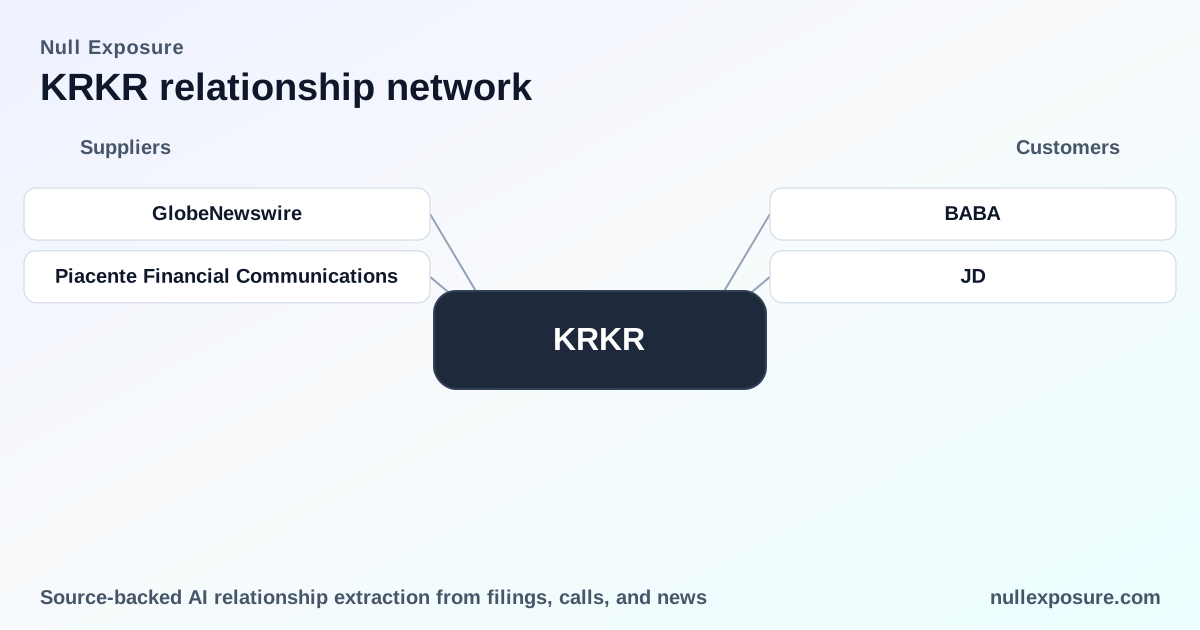
36Kr Holdings (KRKR): Customer Map and What Top Accounts Tell Investors
36Kr Holdings operates a content-and-services platform for China’s “new economy” companies and professionals and monetizes primarily through advertising and enterprise services sold to platform users and corporate accounts. The company’s financials show TTM revenue of $227.9M and a gross profit of $131.5M, highlighting an advertising-led model with growing enterprise offerings that convert audience reach into client contracts. For investors assessing customer risk and revenue durability, the relationship roster and recent commentary about key accounts offer a precise window into concentration and resilience.
For more context and ongoing coverage, visit https://nullexposure.com/.
What investors need to know up front
- Advertising is a material revenue driver. Public reporting and recent commentary flag advertising revenue as the lever most sensitive to client retention and macro cycles. According to the company’s latest reported figures (latest quarter ended 2024-03-31), revenue dynamics are consistent with an ad-and-services hybrid monetization model.
- Large platform accounts anchor stability. Recent reporting lists major e‑commerce players as steady advertisers, reducing single-quarter volatility but increasing concentration risk if one large client rebalances spend.
- Top-line fragility is visible in small declines in ad revenue, but enterprise services provide diversification. TTM revenue and margin profiles indicate a business transitioning from pure media to mixed services.
If you want a concise map of KRKR’s customer relationships and the evidence underlying them, read on. For ongoing signal tracking, check https://nullexposure.com/.
The constraints picture — what’s supplied and what it signals
No constraint excerpts were provided in the materials reviewed; this absence is itself a company-level signal. The record contains no publicly-disclosed contractual constraints or bespoke dependency clauses, so assessment of contracting posture and maturity depends on industry characteristics and disclosed customer names rather than contract text. From that vantage:
- Contracting posture: Transactional and campaign-driven, consistent with advertising client engagements that renew on short cycles.
- Concentration: Moderate to high because commentary singles out a small number of large platform advertisers.
- Criticality: Material for near-term revenue — advertising spend from major platforms directly influences quarterly results.
- Maturity: Transitioning — the company shows stable content monetization but is maturing toward enterprise services that reduce immediate client churn risk.
Recent reporting that anchors the customer view
A March 2026 Yahoo Finance recap of 36Kr’s FY2025 results highlights client stability even as advertising revenue softened. The article explicitly references major e‑commerce advertisers as key accounts underpinning the revenue base.
Alibaba — a named anchor client
Alibaba is cited as a key advertising account that remained stable through FY2025 despite a modest decline in total advertising revenue. This signals that China’s largest e‑commerce platform continues to view 36Kr as a useful channel for reaching new‑economy audiences. (Source: Yahoo Finance coverage of 36Kr FY2025 results, March 10, 2026 — https://finance.yahoo.com/news/36kr-holdings-inc-krkr-full-070133740.html)
BABA — duplicate mention confirming the same relationship
BABA is the stock symbol used in the reporting to reference Alibaba; the coverage repeats that large clients like BABA continued commitments even as overall advertising softened, reinforcing the same stability signal noted for Alibaba. The duplicate entry is evidence of the reporting system mapping both company name and ticker to the same client relationship in FY2025 commentary. (Source: Yahoo Finance coverage of 36Kr FY2025 results, March 10, 2026 — https://finance.yahoo.com/news/36kr-holdings-inc-krkr-full-070133740.html)
JD.com — a second major platform client
JD.com is listed alongside Alibaba as a stable advertising partner during FY2025, adding a second marquee platform advertiser to the customer roster and reducing single-client concentration risk. The presence of both Alibaba and JD.com as repeat accounts strengthens revenue resilience in advertising, even when overall advertising revenue softens. (Source: Yahoo Finance coverage of 36Kr FY2025 results, March 10, 2026 — https://finance.yahoo.com/news/36kr-holdings-inc-krkr-full-070133740.html)
What these relationships imply about 36Kr’s operating model
The customer set composition and the nature of the citations produce a clear operating read:
- Revenue sensitivity is tied to platform ad budgets. Major e‑commerce advertisers like Alibaba and JD.com operate on seasonal and campaign-based budgets, so 36Kr’s top-line is exposed to platform-level marketing strategy shifts.
- Client concentration is real but manageable. Having multiple marquee platforms as customers spreads risk relative to dependence on a single advertiser, but the advertising mix still implies concentration risk in the top handful of accounts.
- Contracts are effectively short-term and renewal-driven. The public commentary references account stability rather than long-term contractual commitments, indicating an advertising contracting posture dominated by recurring, non-exclusive engagements.
- Business maturity is mixed. The underlying content franchise provides durable audience reach, while enterprise services and other commercial offerings are the evolving maturity vector that will lower advertising cyclicality over time.
Risk considerations investors should weigh
- Top-client exposure: Even stable FY2025 spend from Alibaba and JD.com does not eliminate the risk of sudden reallocation of marketing dollars across platforms or to in‑house channels.
- Ad-revenue cyclicality: Reported modest declines in total advertising revenue signal ongoing sensitivity to macro and sector-specific ad budgets.
- Concentration vs diversification: Enterprise services are a diversification path, but current reported economics still show material dependence on the advertising ecosystem for near-term margins.
Final read for investors
36Kr presents a content-driven media business with meaningful advertiser relationships to China’s largest e‑commerce platforms, and recent FY2025 commentary confirms stability among marquee accounts even as advertising revenue softened. The company’s TTM financials (revenue $227.9M; gross profit $131.5M) support a narrative of an advertising franchise that is transitioning toward more diversified enterprise offerings, but investors should treat top-client exposure and ad cyclicality as principal risk factors for earnings volatility.
For an integrated view of KRKR’s customer signals and ongoing monitoring, visit https://nullexposure.com/ — the platform aggregates client-level signals and public commentaries that matter for investor due diligence.