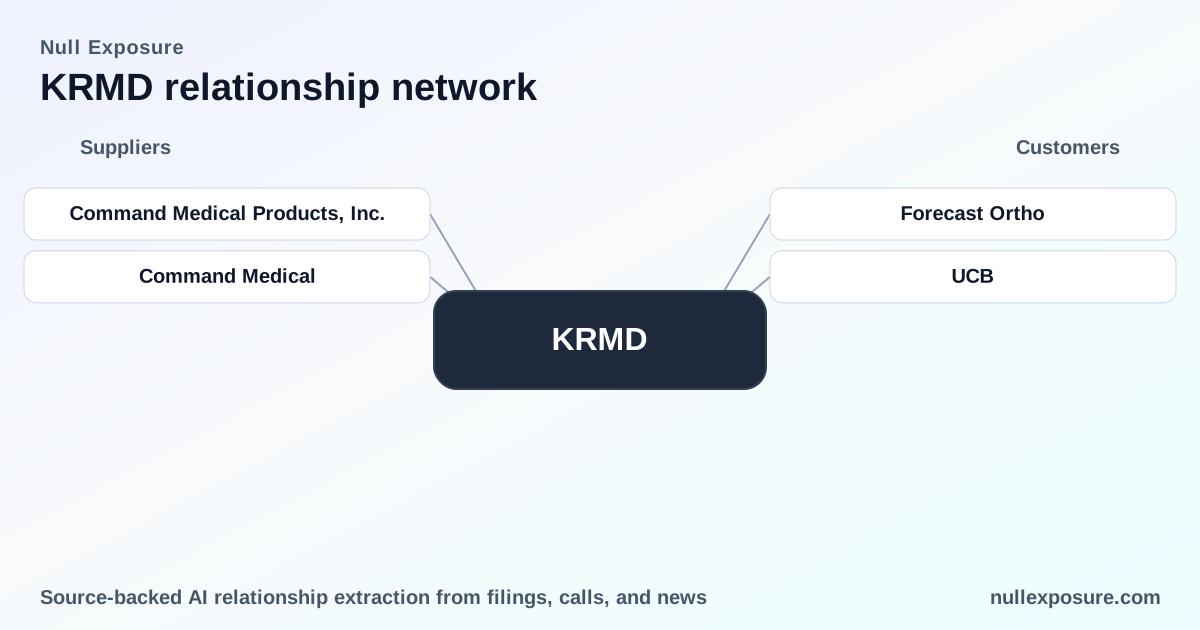
KORU Medical Systems (KRMD): Customer relationships that re-shape distribution risk and market access
KORU Medical Systems designs and sells portable infusion devices, monetizing through device sales and strategic collaborations with pharmaceutical partners and a concentrated base of distributors; revenue flows split into a Domestic Core (U.S./Canada), International Core, and Novel Therapies, with product sales and platform integrations driving recurring commercial relationships. For investors, the company presents growing commercial traction into non-Ig therapies and infusion-clinic channels while retaining high customer concentration through a few distributors, a structural risk that materially affects revenue stability and contracting leverage.
If you want a single-stop view of customer exposure and partner signal intelligence for KRMD, visit https://nullexposure.com/ for the full coverage.
How KORU makes money and why customer relationships matter
KORU sells the FREEDOM infusion platform both directly and through a small number of specialty distributors, and it licenses system use to pharmaceutical customers for delivery of specific therapies. The company reported trailing revenues of roughly $41.1M with a gross profit of $25.6M, but operating and net margins remained negative (operating margin ~ -5.0%, net profit margin ~ -6.4%). These figures reflect a business model that scales when platform adoption by pharma partners and distributors expands, but also one that is exposed to short-term swings because a handful of counterparties account for the bulk of sales.
- Revenue concentration is pronounced: management discloses that three U.S. and three international distributors represented about 75% of net revenues as of year-end 2024, with a single U.S. distributor contributing roughly 35%. That concentration creates a counterparty risk profile more typical of early-commercial medical-device companies than diversified medtech incumbents.
- Channel expansion is a key strategic lever: FDA clearances that enable use of the FREEDOM platform for new drugs open clinical and infusion-clinic channels beyond home infusion, increasing per-patient revenue potential and commercial stickiness.
Customer and partner relationships you must track
Below I cover every relationship the company publicly referenced in our dataset; each entry is a concise, plain-English summary with source context.
Forecast Ortho
KORU announced a collaboration with Forecast Ortho to support clinical trials addressing complications from joint replacement surgeries, signalling use of the FREEDOM platform in orthopedic-related therapeutic development (mentioned in KORU’s Q3 2025 remarks). According to the Q3 2025 earnings call transcript, this is a clinical support collaboration rather than a large-scale commercial supply arrangement (Q3 2025 earnings call / InsiderMonkey transcript, first seen March 2026).
Takeaway: this is an early-stage clinical partnership that expands KORU’s addressable therapeutic areas without yet implying material revenue contribution.
UCB (rozanolixizumab — RYSTIGGO®)
KORU received FDA 510(k) clearance for its FREEDOM EDGE infusion system to deliver RYSTIGGO® (rozanolixizumab-noli), a UCB-commercialized therapy, marking the company’s first collaboration with UCB and enabling entry into the infusion-clinic channel. The clearance and related commercial statements were disclosed in a Biospace press release (March 2026) and reiterated in KORU’s Q4 2025 earnings commentary, which emphasized the clearance as expanding the platform beyond immunoglobulin (FY2026 materials and Q4 2025 earnings call transcript, reported March–May 2026).
Takeaway: FDA clearance for a global pharma partner like UCB is a catalytic commercial milestone that creates a new revenue pathway separate from home infusion and distributor resale.
Roche (Phesgo submission)
KORU told investors that a 510(k) submission for Roche’s PHESGO® was filed on time in December and is moving toward commercial potential in 2026, positioning Phesgo as a second non-IG therapy on the FREEDOM platform. This disclosure was made in the Q4 2025 earnings call transcript (reported May 2026).
Takeaway: Roche engagement signals an escalation from pilot clinical collaborations to potential commercial programs with multinational pharma — a positive evidence point for platform validation and future revenue diversification.
Constraints that determine counterparty and operational risk
The public disclosures and filings establish several company-level constraints that define KRMD’s commercial profile:
- Geographic footprint is primarily North America: management segments revenue into Domestic Core (U.S. and Canada), International Core, and Novel Therapies, with the Domestic Core historically delivering the majority of revenue. This makes U.S. commercial execution essential to near-term results.
- High counterparty concentration is a material risk: three distributors (U.S. and international) drove roughly 64–75% of net product revenues in recent years, with one U.S. distributor alone representing about 35%. That concentration is a company-level signal of critical dependency on a handful of distribution partners rather than a diversified direct-sales network.
- Distributor role is central to the go-to-market posture: KORU’s model is explicitly distributor-centric for large parts of its business, providing specialty pharmacy customers with consolidated inventory and services; this contracting posture reduces sales complexity but increases negotiation and revenue-transmission risk to the distributor counterparties.
- Maturity is mixed: the Domestic Core is the most mature revenue source, International Core is growing but smaller, and Novel Therapies represent a scaling, higher-margin opportunity under development — the combination is typical of medtech companies transitioning from early commercialization to broader market adoption.
These constraints translate into tangible investor risk/reward trade-offs: a high-leverage growth path if pharma partnerships commercialize, and material single-counterparty exposure if distributor relationships falter.
Near-term catalysts, valuation context, and what to watch
KORU is executing a clear strategy to convert platform clearance into recurring pharma revenue. Near-term catalysts and investor signals include:
- FDA clearances and pharma collaborations (UCB, Roche) that open the infusion-clinic channel and create incremental commercial routes beyond home infusion.
- Revenue growth and guidance momentum: management announced full-year 2026 guidance following Q4 2025 results that showed sequential improvement; analysts’ consensus target sits around $6.80 per share, reflecting upside versus recent trading ranges.
- Valuation and fundamentals: market capitalization sits near $185.6M, Price/Sales ~4.5x, and the company remains unprofitable with negative EBITDA and EPS — investors are pricing growth expectations rather than steady cash generation.
Monitor these items closely: the pace at which UCB and Roche transition from regulatory milestones to purchase orders, the retention and terms with the top distributors, and any moves to de-risk distributor concentration (e.g., more direct sales or a broader distributor network). For a consolidated view of customers and partner signals, see https://nullexposure.com/.
Bottom line
KORU Medical is a small-cap medtech player transitioning from concentrated distributor-driven revenue toward diversified pharma partnerships and new clinical channels. The company’s value hinges on converting regulatory clearances into recurring commercial deployments with large pharma customers while managing the systemic risk from a small set of distributors that account for the majority of current revenue. For investors and operators evaluating KRMD customer exposure, the key questions are timing and scale of UCB/Roche commercial adoption and whether KORU can materially reduce distributor concentration as it grows.