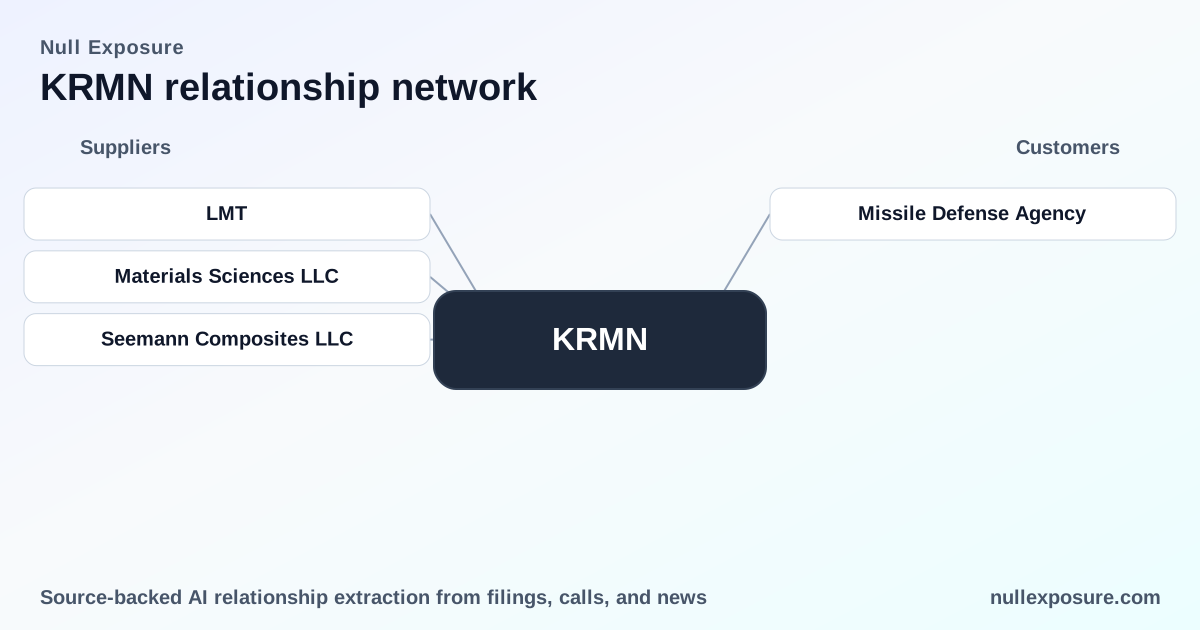
Karman Holdings (KRMN): Customer footprint drives durable, government‑anchored revenue
Karman Holdings monetizes its engineering and manufacturing capabilities by designing, testing, manufacturing and selling mission‑critical subsystems to defense and space customers. Revenue is driven through long‑term program contracts and purchase agreements with U.S. government agencies and prime contractors, plus recurring work for launch providers, giving investors recurring tail visibility and concentrated counterparty exposure.
For a concise, investor‑grade view of Karman’s customer relationships, visit the firm’s profile at NullExposure: https://nullexposure.com/.
Why customers matter: the operating model behind the numbers
Karman’s business model is weighted to long‑lifecycle, high‑criticality programs rather than spot commercial orders. Company disclosures and public filings characterize relationships as long‑term agreements with production phases that can extend beyond two decades; that translates to predictable revenue streams but high customer concentration. For the year ended December 31, 2024, services to U.S. military end‑users accounted for approximately $268 million, or 77.7% of revenue, and three customers exceeded 10% of revenue (27.8%, 11.9% and 11.1%), together representing material receivables concentration (51% of A/R).
Key company‑level signals investors should internalize:
- Contracting posture: Long‑term program contracts and purchase orders provide multi‑year revenue visibility.
- Counterparty mix: Heavy U.S. government exposure and prime contractor relationships.
- Geography: Substantially U.S.‑based customer base.
- Materiality: High concentration—a few customers drive a large share of revenue and receivables.
- Role: Karman operates as a seller, manufacturer and service provider for mission‑critical subcomponents.
- Maturity: Many customer partnerships extend 15+ years, supporting defensible revenue tails.
- Spend band: Typical customer program spend aligns with the $10M–$100M band per customer contribution.
Customer relationships: who Karman delivers to and what that implies
Missile Defense Agency — large program vehicle exposure
Karman is cited in connection with the Missile Defense Agency’s SHIELD IDIQ, a FY2026 contract vehicle with a reported $151 billion ceiling, aligning Karman with a principal defense procurement channel for homeland and layered defense systems. According to a Markets FT announcement on March 10, 2026, that SHIELD IDIQ is a primary vehicle for MDA program awards.
ULA (United Launch Alliance) — launch cadence drives manufacturing revenue
Karman referenced ULA among its space customers on its Q4 2025 earnings call, positioning ULA as a recurring commercial prime for which Karman supplies hardware as launch activity increases. The earnings call transcript published via Investing.com (May 3, 2026) documented management discussing trends with ULA.
Blue Origin — commercial launch supplier
Analysts and company commentary identify Blue Origin as a named customer and a driver of near‑term space work as launch cadence accelerates; William Blair reiterated Karman’s exposure to both ULA and Blue Origin in a May 3, 2026 note reported on Investing.com. That commercial channel complements defense revenue and supports manufacturing volume.
NASA — program and development work
Karman named NASA among its space program customers during the Q4 2025 investor call, signalling participation on NASA‑sponsored missions and technology programs that supplement prime‑contract work. The Investing.com transcript (May 3, 2026) records management citing NASA alongside other space partners.
L3Harris (LHX) — a larger prime customer relationship
Management explicitly identified L3Harris as one of Karman’s larger customers; leadership background and remarks on the March–May 2026 call link Karman to L3Harris prime programs and supply chains. The Investing.com earnings call (May 3, 2026) referenced L3Harris in the context of executive experience and customer scale.
Lockheed Martin (LMT) — large prime contractor linkage
Lockheed is likewise identified as a major customer, reflecting Karman’s role as a supplier into established defense prime programs. Management remarks on the same May 3, 2026 earnings call (Investing.com transcript) cite Lockheed as one of “two of Karman’s larger customers.”
QVCC — media mention that is a name collision with retail QVC programming
A March 10, 2026 news item on Finviz listed new brands joining QVC including “Karma.” That retail mention is a name collision and not related to Karman Holdings’ aerospace and defense operations; the Finviz item documents the retail context (March 10, 2026).
QVCD — duplicate retail coverage naming “Karma”
A March 10, 2026 Yahoo Finance report similarly lists “Karma” among new QVC brands; this is retail coverage unrelated to Karman Holdings’ business model or customer base (Yahoo Finance, March 10, 2026).
What these relationships imply for revenue quality and investor risk
Karman’s customer mix creates high‑quality, high‑visibility revenue because long‑term government and prime contracts endure through design, qualification and multi‑year production ramps. The same attributes create concentrated counterparty risk: a small number of large customers drive most revenue and accounts receivable, amplifying sensitivity to program funding shifts or prime re‑competition outcomes. The March 2026 public materials and investor call evidence reinforce that exposure: government and prime work account for the bulk of sales and receivables.
How to use this when modeling Karman
- Assume multi‑year revenue tails for defense programs with embedded recurring backlog; model production ramps explicitly rather than treating sales as one‑off.
- Reflect customer concentration in downside scenarios: the top three customers historically contributed 50%+ of receivables and close to half of revenue.
- Separate revenue buckets: government prime programs (77.7% historical weight) versus commercial launch suppliers (ULA, Blue Origin) for growth upside tied to launch cadence.
- Price in margin stability from manufacturing scale but watch program‑specific cost actions and qualification spend.
For a consolidated, transaction‑ready view of Karman’s customer exposures and signals, see NullExposure’s customer intelligence hub: https://nullexposure.com/.
Final takeaways for investors
Karman’s strength is its position as a long‑term manufacturer and systems supplier to U.S. defense primes and key launch providers, delivering predictable revenue and defensible program roles. Concentration is the primary risk: a handful of large customers and heavy U.S. government dependency create asymmetric downside if program funding or prime relationships change. For investors, Karman is a company with durable revenue visibility and program‑level criticality that requires active monitoring of prime contracts, MDA/DoD procurement vehicles, and commercial launch pipelines.