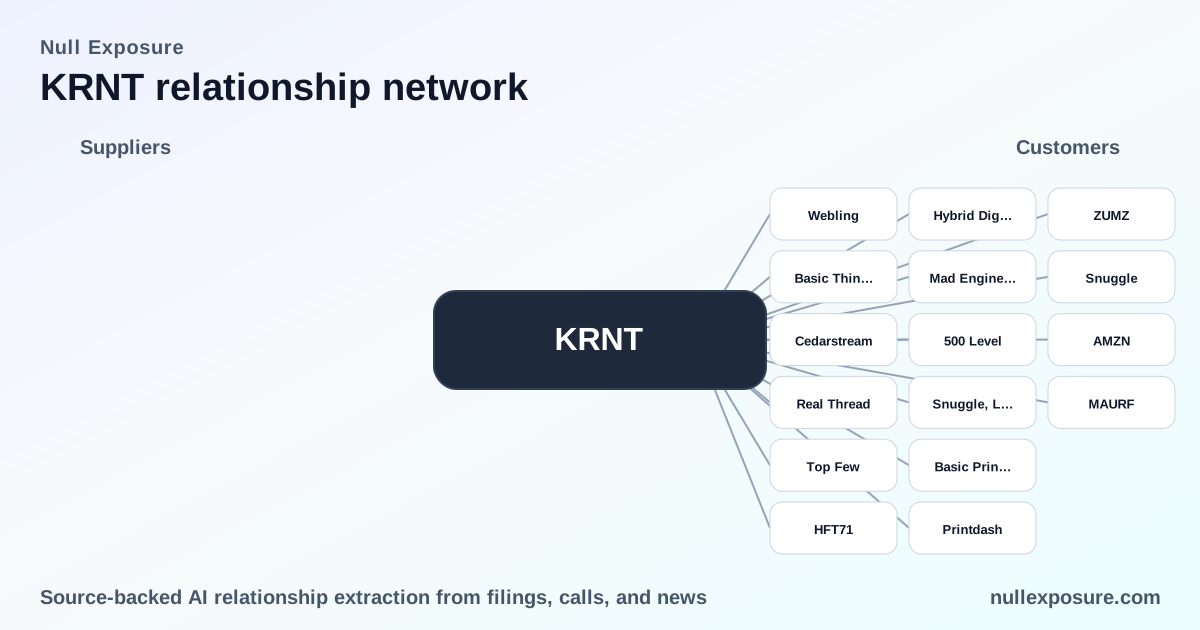
Kornit Digital (KRNT): Customer relationships that underpin a shift to on‑demand apparel production
Kornit Digital sells industrial digital textile printers and associated production programs, generating revenue from equipment (Atlas MAX PLUS, Apollo) and expanded service/consumption contracts under its AIC model; customers are large manufacturers, wholesalers and retail/brand partners that buy capacity to convert screen‑printed and legacy workflows into on‑demand digital production. Investors should view recent wins as execution on a scalable platform strategy: hardware sales plus capacity programs that deepen customer lifetime value. Learn more about how we track these relationships at https://nullexposure.com/.
What Kornit sells in plain English
Kornit’s commercial engine is straightforward: it sells high‑capacity direct‑to‑garment systems (Atlas MAX PLUS family and the Apollo DTG system) and enrolls customers in capacity/consumption programs (described in company materials as the AIC model). That combination converts one‑time equipment commitments into repeatable production economics for customers and recurring revenue potential for Kornit as customers expand fleets to support higher volumes and faster replenishment cycles.
The customer roll call — who bought what and why it matters
Below is a concise, relationship‑by‑relationship rundown drawn from Kornit’s Q3/Q4 2025 earnings commentary and related press releases. Each entry is a plain‑English description followed by a concise source reference.
-
HFT71 — HFT71 (part of the TBI Group) integrated an Apollo with its existing Atlas MAX PLUS fleet to address surging bulk demand and set a new production standard in Central Europe. Source: Kornit Q3 2025 earnings commentary (mentioned March 2026).
-
Hybrid Digital — Hybrid Digital, a fast‑growing wholesaler, added a second Apollo under Kornit’s AIC program to support peak season print‑on‑demand (POD) demand and accelerate its move from bulk screen to digital production. Source: Kornit Q3 2025 earnings call (March 2026).
-
Cedarstream (Cedar Stream) — Cedarstream, a U.S. apparel decoration company focused on high‑volume production, is shifting bulk impressions to digital to capture speed and consistency advantages. Source: Q4 2025 earnings call transcript and related press coverage (March–May 2026).
-
Basic Thinking — Basic Thinking, a UK screen apparel producer, added a second Apollo within months under the AIC program as the business scaled following its initial digital transition. Source: Q3/Q4 2025 earnings call excerpts and Q4 transcript coverage (March 2026).
-
Real Thread — Real Thread, a U.S.-based custom apparel and merchandise producer serving brands and e‑commerce customers, is moving bulk apparel production to Kornit systems to improve speed and consistency. Source: Q4 2025 earnings call transcript and company comments (March–May 2026).
-
Top Few — A leading screen printer in Poland (referred to as “top few” in Kornit remarks) ordered an Apollo for bulk apparel production under the AIC model to scale European capacity. Source: Q4 2025 earnings call (March 2026).
-
TopQ — TopQ in Poland is cited as a recent Apollo order under Kornit’s AIC program for bulk apparel production in Europe. Source: Q4 2025 earnings call transcript (mentioned May 2026).
-
Mad Engine Global — Mad Engine Global, one of the world’s largest licensed apparel manufacturers, added another Apollo under AIC on top of two existing Apollos and a large Atlas MAX PLUS fleet to support branded production. Source: Q3 2025 earnings call (March 2026).
-
Webling — Webling in South Korea became the first customer in Asia to adopt the AIC model, operating two Atlas MAX PLUS systems as part of a full digital transformation replacing legacy screen capacity. Source: Q3 2025 earnings call (March 2026).
-
500 Level — 500 Level, a U.S. producer of licensed sports fan apparel, added an Apollo on top of its Atlas MAX PLUS fleet under the AIC program to scale licensed apparel and replenishment programs. Source: Q4 2025 earnings call and press excerpts (March–May 2026).
-
Basic Prints — UK manufacturer Basic Prints expanded digital capacity with a second Kornit Apollo, publicly announced in several Kornit press releases and GlobeNewswire releases in Oct 2025 and consolidated in FY2026 filings. Source: GlobeNewswire press release (Oct 15, 2025) and subsequent company announcements (FY2025–FY2026).
-
Snuggle, Ltd. (Snuggle) — Snuggle, a UK Atlas MAX PLUS customer, expanded its Atlas MAX PLUS fleet to meet rising demand and preserve time‑to‑market and print economics. Source: GlobeNewswire release (Oct 15, 2025).
-
Printdash — Printdash, a Texas‑based custom garment and fabric producer for online stores, selected Kornit Apollo for its DTG production needs. Source: GlobeNewswire announcement (Sept 3, 2025).
-
Zumiez (ZUMZ) — Zumiez, a specialty action‑sports retailer, added a second Apollo in Q4 2025 on top of existing Atlas MAX PLUS systems to support higher volumes and faster replenishment. Source: Q4 2025 earnings call transcript and investor press coverage (March–May 2026).
-
MARUI (Marui / MAURF) — MARUI in Japan expanded production by adding a fleet of Atlas MAX PLUS systems to meet demand for speed, quality and operational agility in a sophisticated POD market. Source: Q4 2025 earnings call transcript and related coverage (March–May 2026).
-
Amazon / AMZN — Kornit’s management discussed an Amazon upgrade order when bridging 2025 revenue to 2026 guidance, indicating Amazon is part of upgrade/order discussions that impact near‑term revenue assumptions. Source: Q4 2025 earnings call transcript (investor Q&A, March–May 2026).
What these relationships tell investors about Kornit’s operating model
Taken together, the customer roster reveals several compact but important company‑level signals about Kornit’s business model and go‑to‑market posture:
-
Contracting posture: product + capacity. Customers purchase both hardware and capacity programs (AIC), which shifts Kornit’s economics away from pure one‑time equipment sales toward recurring, consumption‑linked revenue. Multiple customers adding second systems under AIC demonstrates a commercial motion that converts upgrades into longer customer lifecycles.
-
Concentration and vertical breadth. Customers span wholesalers, licensed apparel manufacturers, retail brands, and regional screen printers across North America, Europe and Asia. This diversifies commercial exposure while concentrating value in customers that scale fleets (e.g., large manufacturers and retail partners).
-
Criticality and switching economics. Buyers are replacing legacy screen capacity with Kornit systems to win speed, consistency and time‑to‑market — attributes that create operational stickiness and higher switching costs as production lines standardize on Kornit workflows.
-
Maturity and expansion cadence. The pattern of initial system installs followed by additional Apollo/Atlas MAX PLUS units under AIC signals a repeatable expansion cadence: customers upgrade capacity after initial deployment, which supports durable revenue per customer even if first‑order cadence lags.
Financial context reinforces these signals: Revenue TTM $208.2M and gross profit $93.3M alongside negative operating margin (approx. −5.0% TTM) indicate Kornit is scaling commercial execution while absorbing profitability pressures from investment and growth. Institutional holders dominate the capitalization (insider ownership under 1%, institutions ~98%), implying the market already positions Kornit as a growth technology industrial.
Investment implications and near‑term watch items
- Growth lever: fleet expansion and AIC adoption—evidence across several customers shows conversion from trial to scale; follow‑on orders are the primary driver for near‑term revenue upside.
- Profitability lever: translating capacity programs into steady recurring revenue will be critical to move operating margins positive. Kornit’s current negative operating margin and EPS losses require the recurring model to scale faster than cost base.
- Execution risk: concentration of value in a subset of large customers creates short‑term revenue volatility tied to upgrade cycles and macro apparel demand.
For a concise, investor‑grade view of how these relationships translate into commercial traction, visit our homepage: https://nullexposure.com/.
If you want a custom brief tying these customer wins to Kornit’s revenue cadence and margin trajectory, contact our research desk through https://nullexposure.com/.