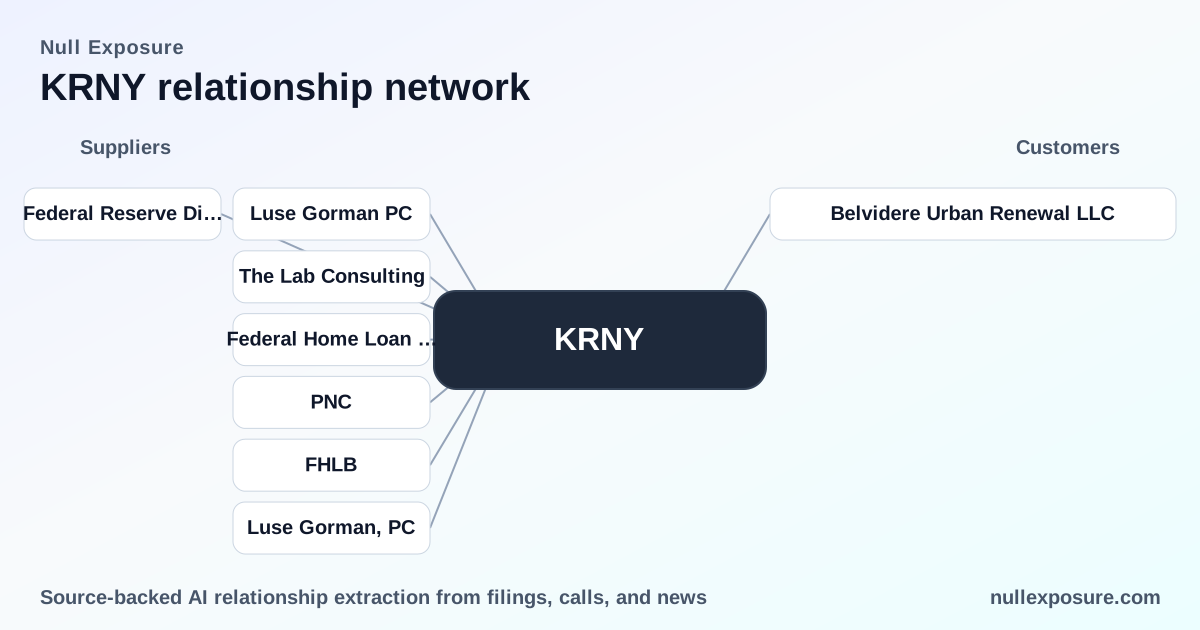
Kearny Financial (KRNY): Customer relationships expose a CRE‑centric, deposit‑funded regional bank with stable core funding
Kearny Financial operates as a full‑service community bank that monetizes through net interest margin on a concentrated commercial lending book and fee income from deposit services. The bank sources low‑cost funding primarily from core non‑maturity deposits, then deploys those funds into middle‑market and commercial real estate loans concentrated in New Jersey and New York, while generating ancillary fee revenue from transaction and account services.
For a deeper signal view of customer dynamics and counterparties, see Null Exposure for ongoing relationship monitoring: https://nullexposure.com/
The headline customer: a $37.25 million industrial construction loan
Kearny Bank closed a $37.25 million financing to Belvidere Urban Renewal LLC to build a roughly 34,000 m² logistics center in Warren County, New Jersey, reflecting the bank’s appetite for large commercial real estate credits tied to local development partners. This transaction was reported by Ad‑Hoc News in March 2026 and again surfaced in May 2026 as part of Kearny’s earnings coverage. (Ad‑Hoc News, March–May 2026)
Why a single loan speaks to strategic direction
This Belvidere relationship is not an outlier; it is fully consistent with Kearny’s stated strategy of expanding commercial lending and deepening business banking relationships in its home markets. The loan exemplifies the bank’s focus on middle‑market commercial real estate deals that both deploy capital and generate origination/loan fees.
Visit Null Exposure for additional customer relationship detail and tracking: https://nullexposure.com/
Contracting posture — relationship‑driven, high‑touch
Kearny describes an evolution from a thrift into a relationship‑oriented community bank that emphasizes personalized service and dedicated business development teams. That operational posture indicates contracting that favors multi‑year deposit and loan relationships over one‑off transactions, increasing customer stickiness but also tying portfolio performance to local economic cycles. (Company filing disclosures as of June 30, 2025)
Concentration — geographic and asset class risk are material
Lending and deposit gathering are geographically concentrated in New Jersey and New York, with commercial lending activity generally focused on borrowers and real estate in those states. The bank also reports a significant concentration in commercial real estate: non‑owner occupied CRE exposure equaled 535% of bank total risk‑based capital at June 30, 2025, a level that magnifies sensitivity to local CRE cycles. (Company filing, June 30, 2025)
Funding criticality — deposits are the core funding engine
Deposits are Kearny’s primary source of funds and a strategic asset: core non‑maturity deposits totaled $3.70 billion, representing 65.2% of total deposits, and total deposits increased by $517.1 million (10.0%) to $5.68 billion at June 30, 2025. Public‑fund deposits alone were $539.1 million, or 9.5% of total deposits, underscoring a reliance on municipal balances as a stable funding tranche. These metrics make Kearny’s deposit base both a competitive advantage and a concentration exposure. (Company filing, June 30, 2025)
Counterparty mix — diversified across households, SMEs and public entities
Kearny’s customer universe includes individual depositors, small and mid‑market businesses, and local government entities. The bank explicitly targets small to middle‑market businesses via experienced relationship managers while also serving townships, counties, school districts and charter schools through public funds deposits. This mix supports fee revenue and deposit growth but ties asset performance to SME and local government fiscal health. (Company filings and management commentary, FY2025)
Relationship stage and maturity — active and relationship‑deepening
Deposits and lending activity are active and increasingly mature, as management reports growing core non‑maturity accounts and a focus on deepening customer relationships with tailored products and high‑touch service. That suggests a stable liability base but also a need to continuously service and expand relationships to prevent attrition. (Company filing, June 30, 2025)
Every customer relationship in the record
- Belvidere Urban Renewal LLC — Kearny Bank extended a $37.25 million construction/term financing for an industrial logistics center in Warren County, NJ, consistent with the bank’s CRE lending focus. Reported by Ad‑Hoc News in March 2026 (also referenced in May 2026 coverage).
Investment implications: risk, return and where customer relationships move the needle
Kearny’s business model converts deposit scale and stickiness into NII and fee revenue by underwriting middle‑market and CRE loans in its core markets. That model delivers attractive operating leverage when loan demand and local CRE fundamentals are healthy, but it also concentrates credit and geographic risk. Key investment implications:
- Upside: Strong core deposit ratio and recent deposit growth support margin stability and fundable loan deployment; fee income from deposit services cushions volatility.
- Downside: A CRE exposure equal to more than five times capital magnifies loss potential in a downturn; public fund concentration increases sensitivity to municipal cash flow decisions and local policy changes.
- Valuation context: Market metrics show a modest price/book ratio below parity and a forward P/E that implies earnings visibility, which makes customer‑book stress or resilience a critical determinant of share performance. (Kearny Financial reported financials and market data, latest quarter March 31, 2026)
How the Belvidere loan maps to these risks and opportunities
The Belvidere transaction is revenue‑accretive and fits the deployment pattern of Kearny’s balance sheet, but its size relative to the bank’s capital and the CRE concentration metric underscores the sensitivity of the portfolio to local real estate cycles and single‑asset economic outcomes. (Ad‑Hoc News; company filings, June 30, 2025)
Bottom line: customer relationships are the primary signal for Kearny's trajectory
Kearny is a community bank that leverages deep local deposit relationships to finance middle‑market and CRE lending. That operating model yields durable deposit funding and fee income but concentrates credit risk in NJ/NY commercial real estate and leaves the bank sensitive to municipal and SME liquidity flows. Investors should watch new large CRE credits, core deposit trends, and public funds balances as the primary indicators of franchise health.
For ongoing monitoring of Kearny’s counterparties, customer flow and relationship changes, visit Null Exposure: https://nullexposure.com/