KRON customer relationships: what investors need to know
Kronos Bio operated as a therapeutic developer that monetized through collaboration and licensing deals and, following a strategic wind-down, by divesting its clinical pipeline to other biotechs. FY2025 revenue included a $9.8 million recognition tied to a collaboration and license agreement, and subsequent corporate actions transferred core assets off the balance sheet into third-party hands — transforming Kronos from an operating R&D company into a seller of intellectual property and programs. For primary customer/contact visibility and to track remaining counterparties, see the Kron coverage at NullExposure: nullexposure.com.
Quick thesis: monetization shifted from development to asset realization
Kronos built value through drug discovery and clinical development and historically converted that value into cash via partner licenses and asset sales. The company’s revenue vector in the last reported fiscal year was license-driven, not product sales. After program setbacks and workforce reductions, Kronos extracted value through a controlled pipeline sale, leaving investors exposed to concentrated counterparties and execution outcomes tied to the buyers’ ability to rehabilitate programs.
All identified customer/partner relationships and what they mean
This section covers every relationship reflected in public reporting and press coverage.
-
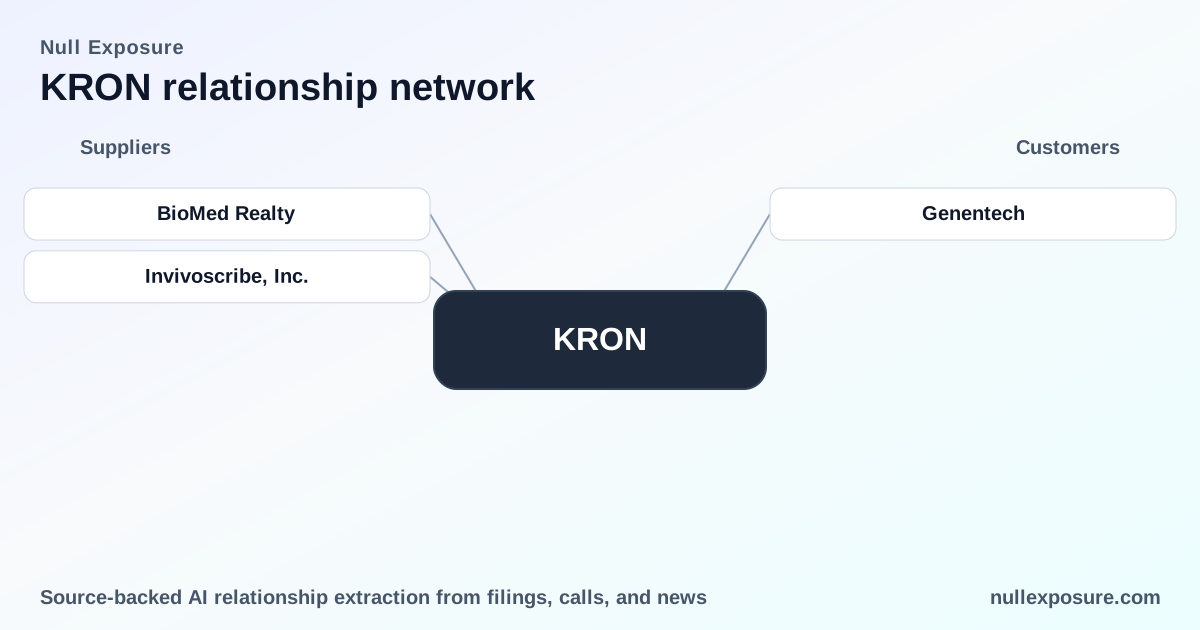
Genentech — Kronos reported $9.8 million in revenue in FY2025 that was generated from a collaboration and license agreement with Genentech. This is concrete, recognized revenue that demonstrates Kronos’ historical ability to monetize intellectual property through strategic licensing. (According to a Quartz earnings recap, March 2026.)
-
Concentra Biosciences — Concentra submitted and ultimately accepted a buyout bid for parts of Kronos’ program portfolio following multiple program suspensions and workforce reductions; the transaction represents an exit path for shelved assets and a buyer consolidation in the biotech rescue market. (Reported by FierceBiotech, May 3, 2026.)
-
Ignota Labs — Ignota Labs purchased Kronos’ clinical pipeline as part of an industry trend to rehabilitate shelved drug programs; the buyer intends to evaluate and spin forward select candidates, converting Kronos’ sunk R&D into new development opportunities under a different operator. (Reported by FierceBiotech, May 3, 2026.)
Each of the above relationships is supported by contemporary press coverage and corporate disclosures in FY2025–FY2026; these interactions mark a transition from partner-driven revenue toward asset disposition and buyer-driven development.
What the relationship map implies for investors and operators
-
Revenue concentration and cash events: The only explicit revenue line in FY2025 is the $9.8 million Genentech license payment, which makes licensing and collaborations a material near-term cash source rather than product sales. That concentration creates volatility if similar licensing renewals or new deals do not occur.
-
Operational posture: contracting and divestiture: Public reporting documents Kronos stopping work on multiple assets and accepting buyout offers; this indicates a deliberate contracting posture — scaling back internal development and monetizing assets through third-party transactions.
-
Criticality of counterparties: With buyers like Concentra and Ignota stepping in to take clinical programs, the economic recovery of Kronos-originated assets now depends on those firms’ execution. From an investor perspective, counterparty execution risk is elevated because future upside flows through buyers rather than Kronos’ internal development team.
-
Maturity and lifecycle: The asset sale and workforce reductions indicate a transition to late-stage corporate lifecycle activity — asset liquidation and transfer — rather than early-stage expansion. For operators, this signals a shift from discovery/development management to transaction execution and IP stewardship.
Key takeaways for evaluation and due diligence
-
License revenue proves monetization capability: The FY2025 Genentech license establishes that Kronos successfully converted R&D into cash via partnerships; investors should price future upside based on the likelihood and timing of similar licensing events.
-
Post-sale upside is contingent on buyers: With Concentra and Ignota acquiring programs, value realization for legacy Kronos stakeholders is now a function of the buyers’ clinical and commercial execution, not Kronos’ internal pipeline progression.
-
Concentration creates binary outcomes: A small number of large contractual relationships — one license payment and a handful of program buyers — yields pronounced tail risk. Either buyers rehabilitate assets and generate value, or the assets remain stranded.
-
Operational risk replaced by counterparty risk: The chief investment risk has shifted from Kronos’ ability to run trials to counterparties’ ability to re-run or advance those trials under new management.
If you are mapping counterparty exposure or constructing recovery scenarios, NullExposure provides the relational visibility you need: Explore Kron coverage at NullExposure.
Short practical checklist for investor monitoring
- Track milestone and royalty clauses tied to the Genentech license for contingent upside.
- Monitor regulatory filings and press releases from Concentra and Ignota for clinical progression of acquired programs.
- Watch for any residual licensing deals or IP sales that could create additional one-off revenue events.
- Re-assess valuation assumptions to reflect realized asset sales rather than in-house trial de-risking.
Constraints and company-level signals
No external contractual constraints were reported in the reviewed records. Company-level signals derived from public reporting and press coverage include:
- Contracting posture: Shift from in-house development to asset monetization and divestiture, demonstrated by program suspensions and buyout acceptance.
- Concentration: Revenue concentration exists — a material FY2025 amount was tied to a single collaboration/license event.
- Criticality: Counterparty execution is now critical for future value recovery because acquired programs are in the hands of other firms.
- Maturity: Corporate lifecycle has progressed to asset disposition and potential wind-down, rather than growth-stage reinvestment.
These signals should frame any valuation or operational diligence—assign higher probability to binary outcomes driven by the buyers’ success or failure.
Bottom line
Kronos’ recent public history reframes it from a classic play on clinical de-risking to a company that extracted value through licensing and sold its development assets to specialized buyers. Investors should reorient valuation models toward license and sale proceeds and track buyer execution closely, as future recoveries for Kronos-originated programs rest with Concentra and Ignota rather than Kronos’ legacy team. For ongoing monitoring and a relational map of counterparties, visit NullExposure for up-to-date coverage: https://nullexposure.com/.