Keros Therapeutics (KROS): Licensing deals have reshaped the revenue base — and the risk profile
Keros Therapeutics monetizes proprietary biologics by granting exclusive development and commercialization licenses to larger pharmaceutical partners while retaining upside through milestones and royalties. The company’s recent financials show a pivot from pure R&D-stage burn to license-driven revenue recognition, materially funded by a large Takeda upfront and complemented by an earlier Hansoh agreement in Greater China. For investors, the core thesis is straightforward: value realization now depends on partner execution and milestone flow, not product sales by Keros itself.
Explore a concise mapping of Keros’ customer relationships and the operational constraints that flow from them at https://nullexposure.com/.
How Keros structures commercial value: licensing first, development second
Keros operates as a licensor: it discovers and advances therapeutic candidates, then licenses regional or global rights to partners that assume development, manufacturing, and commercialization responsibilities. This model converts scientific assets into near-term cash via upfront payments and long-term contingent value via milestones and royalties. The Takeda deal transformed 2025 profitability metrics by converting a material portion of value into recognized license revenue (company release, FY2026). Meanwhile, the Hansoh arrangement provides regional monetization in APAC that was booked earlier in Keros’ revenue history (Keros 2024 Form 10‑K).
Key commercial drivers: upstream asset ownership, partner selection (global vs. regional), and milestone timing. These drivers create a concentrated revenue profile that is highly lumpy but capable of altering capital structure and dilution dynamics quickly.
Customer relationships: who pays Keros, and what they bought
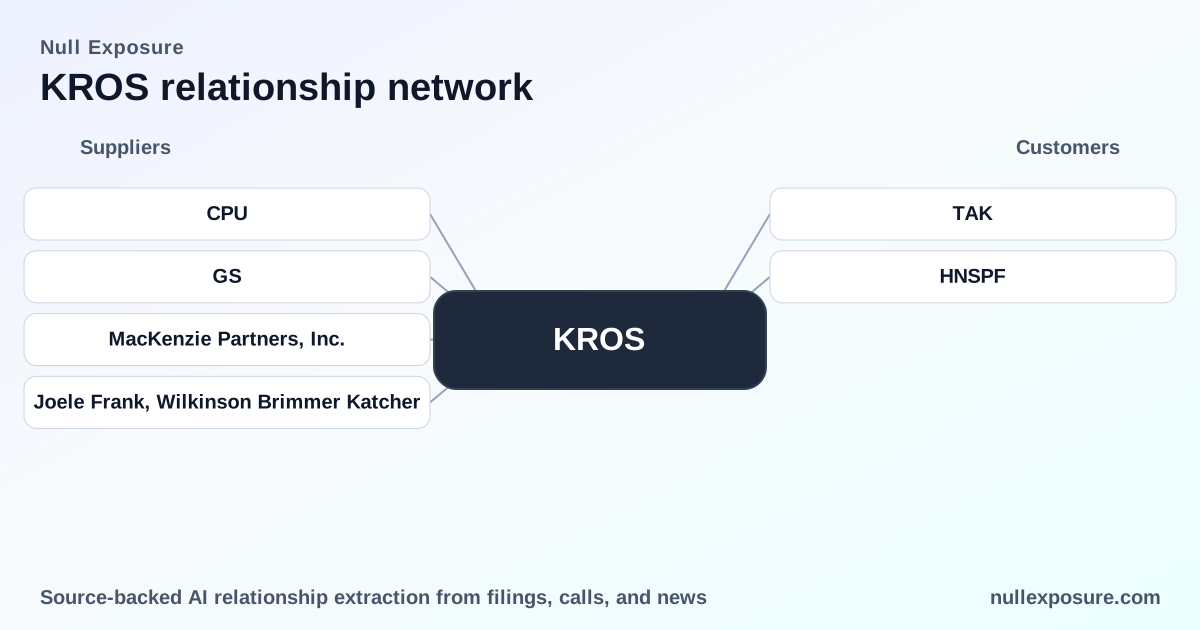
Takeda Pharmaceuticals (TAK) — a transformational global license
Takeda holds an exclusive global license (excluding mainland China, Hong Kong, and Macau) to develop, manufacture and commercialize elritercept and certain derivatives. Keros recognized significant license revenue tied to this agreement — including a $200.0 million upfront payment and a $10.0 million development milestone — which together drove license revenue recognition of roughly $205.4 million in the relevant reporting period (Keros press release, Mar 2026; TradingView coverage, May 2026; Yahoo Finance recap, Mar 2026). The contract also includes material future upside in the form of development and commercial milestones (reported eligibility of more than $1.1 billion) and tiered royalties (low-double digits to high-teens), aligning Keros’ long-term value to Takeda’s execution (Yahoo Finance, Mar 2026). Additionally, third‑party arrangements around proceeds distribution affect shareholder economics: an agreement disclosed in corporate counsel materials commits to distribute 25% of net cash proceeds received by an investor from the Takeda license to Keros stockholders under certain conditions (McDermott press note, 2026).
Hansoh (HNSPF) — China/HK/Macau commercialization partner
Under its Hansoh license, Keros granted exclusive rights for mainland China, Hong Kong and Macau, and the company received a net one-time $18.0 million upfront license payment in January 2022. Keros’ public filings attribute a prior reporting segment’s revenue entirely to agreements with Hansoh, which in that period equaled consolidated total revenue — a clear sign of regional concentration in earlier years (Keros 2024 Form 10‑K).
What the relationship constraints tell investors about the operating model
-
Contracting posture: Keros is a licensor, not a commercial partner in market execution; license agreements explicitly transfer development, manufacturing and commercialization responsibilities to counterparties (constraints citing Takeda and Hansoh license terms). That posture reduces Keros’ capital burden for late‑stage development but increases its dependence on partner milestones and royalties for future cash flow.
-
Concentration and spend bands: The firm’s revenue profile is concentrated and lumpy — the Takeda license produced a $200M+ upfront (spend band: 100m_plus), while Hansoh produced a $18M upfront (spend band: 10m_100m). These events show that a single partner can drive a full-year swing in profitability and cash position (constraints: spend band evidence).
-
Geographic footprint and strategic segmentation: Keros deliberately split rights by region — Hansoh controls APAC (mainland China, Hong Kong, Macau) while Takeda controls global rights outside those territories — creating complementary but asymmetric exposures across markets (constraints: geography_region evidence).
-
Relationship role and maturity: The partners are licensees under binding agreements; Hansoh’s upfront dates back to early 2022, while Takeda’s material payments were recognized in the 2024–2025 cycle, indicating staggered maturation of revenue sources and a recent shift toward larger global monetizations (constraints: relationship_role and timing evidence).
Investment implications and principal risks
Keros’ licensing strategy converts science into near-term cash, but it also concentrates ultimate product risk in partners’ hands. Investors should weigh:
-
Upside: Large upfronts and explicit milestone pools de‑risk the balance sheet, reduce near‑term dilution, and provide runway for non-licensed programs. The Takeda agreement alone materially improved FY2026 operating metrics via license revenue recognition (company press release, Mar 2026).
-
Concentration risk: License revenue is lumpy and partner‑dependent. A single global deal produced a majority of recent license revenue; future results will depend on timing of remaining milestones and royalty realization.
-
Execution and regulatory risk: Keros’ value is contingent on partner clinical and commercial execution, regulatory approvals, and successful launches in multiple territories.
-
Shareholder economics complexity: Third‑party distribution commitments (e.g., the 25% distribution commitment referenced in corporate counsel materials) can alter how proceeds flow to public shareholders, affecting net cash available to the company and its investors (McDermott note, 2026).
How to monitor progress and when to act
- Track milestone announcements and revenue recognition from Takeda and Hansoh — these directly move the income statement and cash flow.
- Monitor partner regulatory filings and commercial plans in the Takeda and Hansoh territories; successful approvals should convert contingent milestone pools into royalties.
- Watch Keros’ own disclosures for further license or co-promotion agreements that could diversify counterparties and reduce concentration.
For deeper mapping of KROS customer signals and to compare counterparties across portfolios, visit our hub at https://nullexposure.com/.
Final take
Keros has successfully monetized core assets through large, structured licensing transactions, shifting the company’s near-term financial profile from development spend to license-driven cash recognition. That strategic choice reduces Keros’ capital intensity and near-term dilution risk but simultaneously concentrates long-term value realization in partners’ hands. Investors should treat Keros as a hybrid: an early-stage biotech whose market value now hinges on contract economics and partner execution as much as on its own pipeline progress.