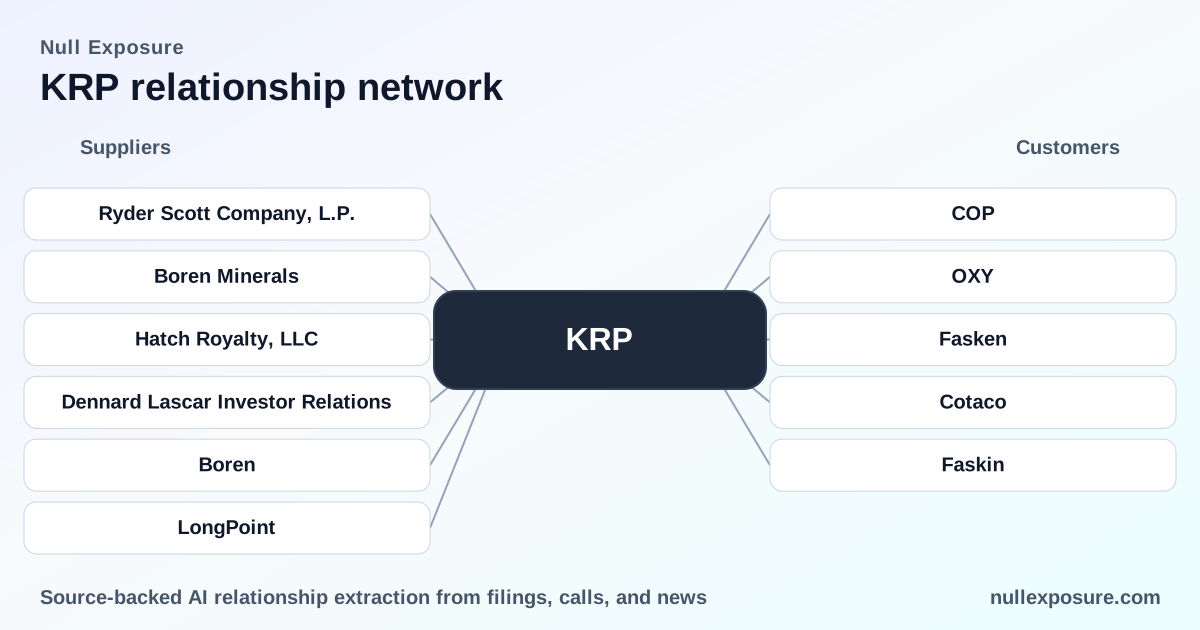
Kimbell Royalty Partners (KRP): operator relationships and what they mean for investors
Kimbell Royalty Partners acquires and holds mineral and overriding royalty interests across U.S. oil and gas acreage and monetizes those interests by collecting production‑linked royalty revenues at the wellhead or processing facility. Revenue accrues daily as wells produce, so the Partnership’s cash flow profile is a function of acreage quality, operator activity on that acreage, commodity prices and the contractual structure of leases and overriding royalty interests. For investors, KRP is a cash‑flow vehicle exposed to operator execution rather than an operator itself. Learn more about relationship intelligence at Null Exposure: https://nullexposure.com/.
How KRP’s commercial structure shapes risk and return
Kimbell’s operating model combines long‑lived ownership claims with short‑term production exposure. The company holds mineral and overriding royalty interests that are effectively perpetual so long as production continues, but the agreements and revenue realization have elements that behave like short‑term or spot contracts:
- Contracting posture: Mineral leases are commonly granted for initial three‑year terms with upfront bonuses, while overriding royalty interests typically persist for the life of the lease; KRP therefore benefits from durable property rights tied to production, even though operators’ drilling schedules and lease renewals create short‑term variability.
- Revenue recognition and cash flow timing: Revenue is recognized when production transfers to the purchaser at the wellhead or processing facility, so KRP’s cash flows are generated daily and reflect spot production volumes and pricing.
- Concentration and criticality: The Partnership receives production payments from roughly 1,400 operators, but approximately 41.2% of revenues came from the top ten purchasers as of year‑end 2024—a concentration across a small group even while any single top purchaser historically accounts for under ~11% of revenue. This structure makes operator execution and activity on key acreage clusters materially important to near‑term performance without exposing KRP to single‑counterparty insolvency as a systemic risk.
- Maturity: The business is asset‑centric and mature in cash‑flow profile—royalty receipts are recurring and tied to the life of production rather than to capital‑intensive drilling risk borne by operators.
These characteristics create a portfolio of long‑duration, production‑linked cash flows with sensitivity to operator drilling cadence and commodity cycles.
What management highlighted on the Q4 2025 call
Management’s Q4 2025 comments referenced active drilling and strong well results on specific ranches that underpin near‑term revenue upside. The Q4 transcript repeatedly cites operators surrounding Kimbell acreage—Conoco, Oxy, Cotaco and Fasken/Faskin—as contributors to recent production improvements, signaling that operator activity, not acreage resale, is driving incremental cash flow in the near term. This management commentary is documented in published earnings transcripts from March 2026. A second point of access to relationship data and full transcripts is available at Null Exposure: https://nullexposure.com/.
Relationship mentions from the public record (each item from the results)
Below are each of the recorded relationship mentions from the public record, reproduced with concise plain‑English summaries and source attributions.
-
Conoco — “Conoco has drilled a couple of wells that have been very good…” Source: Q4 2025 earnings‑call transcript republished by InsiderMonkey (first seen Mar 10, 2026). The company credited Conoco’s drilling activity around Kimbell acreage for recent positive production results. https://www.insidermonkey.com/blog/kimbell-royalty-partners-lp-nysekrp-q4-2025-earnings-call-transcript-1705273/
-
COP — duplicate entry referencing Conoco (COP) with the same quote and context from the Q4 2025 transcript; the reference confirms Conoco’s (COP) operator activity was called out by management. Source: InsiderMonkey (Q4 2025 transcript, Mar 10, 2026). https://www.insidermonkey.com/blog/kimbell-royalty-partners-lp-nysekrp-q4-2025-earnings-call-transcript-1705273/
-
Oxy — management noted being “surrounded by activity from other operators like Oxy and Faskin” on certain ranches, indicating Occidental’s operational presence on adjacent or nearby acreage that supports drilling momentum. Source: Q4 2025 earnings transcript republished on The Globe and Mail (Mar 10, 2026). https://www.theglobeandmail.com/investing/markets/stocks/KRP/pressreleases/447452/kimbell-royalty-krp-q4-2025-earnings-transcript/
-
OXY — a second record reiterates OXY’s mention in the same transcript and confirms that Occidental Energy’s activity is part of the operational ecosystem cited by management as driving production. Source: InsiderMonkey (Q4 2025 transcript, Mar 10, 2026). https://www.insidermonkey.com/blog/kimbell-royalty-partners-lp-nysekrp-q4-2025-earnings-call-transcript-1705273/
-
Fasken — management referenced “Fasken” (also reported as “Faskin” in other transcripts) as one of the operators active near Kimbell acreage, contributing to a clustered drilling environment that supports royalty receipts. Source: InsiderMonkey Q4 2025 earnings transcript (Mar 10, 2026). https://www.insidermonkey.com/blog/kimbell-royalty-partners-lp-nysekrp-q4-2025-earnings-call-transcript-1705273/
-
Cotaco — on the Navy Ranch specifically, Cotaco was named as drilling “a couple of wells that have been very good,” signaling that smaller operators on Kimbell acreage can also generate meaningful localized production uplifts. Source: Q4 2025 transcript republished by The Globe and Mail (Mar 10, 2026). https://www.theglobeandmail.com/investing/markets/stocks/KRP/pressreleases/447452/kimbell-royalty-krp-q4-2025-earnings-transcript/
-
Faskin — The Globe and Mail transcript uses the variant “Faskin” in the same sentence that names Oxy and Cotaco, again pointing to multi‑operator activity around specific Kimbell properties. Source: The Globe and Mail (Q4 2025 earnings transcript, Mar 10, 2026). https://www.theglobeandmail.com/investing/markets/stocks/KRP/pressreleases/447452/kimbell-royalty-krp-q4-2025-earnings-transcript/
Each of these mentions is a management‑level confirmation that operator drilling activity around KRP acreage is the proximal driver of short‑term revenue changes.
Investment implications: what operators mean for KRP’s cash flows
- Upside pathway: Active drilling by Conoco, Oxy, Cotaco and Fasken/Faskin on Kimbell acreage translates directly into increased royalty volumes and therefore near‑term cash flow uplift without KRP funding drilling capital. That is the core lever for upside.
- Concentration risk: Top‑ten purchasers delivered ~41% of 2024 revenue, so clustered operator success or decisioning can materially swing results even though no single purchaser historically dominates revenues above double digits; this creates a middle‑ground risk profile—diversified across many producers but sensitive to a handful of operators.
- Contractual durability: The prevalence of perpetual overriding royalty interests provides durable cash‑flow rights; however, revenue is realized on a spot/production basis and so is exposed to commodity volatility and operator execution cycles.
- Operational dependency: KRP’s earnings are highly dependent on third‑party operators’ drilling programs and reservoir performance, making operator selection, local geology and neighboring operator activity critical monitoring items for investors.
Final takeaways for business and research users
Kimbell Royalty is a cash‑flow focused royalty owner whose revenue trajectory is governed by the activity of nearby operators rather than by its own drilling capital. The Q4 2025 transcripts explicitly name Conoco, Oxy, Cotaco and Fasken/Faskin as active operators around the Partnership’s acreage, corroborating management’s view that operator execution is the proximate growth driver. Investors should treat KRP as a long‑duration, production‑tied instrument whose short‑term performance is set by operator cadence and commodity prices.
For deeper relationship mapping and ongoing monitoring of operator activity and transcript citations, visit Null Exposure: https://nullexposure.com/.