Korro Bio (KRRO): Collaboration-driven biotech with concentrated financing and reimbursement exposure
Korro Bio discovers and develops RNA-editing genetic medicines and currently monetizes through research collaborations and equity financing while advancing clinical programs toward commercialization. Its near-term revenue profile is collaboration- and grant-centric, while structural losses and heavy R&D spending require repeated financing; investors should evaluate partner commitments and payor risk as primary value drivers.
If you want a fast map of partner relationships and financing activity behind KRRO, see more at https://nullexposure.com/.
How Korro makes money and why partnerships matter
Korro’s operating model is built on three commercial dynamics:
- Collaboration revenue from pharmaceutical partners that fund discovery and translate early-stage programs into clinic-ready assets.
- Equity financing (private placements and PIPEs) to fund operations through inflection points given persistent operating losses.
- Future product revenue exposure to payors once programs advance to approval and commercialization.
Financial context reinforces this model: Revenue TTM ~$6.4M, negative EBITDA, and diluted EPS of -12.03 reflect an R&D-intensive company that relies on external capital and collaborations for near-term funding. Korro’s Price-to-Sales > 29x and high beta indicate a market pricing of growth potential coupled with material execution and financing risk.
Collaboration and financing relationships — who matters right now
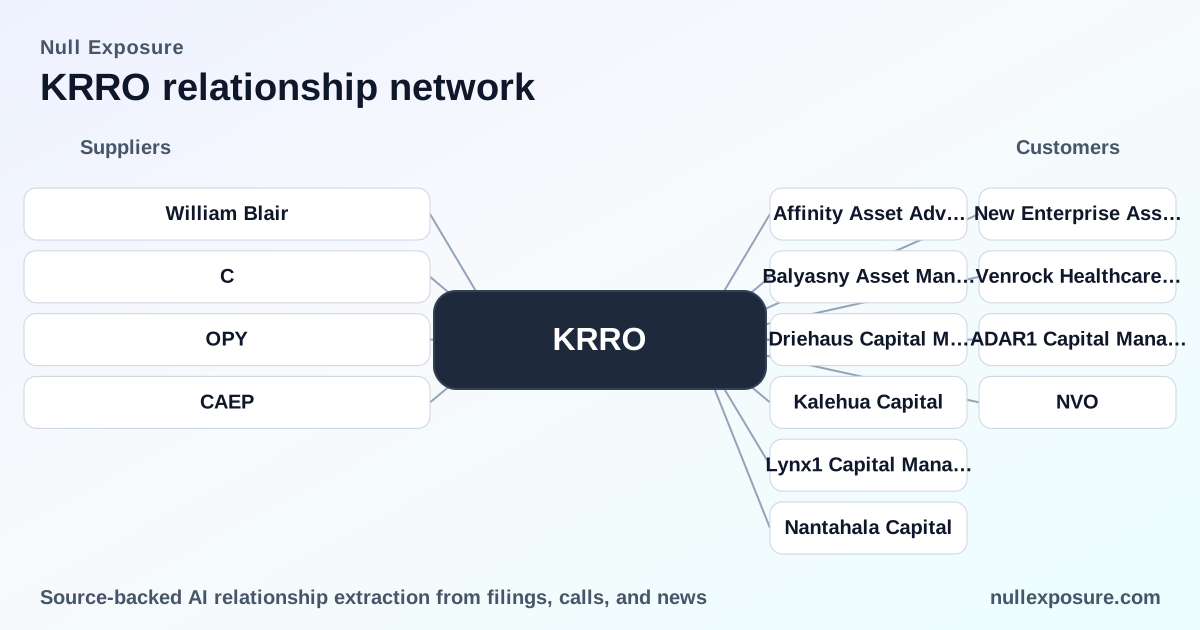
Below are every customer, partner, and financing participant surfaced in recent filings and reporting. Each entry is a concise, investor-focused read with sources.
-
Novo Nordisk A/S (NVO) — Korro runs a research agreement with Novo that materially increased collaboration revenue to roughly $6.4 million for 2025, up from $2.3 million in 2024, reflecting active program work under the deal. Separately, Novo previously committed up to $530 million across the arrangement and paid $10 million related to the first program; reporting indicates Novo paused aspects of the pact amid program performance updates. Source: SahmCapital (May 3, 2026) and FierceBiotech (Mar 10, 2026, FY2025/FY2026).
-
Venrock Healthcare Capital Partners — Led an $85 million private placement (PIPE) that provided critical near-term capital for Korro in March 2026; Venrock’s lead role signals institutional confidence among life-science investors. Source: CityBiz (Mar 10, 2026, FY2026).
-
ADAR1 Capital Management — Participated as a PIPE investor in the March 2026 financing round alongside Venrock and other new and existing backers. Source: CityBiz (Mar 10, 2026, FY2026).
-
Affinity Asset Advisors — Listed among participants in the $85 million private placement, representing institutional support from asset managers. Source: CityBiz (Mar 10, 2026, FY2026).
-
Balyasny Asset Management — Participated in the PIPE financing, adding multi-manager hedge fund capital to Korro’s shareholder base. Source: CityBiz (Mar 10, 2026, FY2026).
-
Driehaus Capital Management — Confirmed as a participant in the March 2026 private placement, contributing to the syndicate that backed Korro through the funding round. Source: CityBiz (Mar 10, 2026, FY2026).
-
Kalehua Capital — Joined the group of new and existing investors in the PIPE, broadening Korro’s institutional investor mix. Source: CityBiz (Mar 10, 2026, FY2026).
-
Lynx1 Capital Management — Participated in the financing round, further validating market appetite among specialist healthcare investors. Source: CityBiz (Mar 10, 2026, FY2026).
-
Nantahala Capital — Listed as one of the participating investors in the $85 million private placement that closed in March 2026. Source: CityBiz (Mar 10, 2026, FY2026).
-
New Enterprise Associates (NEA) — A notable venture investor that participated in the PIPE alongside venture and institutional partners, preserving venture-capital involvement during the public financing. Source: CityBiz (Mar 10, 2026, FY2026).
(Reporting on the PIPE syndicate was also syndicated via Intellectia.ai, mirroring the CityBiz coverage for FY2026 participants.)
What the relationship map tells investors about contracting posture and concentration
Korro’s partner and investor mix creates a specific operating posture investors must price into the stock:
-
Contracting posture: partnership-first. Korro structurally relies on collaboration agreements (e.g., Novo) to underwrite early development and de-risk programs, while equity raises fill funding gaps between milestones. Collaboration revenue can be lumpy and milestone-dependent, so near-term liquidity depends on continued partner engagement and access to capital markets.
-
Concentration of funding sources. A small number of large counterparties and institutional investors dominate funding and revenue; the Novo relationship and the March 2026 PIPE are examples. Concentration elevates counterparty execution risk if a major partner pauses or re-prioritizes programs.
-
Criticality to commercialization is high. For late-phase progress, payor acceptance and reimbursement will be critical given the therapeutic positioning; government (Medicare/Medicaid) and large commercial payors are explicit counterparty types for future commercial success.
-
Maturity signal: pre-commercial. Current revenue is collaboration-driven and relatively modest (~$6.4M in 2025) against sizable R&D and operating losses, indicating Korro is in a development-stage maturity with commercialization risk ahead.
Risk signals and investment implications
-
Execution risk tied to partnerships. The Novo structure demonstrates material upside (multi-hundred million commitment) but also the potential for program pauses that materially affect staffing and near-term operations; FierceBiotech reported layoffs linked to a lead program’s performance (FY2025). Source: FierceBiotech (Mar 10, 2026).
-
Financing dependency. The March 2026 $85M PIPE led by Venrock underscores ongoing dilution risk and reliance on institutional backstops to bridge to clinical readouts. Source: CityBiz (Mar 10, 2026).
-
Reimbursement and payor exposure. Company-level disclosures flag governmental and large commercial payors (Medicare, Medicaid, major commercial insurers) as decisive for product uptake and pricing, which affects long-term revenue scaling and valuation multiples.
-
Valuation versus revenue and profitability. With market capitalization under $200M and price-to-sales north of 29x, current valuation presumes successful partnership transitions into marketed products; investors should price in binary clinical outcomes and financing events.
Bottom line for operators and investors
Korro’s value trajectory is driven by partner execution (Novo) and access to capital (the March 2026 PIPE led by Venrock and participants). Key near-term monitoring points: Novo program status and milestone payments, burn rate versus available cash raised in the PIPE, and any signal on payor strategy or pricing modeling as programs approach registrational phases.
For a deeper relationship map and continuous monitoring of counterparty exposure, visit our research hub: https://nullexposure.com/.
Bold investments require clear line-of-sight to partner commitments and financing capacity; Korro’s current profile offers asymmetric upside if collaborations resume full activity, and asymmetric downside if major counterparties deprioritize programs.