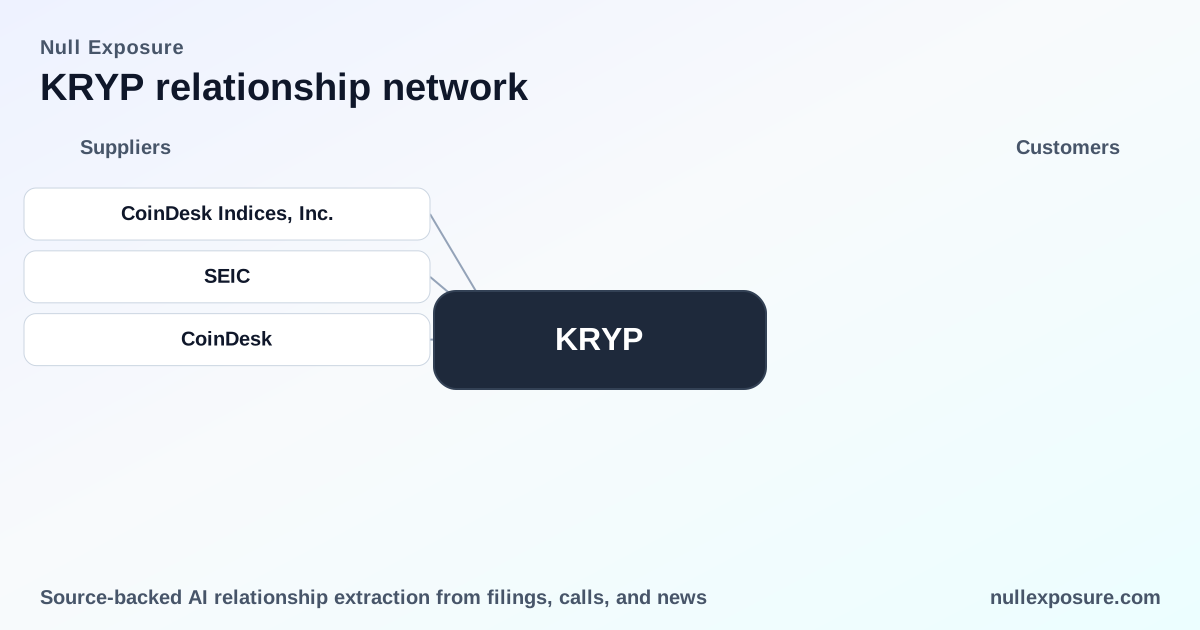
KRYP customer map: what ProShares-linked flows reveal about commercial risk and revenue
KRYP operates as an institutional-focused premium finance and risk services provider to crypto and trad-fi clients, monetizing through recurring custody and treasury-operations fees, trade-level financing spreads, and bespoke balance-sheet management mandates. Its customer set — including issuers and fund vehicles tied to major ETF sponsor ProShares — signals a revenue mix anchored in large, contract-driven counterparties and treasury-management engagements. For investors, the dominant takeaway is straightforward: KRYP’s commercial value is derived from servicing high‑scale liquidity and reserve-management needs, where per-client revenue is elevated and contract terms are strategic.
Learn more about coverage and research at https://nullexposure.com/.
Why ProShares relationships matter for KRYP’s economics
KRYP’s links to ProShares-related funds are not retail fluff; they represent institutional treasury and liquidity workflows that generate predictable, high-margin revenue. ETFs and money-market vehicles require operational partners for custody, short‑term financing, and settlement — functions that produce steady fee streams and occasional episodic liquidity demands. The presence of money-market and leveraged ETF customers implies KRYP underwrites both safety-first reserve operations and higher-turnover leveraged product mechanics.
- Contracting posture: Services sold to institutional funds are contract-heavy and require SLAs, custody guarantees, and regulatory compliance frameworks. That produces sticky, long-duration engagements.
- Concentration: A small number of large fund clients concentrates revenue but boosts per-client lifetime value.
- Criticality: These customers rely on operational continuity; service interruptions would be materially disruptive to funds’ NAV and investor relations.
- Maturity signal: Fund sponsorship by an established issuer like ProShares indicates enterprise‑grade counterparties and processes that scale.
Explore KRYP’s positioning and product detail at https://nullexposure.com/ (home).
What the customer list actually includes — one line per relationship
Below I cover every relationship in the source results with a plain-English summary and a citation for verification.
-
IQMM — ProShares GENIUS Money Market ETF: ProShares launched IQMM as a money-market ETF structured to comply with the GENIUS Act so it can serve as an eligible reserve asset for stablecoin issuers; the launch drew outsized first‑day attention tied to treasury-management flows. According to ETF Trends (Feb 20, 2026), ProShares debuted the GENIUS Money Market ETF (IQMM) with an institutional design that targets stablecoin reserve use.
Source: ETF Trends, Feb 19–20, 2026. -
CRCA — ProShares Ultra CRCL (2x leveraged): ProShares introduced CRCA to provide a 2x leveraged exposure to Circle Internet Group (CRCL), offering traders a way to take amplified directional positions on a major stablecoin issuer’s stock. The Block reported the product as a leveraged ETF launched to capture trader demand following Circle’s public listing (Mar 9, 2026).
Source: The Block, Mar 9, 2026. -
URSP — ProShares Ultra S&P 500 Equal Weight ETF: ProShares added URSP as a 2x daily equal-weight S&P 500 fund, expanding its leveraged/equal-weight suite and reinforcing its role as an issuer of fast-turnover, structurally leveraged products. ETFdb documented the URSP listing and product details in its fund index coverage (Aug 27, 2025).
Source: ETFdb, Aug 27, 2025. -
QQDN — ProShares UltraShort Top QQQ (inverse levered): ProShares launched the Ultrashort Top QQQ product (QQDN) to provide -2x daily returns versus the Nasdaq-100 Mega Index, targeting short-bias and hedging demand among active traders. Industry coverage by Intellectia and related press identifies QQDN as part of the June 2025 leveraged suite additions (reported Mar–May 2026).
Source: Intellectia.ai coverage, reported Mar–May 2026. -
QQUP — ProShares Ultra Top QQQ (2x leveraged): The counterpart to QQDN, QQUP delivers +2x daily returns on the Nasdaq-100 Mega Index and underscores ProShares’ continued expansion of single‑index leveraged products for tactical traders. MarketBeat lists QQUP’s issuer and ticker-level details consistent with the product launch timing (May 2026 reporting).
Source: MarketBeat, May 3, 2026.
Commercial implications for KRYP’s revenue and risk profile
KRYP’s customer roster composed of money-market and leveraged ETF vehicles produces a very specific commercial profile:
- High-margin recurring fees for custody and treasury management. Money-market ETFs and reserve-aware funds demand strict custody and settlement functions that are billable and long-term.
- Intermittent but material liquidity provisioning. Leveraged and ultra short/long funds create episodic financing and margin demands, increasing short-term working-capital requirements and lending spread opportunities.
- Contractual stickiness with counterparty concentration. A handful of large fund relationships generates outsized revenue but concentrates counterparty credit risk.
- Operational criticality elevates pricing power. Funds that depend on continuous settlement and precise cash management pay premium for reliability; that is a durable pricing lever for KRYP.
Key risk vector: revenue concentration tied to a small number of institutional sponsors. If one large fund shifts treasury operations, top-line volatility could be material. Key upside: the regulatory-driven demand for compliant reserve vehicles (for example, GENIUS Act–eligible instruments) creates sustained volume for custody and short-term asset placement services.
How investors should read the relationship signals
The presence of IQMM — a GENIUS Act–oriented money market vehicle — is the clearest operational signal: KRYP is positioned to capture stable, regulatory-driven flows from institutional stablecoin issuers and related fund managers. Leveraged ETF customers (CRCA, URSP, QQUP, QQDN) indicate an additional revenue stream tied to short-term financing and swap settlement mechanics that produce higher yield per dollar of assets under management.
For valuation and risk modeling, treat KRYP as a service provider whose revenue is a blend of:
- long-duration custody and compliance fees (predictable),
- transactional financing spreads and margin revenue (volatile but higher unit economics),
- and potential one-off implementation or migration fees for new fund launches.
Bottom line for allocators and operators
KRYP’s customer relationships show a company monetizing through institutional custody and treasury operations for high-value fund products. The combination of GENIUS Act–aligned money-market demand and leveraged ETF operational needs creates a balanced revenue set: stable baseline cash-management fees plus episodic, higher-margin financing activity. Investors should model both concentration risk and the premium pricing power that comes from being a mission‑critical provider to large fund sponsors.
For follow-up research, detailed contract-level diligence or public filings on counterparty arrangements will clarify concentration and margin assumptions; our platform collects and synthesizes those traces for institutional users at https://nullexposure.com/.