Knightscope (KSCP) customer relationships: reseller traction, recurring revenue mix, and operational constraints
Knightscope sells autonomous security robots (ASRs), emergency communication devices (ECDs) and a cloud monitoring service (KSOC). The company monetizes through a hybrid model: subscription Machines‑as‑a‑Service (12‑month leases that bundle hardware, maintenance, monitoring and software) and spot product sales for ECDs and one‑off installations. For investors, the relevant signal set is clear — growth depends on converting pilots to recurring contracts, scaling reseller channels, and expanding the KSOC/RTX recurring revenue base while addressing negative gross margins and capital constraints. For more background, visit the NullExposure research hub: https://nullexposure.com/
How Knightscope actually operates and what that means for revenue
Knightscope’s go‑to‑market mixes three economic drivers: hardware sales (ECDs and ASRs), subscription leasing (MaaS) and managed monitoring services (RTX/KSOC). Public filings and press language show product revenue includes point‑of‑sale ECD transactions while subscription revenue arises from 12‑month ASR leases that bundle service and software. That structure produces a mix of predictable recurring cash from ASR subscriptions alongside lumpy spot revenue from ECD installations. Because Knightscope’s long‑lived assets and customers are overwhelmingly U.S.‑based, the company’s addressable market and contract execution will be concentrated geographically and tied to reseller and government procurement channels.
Financial context sharpens the commercial picture: TTM revenue is roughly $11.3M with negative gross profit and EBITDA, and market capitalization is approximately $53.9M. Those metrics make recurring contract economics and margin improvement essential to justify the valuation.
Constraints that shape the operating model (company‑level signals)
Knightscope’s contract and go‑to‑market characteristics, drawn from company disclosures, create both opportunity and structural risk:
- Contracting posture — dual nature: Knightscope runs subscription (MaaS) contracts with typical 12‑month terms while also booking spot product sales for emergency communication devices. That dual posture increases revenue diversity but complicates cash flow predictability.
- Revenue concentration & geography: Substantially all assets and revenue are U.S.‑based, making growth dependent on domestic adoption and federal/state procurement success.
- Counterparty mix: The company sells to both private sector customers and government entities, and is positioned for federal opportunities after obtaining FedRAMP ATO and running a VA pilot.
- Relationship roles: Knightscope acts as a seller/manufacturer and service provider while also recognizing accounts receivable from leasing activity — reinforcing a blended product/service balance.
- Product versus service split: The business is effectively three lines — hardware, software (KSOC), and services (RTX) — with recurring revenue anchored in software and RTX monitoring.
- Maturity signals: Deployments with government entities are still at pilot stage for federal ASR variants, implying revenue upside but early execution risk.
These constraints are company‑level realities that investors should fold into any cash flow or customer lifetime valuation.
Public customer signals — every relationship in the record
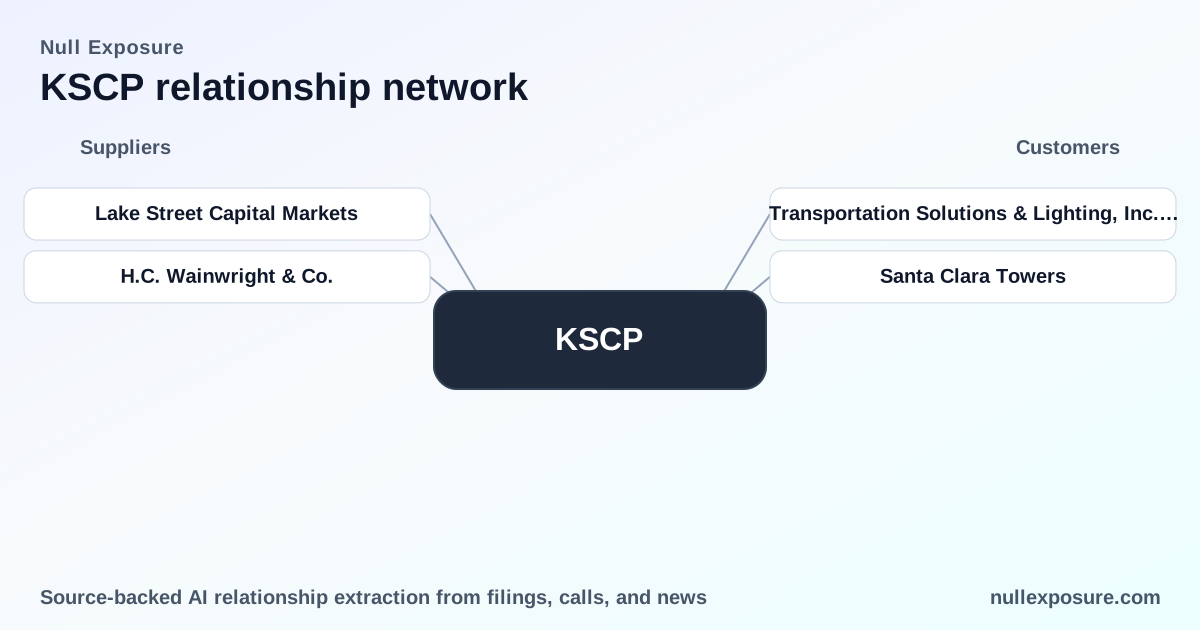
Transportation Solutions & Lighting, Inc. – Safety and Security Division – National Safety Systems
Knightscope’s authorized partner TS&L/NSS issued a purchase order for 23 K1 Blue Light Emergency Phones to be installed at a leading Florida cancer center, reflecting reseller‑driven spot product sales in healthcare facilities. This came through a press release captured on March 10, 2026 (Silicon.co.uk). Source: Silicon.co.uk press release (first seen 2026‑03‑10).
Santa Clara Towers (renewal)
A June 25, 2024 press release disclosed that Santa Clara Towers renewed a K5 contract, confirming Knightscope’s ability to retain ASR subscriptions at a Class‑A twin‑tower office in Silicon Valley where a K5 has been active since early 2022. This is a positive renewal signal for recurring subscription economics. Source: BusinessWire via FinancialContent (June 25, 2024).
Santa Clara Towers (duplicate syndicated release)
A syndicated copy of the June 25, 2024 BusinessWire release appeared on a regional broadcast site, reiterating the same renewal at Santa Clara Towers and underscoring the publicity and distribution of Knightscope’s renewal news. Source: Clarke Broadcasting / MyCentralOregon (repost of June 25, 2024 BusinessWire).
TS&L — Georgia State University installation
A separate press notice (first seen May 3, 2026) states that Georgia State University selected Knightscope reseller TS&L to supply and install K1 Blue Light Towers and Call Boxes on its downtown Atlanta campus, signaling reseller penetration into higher‑education public safety installations. Source: FinancialContent press distribution (first seen 2026‑05‑03).
What the relationship set implies for growth and risk
The public relationships form a coherent picture: resellers are doing the heavy lifting on ECD installations, and renewals on K5 subscriptions validate recurring revenue retention in commercial property use cases. Key takeaways:
- Reseller channel is critical. Both TS&L and its NSS/TS&L division are active partners executing installations at healthcare and higher‑education sites, highlighting Knightscope’s reliance on third‑party installers for spot product distribution and campus rollouts.
- Recurring revenue exists but is early. The Santa Clara Towers K5 renewal is evidence that subscription contracts convert to retained clients, but the company’s overall revenue base is small and margins are negative — scale is required to unlock meaningful free cash flow.
- Government is a strategic target but still early stage. FedRAMP ATO and a VA pilot position the company for federal procurement, yet public evidence classifies federal deployments as pilot‑stage for K5 GOV units.
- Geographic concentration elevates execution risk. With virtually all activity centered in the U.S., macro or procurement headwinds domestically will have outsized impact.
Investment implications and recommended focus for operators
For investors: value will accrue from expanding recurring ASR subscriptions, improving gross margins, and scaling RTX/KSOC monitoring. The current financial profile — negative gross profit and EBITDA against modest revenue — places a premium on operational execution and capital efficiency. Watch three metrics closely: subscription renewal rates, average contract length and AR churn; gross margin per deployed ASR/ECD; and cash flow from reseller‑facilitated installations.
For operators and partners: prioritize standardized reseller onboarding, service level agreements for RTX coverage, and tighter inventory‑to‑installation cycles to reduce spot sale volatility and improve margin realization.
If you want a concise feed of customer relationship signals and the implications for KSCP’s commercial trajectory, get the full mapping at https://nullexposure.com/
Conclusion: Knightscope’s public customer evidence shows early commercial traction through resellers and selective renewals, combined with government pilot opportunities and a clear subscription backbone. The path to a sustainable valuation runs through scaling recurring contracts, improving product margins, and converting pilot federal programs into multi‑year revenue streams.