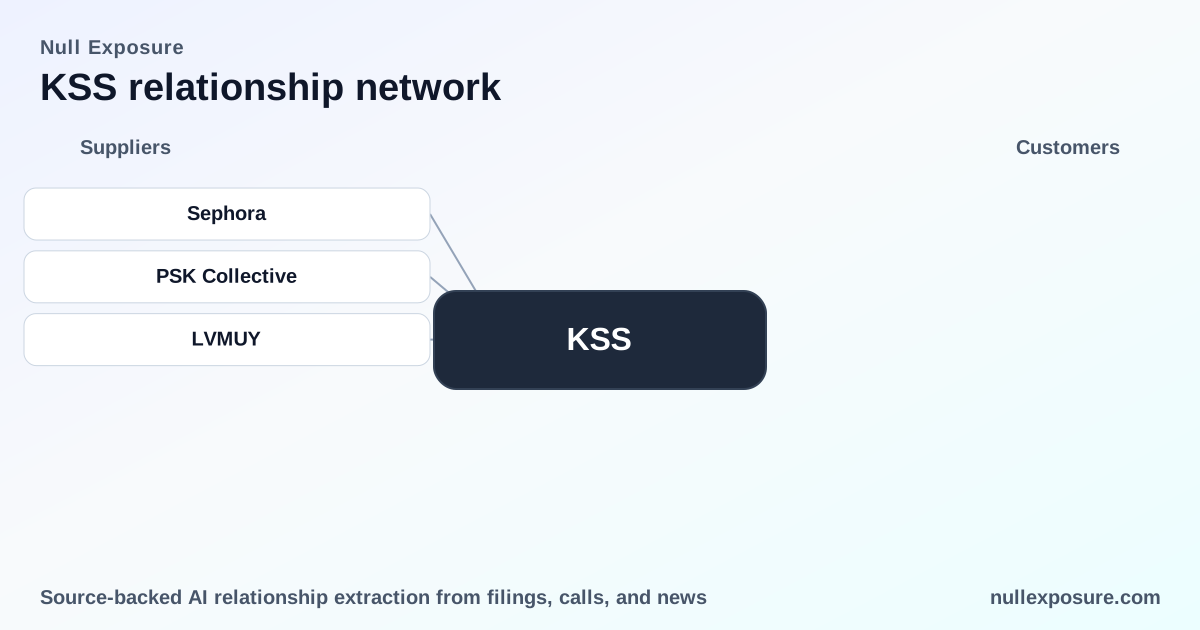
Kohl's (KSS) — customer relationships that shape revenue and strategic optionality
Kohl’s operates a national network of department stores and an e-commerce platform that monetize primarily through merchandise sales, private- and national-brand assortments, and ancillary loyalty/credit arrangements. Revenue derives from high-volume, low-margin retail transactions with a core, moderate-income U.S. customer base and incremental margin capture through loyalty programs and private labels. For a quick look at how we source relationship intelligence, visit https://nullexposure.com/.
What the customer signals tell investors about how Kohl’s runs the business
Kohl’s customer profile is a clear, actionable operating signal: the retailer sells everyday apparel, accessories, beauty and home goods to a moderate-income, price-sensitive U.S. consumer. That profile translates into four practical business-model characteristics:
- Contracting posture — transactional and retail-focused. Kohl’s customer relationships are largely open-market purchases rather than long-term contracts, which supports flexible pricing and promotional activity but reduces switching friction.
- Concentration — geographically U.S.-centric. All stores are U.S.-based, creating direct exposure to U.S. macro cycles and consumer sentiment.
- Criticality — high-volume, low-margin dependence. Customers are revenue-critical but individually low-ticket; profitability depends on scale, loyalty programs, and inventory turns rather than deep contractual lock-ins.
- Maturity — an established, active retail footprint. Kohl’s operates an established store base and an active omnichannel presence that drive recurring retail flows and operational leverage.
These signals explain why corporate events (M&A proposals, credit partnerships, loyalty tweaks) quickly ripple through top-line forecasts and valuation multiples.
Every recorded customer relationship in the records — concise investor notes
FRGAP — Kohl’s entered sale negotiations with Franchise Group Inc. (Milwaukee Journal Sentinel)
Kohl’s disclosed that it entered negotiations with Franchise Group Inc., the owner of The Vitamin Shoppe and Pet Supplies Plus, as part of a possible sale process; the story was reported in a July 1, 2022 piece by the Milwaukee Journal Sentinel. (Milwaukee Journal Sentinel, July 1, 2022: https://www.jsonline.com/story/money/2022/07/01/kohls-no-longer-talks-sell-company-but-pressure-remains/7785915001/)
FRGAP — Franchise Group offered $60 per share, per Kohl’s press release reported by WPR
Kohl’s public press release and coverage noted that Franchise Group submitted a $60-per-share proposal, signaling an outside-party valuation anchor and activist/strategic pressure on the board during mid‑2022. (Wisconsin Public Radio coverage referencing the June 6, 2022 press release: https://www.wpr.org/economy/kohls-sale-owner-vitamin-shoppe-falls-through)
FRGAP — Press and public filings reiterated the offer and negotiations in June 2022
Multiple press outlets and company statements repeated that Franchise Group formally offered $60 per share during June 2022 negotiations, underscoring the level of third‑party interest in Kohl’s equity and potential implications for governance and strategic alternatives. (Wisconsin Public Radio reporting on Kohl’s negotiations, June 2022: https://www.wpr.org/economy/kohls-corp-negotiating-company-sale-owner-vitamin-shoppe)
AVBC — Avidia Bank credit-card rewards referencing Kohl’s bonus points (FY2020 context)
A CardRates profile of Avidia Bank’s card products listed Kohl’s among reward partners, citing a bonus‑points structure (for example, “Kohl’s: 4 bonus points per $1”), which reflects the role of co‑branded or partner cards in driving incremental spend and loyalty. (CardRates coverage of Avidia Bank cards, FY2020 context: https://www.cardrates.com/news/avidia-bank-cards-offer-competitive-rates-and-rewards/)
How these relationships and constraints change the investment equation
The FRGAP entries collectively document material strategic interest in Kohl’s in mid‑2022 and reveal an important investor dynamic: external parties see immediate value that can be unlocked by consolidation or portfolio reconfiguration. That attention affects valuation multiples, governance focus, and capital-allocation debate. For operators, this translates into heightened scrutiny on margin improvement levers, real-estate strategy, and loyalty monetization.
The AVBC entry highlights an operational lever with direct customer economics: co‑branded or partner credit/rewards arrangements increase spend per customer and improve retention without creating long-term contractual obligations. For a retailer whose contracting posture is transactional, these partnerships serve as a low-friction pathway to increase customer lifetime value.
Put together with the company-level constraints described above, the practical implications are:
- Macroeconomic sensitivity is elevated. With an exclusively U.S. store footprint and a moderate‑income customer base, earnings elasticity to U.S. consumption is significant. Investors must model downside scenarios for discretionary spending.
- Operational execution matters more than contractual shields. Because customer relationships are largely non-contractual, Kohl’s competitive advantages rely on brand relevance, loyalty chemistry, pricing cadence, and inventory discipline.
- Strategic optionality is real and visible. The presence of a $60-per-share offer in 2022 demonstrated that an outside buyer could change the capital structure or strategy, which compresses the time horizon for management to deliver material performance inflection.
Practical risk and opportunity checklist for investors and operators
- Risk — concentration to the U.S. consumer: plan stress tests for U.S. consumption shocks.
- Risk — low switching costs: customer loyalty programs and credit partnerships are mission-critical to sustain spend.
- Opportunity — monetizing loyalty and private brands: incremental margin accretion from private-label growth and card revenue.
- Opportunity — M&A dynamics: activist or strategic bids put a premium on near-term cash generation and cost rationalization.
Key takeaway: Kohl’s business model is straightforward retail: scale and loyalty drive profitability. External interest and credit-partnership signals show where incremental value and downside exposure both concentrate.
For further company relationship intelligence and source-level tracking for consumer retailers, visit https://nullexposure.com/ — the repository we used to compile and verify the items summarized above.
Final thought: investors should value Kohl’s as a high‑operational‑leverage retail chain with material U.S. exposure, meaningful loyalty-driven upside, and visible strategic optionality that surfaces as sale interest or partnership activity.