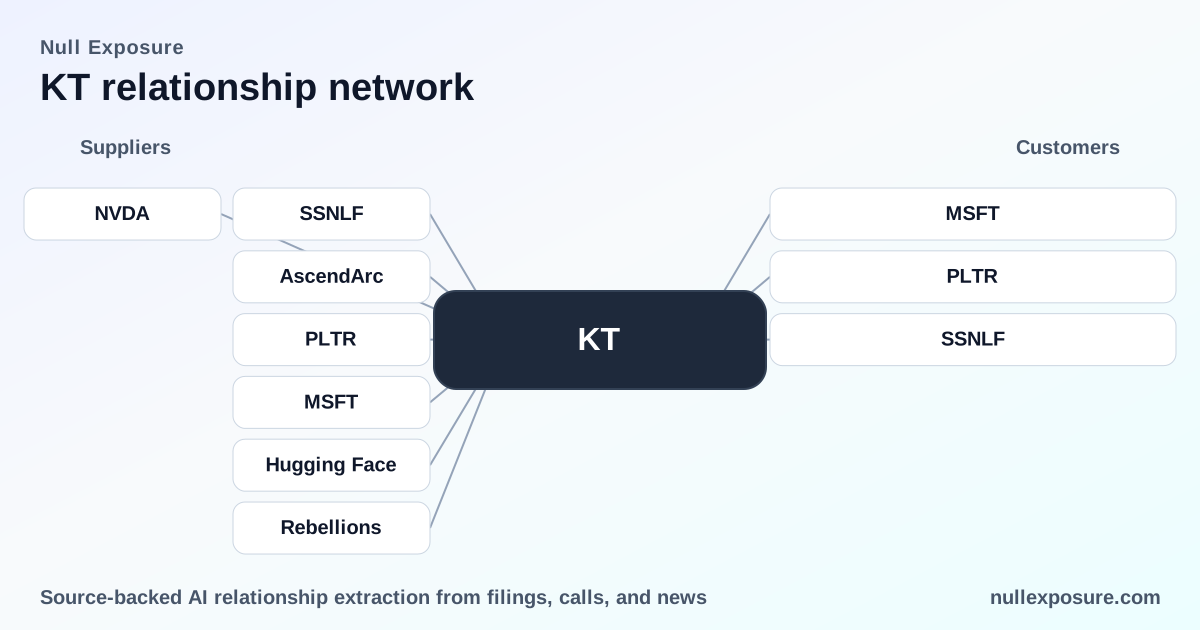
KT Corporation: Customer relationships shaping a telco platform pivot
KT Corporation operates as South Korea’s incumbent integrated telecommunications and platform services provider, monetizing through a mix of core connectivity (mobile, fixed broadband, enterprise links), platform services (cloud, B2B software, digital advertising gateways) and emerging AI-enabled offerings. Revenue is driven by high-volume connectivity contracts and expanding platform monetization tied to strategic technology partnerships, with margins supported by scale and recurring service fees. Learn how these customer and partner relationships de-risk execution and accelerate platform revenue at https://nullexposure.com/.
Why the partner map matters to investors
KT is transitioning from a pure telco utility toward a platform play: partnerships with global software and data vendors accelerate productization of AI and advertising inventory, while local ad and enterprise relationships expand go-to-market reach. These relationships reveal KT’s contracting posture (collaborative with global technology providers), revenue concentration dynamics (large domestic footprint with targeted enterprise and ad partners) and maturity of new revenue streams (early-stage monetization with visible pilot results).
What KT said on the record: relationship entries from its 2025 Q4 earnings call and public reporting
Below I cover each relationship item pulled from the records. Each starts with a short, plain-English summary and a concise citation.
PLTR (entry 1)
KT reported that it is “starting to gain more visibility in business outcomes from the Palantir partnership, particularly in respect to the financial sector of customers.” Palantir is being used to drive measurable outcomes in financial services use cases, representing early commercial traction for KT’s analytics-led platform offers. Source: KT 2025 Q4 earnings call, referenced March 7, 2026.
MSFT (entry 2)
KT stated that the September rollout of SOTA K, an AI model developed in partnership with Microsoft, has proceeded as planned. This partnership embeds Microsoft technology into KT’s AI roadmap and commercial offerings, signaling a strategic cloud/AI alliance for productizing KT’s AI services. Source: KT 2025 Q4 earnings call, referenced March 7, 2026.
Palantir (entry 3)
A second record reiterates that KT is gaining visibility into business outcomes from its Palantir collaboration, with emphasis on financial-sector customers. The repetition underscores Palantir’s role as a core analytics partner driving verticalized enterprise use cases. Source: KT 2025 Q4 earnings call, referenced March 7, 2026.
Microsoft (entry 4)
The call also reiterated that SOTA K was developed in partnership with Microsoft and rolled out in September, reinforcing Microsoft’s strategic role across KT’s AI stack. Microsoft is positioned as both a technology supplier and an enabler of KT’s AI commercialization. Source: KT 2025 Q4 earnings call, referenced March 7, 2026.
PERI (Perion) (entry 5)
Perion’s Q2 2025 reporting noted geographic expansion via “strategic partnerships in Korea through KT Corporation and NHN AD,” enabling access to Asia-Pacific DOOH (digital out-of-home) advertising inventory. KT provides local distribution and inventory access for programmatic DOOH sellers, broadening KT’s advertising platform reach into the Asia‑Pacific market. Source: Perion Q2 2025 report coverage (news mention dated March 10, 2026).
SSNLF (entry 6)
An earnings-call transcript contains an exchange introduced by “Minha Choi from Samsung Securities,” indicating that Samsung Securities participated as an analyst on the call. This item reflects investor/analyst engagement rather than a customer contract, and confirms market attention from a South Korean brokerage. Source: KT 2025 Q4 earnings call, referenced March 7, 2026.
Samsung Securities (entry 7)
The same text appears under the Samsung Securities label, again noting an analyst question from Minha Choi of Samsung Securities during the 2025 Q4 call. The repeat mention highlights active sell-side coverage and dialogue on KT’s strategic progress. Source: KT 2025 Q4 earnings call, referenced March 7, 2026.
How these relationships define KT’s operating model and business characteristics
- Contracting posture — collaborative and platform-oriented. KT’s partnerships with Microsoft and Palantir reflect a deliberate strategy to integrate third-party enterprise AI and analytics tech rather than build all capabilities in-house. These are strategic alliances structured to accelerate product launches and enterprise sales cycles.
- Concentration and criticality — balanced domestic heft with targeted global partners. KT retains a domestic revenue base of scale while selectively partnering to address high-value verticals (financial services) and new channels (DOOH advertising). These relationships are critical to KT’s platform monetization, not to core connectivity cash flow.
- Maturity and commercialization — early but measurable traction. Mentions of “gaining visibility in business outcomes” and SOTA K rollout indicate pilots progressing to early commercial use; monetization is nascent but evidence of enterprise adoption exists.
- Disclosure signal — no contract-level constraints flagged. The provided records contain no explicit contractual constraints or redacted terms. That absence is a company-level signal: no contract-specific limitations were identified in the sample, which simplifies initial legal/operational diligence but does not replace full contract review.
Investment implications and risk factors
- Upside: Partnerships with Microsoft and Palantir materially accelerate KT’s capacity to sell AI-augmented services to enterprise customers and to monetize advertising inventory through partners like Perion. Given KT’s scale and recurring connectivity revenue, platform growth flows into a stable cash base and supports margin expansion over time.
- Constraints to monitor: Commercialization remains in early stages; investors should watch customer outcome metrics, contract tenure and revenue recognition from Palantir-enabled deals and SOTA K deployments. The public reporting shows pilot-to-sale momentum but not yet full revenue scale.
- Concentration risk: KT’s platform bets concentrate on a few strategic partners for technology; any disruption in those alliances would slow GTM execution even if core connectivity revenues remain stable.
- Governance/visibility: Repeated references to the same partnerships across the call suggest management is prioritizing these alliances in near-term strategy — track upcoming quarters for conversion of visibility into recurring platform revenues.
Bottom line and next steps for investors
KT is executing a clear hybrid model: stable, high-volume telecom cash flows underwrite a fast-follow platform strategy powered by global partners. Palantir and Microsoft are functionally core to KT’s enterprise AI and analytics roadmap, while Perion-style ad partnerships expand addressable market for KT’s media inventory. Analyst engagement from firms such as Samsung Securities confirms market focus on these developments.
For a deeper look at the partner and customer signals that matter to telecom-platform investors, visit https://nullexposure.com/ for the full analytical toolkit and ongoing coverage.