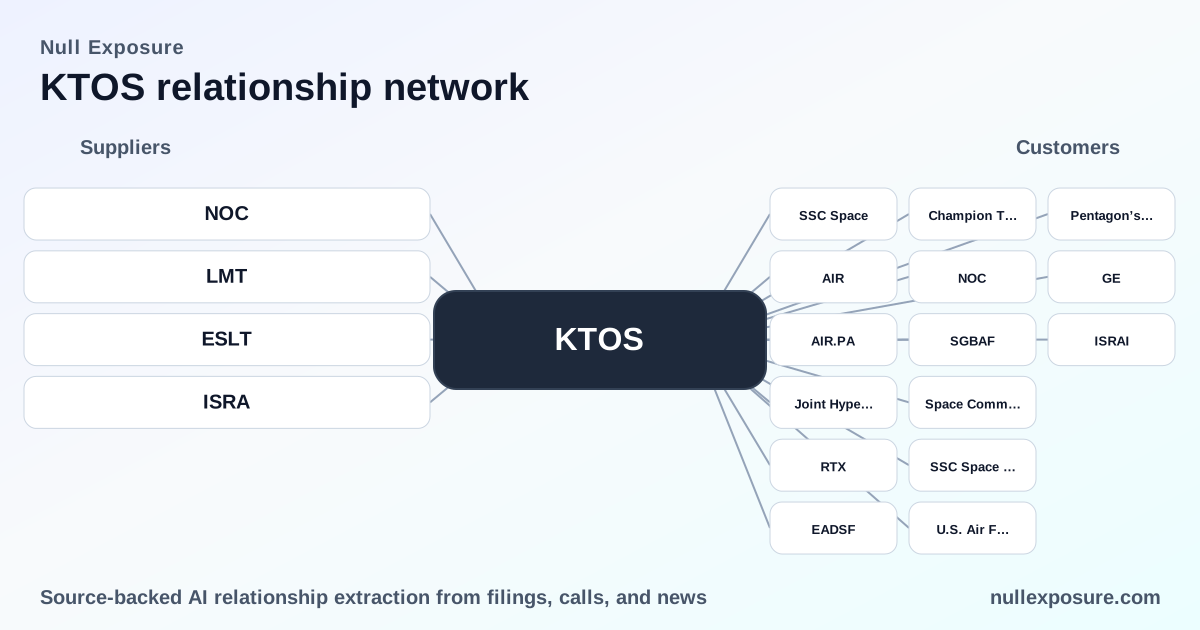
Kratos (KTOS): Customer Map and Commercial Thesis for Investors
Kratos Defense & Security Solutions operates as a hybrid defense systems provider that monetizes through long‑term government prime contracts, allied export sales, and commercial satellite/ground-system programs, combining hardware (unmanned aircraft, propulsion, RF products), software (command & control) and services (systems integration, testing, sustainment). Its revenue mix is highly government‑centric but expanding into commercial and international space and satellite ground systems, creating both revenue stability and scalable commercial upside. For deeper research on Kratos’ contracts and partner footprint visit https://nullexposure.com/.
How Kratos wins and where value is created
Kratos’ operating model is driven by multi‑year awards and framework IDIQ work that recognize revenue over time as projects deliver. Management emphasizes long‑term contract duration (three to seven years for many awards), heavy exposure to U.S. Government customers, and parallel commercial wins in satellite ground systems and allied CCA (Collaborative Combat Aircraft) programs. These characteristics produce:
- Stable cash flow from government prime/sub contracts, supporting R&D and production scale.
- High program criticality where a small number of large awards materially move revenue — for example, a single space systems award can equal a substantial share of annual revenue.
- Diversification into commercial space ground systems and international partnerships that leverages Kratos’ Epic command‑and‑control and OpenSpace platforms.
Key company‑level signals from filings: long‑term contracting posture, government concentration (~67% of revenues historically), North American revenue base with increasing global commercial activity, and a balanced product/service mix (hardware, software, services). Learn more at https://nullexposure.com/.
Relationship roll‑call: every named counterparty in recent coverage
Below are plain‑English takeaways for each relationship cited in the collected results, with source context for validation.
-
SSC Space — Kratos’ OpenSpace platform has been deployed in SSC Space’s new Space Go LEO service, and Kratos also won a Counter‑UAS production order tied to that activity; both moves underpin near‑term revenue visibility in unmanned and space businesses (MarketBeat / ASDNews, Mar 2026).
Source: MarketBeat instant alert and ASDNews coverage (Mar 2026). -
MOG‑B — A supplier on Kratos platforms, MOG‑B provides flight control and actuation products for Kratos’ XQ‑58 Valkyrie and BQM‑177, and discussions continue to expand components on future Kratos CCA programs (MOG‑B earnings call, 2025 Q4).
Source: MOG‑B 2025 Q4 earnings call (Mar 2026). -
U.S. Space Force — Kratos was awarded a prime Other Transaction Agreement for Ground Management & Integration work supporting the Resilient Missile Warning and Tracking program, positioning Kratos as a ground‑systems integrator for missile‑warning satellites (Globe and Mail / Sahm Capital reporting, Apr–May 2026).
Source: Press coverage and program analysis (Apr–May 2026). -
Airbus Defence and Space / Airbus / AIR / AIR.PA — Kratos secured a multi‑million contract to deliver a ground segment for Airbus’ OmanSat‑1 program and completed Epic‑to‑OneSat factory acceptance testing, signaling an expanding commercial space relationship and product validation for Kratos’ satellite C2 systems (ASDNews, Intellectia, StockTwits, Mar 2026).
Source: ASDNews, Intellectia, StockTwits and Kratos earnings remarks (Feb–Mar 2026). -
EADSF — Airbus’ investor ticker shows up in earnings commentary confirming formal interoperability milestones between Kratos’ Epic C2 and Airbus’ OneSat platform (Kratos 2025 Q4 earnings call).
Source: Kratos 2025 Q4 earnings call (Mar 2026). -
Raytheon / RTX — Earnings commentary ties Kratos’ program support to larger DoD air‑defense initiatives where Raytheon is also a prime, underlining Kratos’ role as a systems supplier across multi‑prime programs (Kratos 2025 Q4 call).
Source: Kratos 2025 Q4 earnings call (Mar 2026). -
Northrop Grumman / NOC / Northrop Grumman Mission Systems — Northrop is a co‑awardee on a $230M MUX TACAIR/CCA program that will be split with Kratos, reflecting partnership on large unmanned combat aircraft initiatives (TradingView / Kratos earnings comments, May 2026).
Source: TradingView summary and Kratos 2025 Q3/2025 Q4 remarks (2025–2026). -
SES / SGBAF — Management cited SES as a strategically important global space partner and industry peer in the satellite/space segment, reflecting commercial channel and systems collaboration potential (Kratos 2025 Q4 earnings call).
Source: Kratos 2025 Q4 earnings call (Mar 2026). -
Joint Hypersonics Transition Office (JHTO) — Kratos won a Pentagon contract via JHTO to support hypersonic thermal protection system testing and evaluation efforts, supporting Project Helios and materials testing capabilities (OvertDefense, Feb 2026).
Source: OvertDefense reporting (Feb 2026). -
Space Communication Technologies (SCT) SPC — Kratos will deliver the end‑to‑end ground system for Oman’s OmanSat‑1 through Airbus, making SCT the ultimate customer for that ground segment delivery (ASDNews, Defence‑Industry.eu, Mar 2026).
Source: ASDNews and Defence‑Industry.eu reports (Feb–Mar 2026). -
SSC Space Go — Kratos’ OpenSpace was selected as the backbone of SSC Space Go, the company’s LEO service for small satellites, tying Kratos software to recurring service revenue in commercial LEO operations (ASDNews / SimplyWall.St, Mar 2026).
Source: ASDNews and SimplyWall.St coverage (Mar 2026). -
United States Marine Corps — Kratos demonstrated XQ‑58A electronic warfare capabilities for USMC, reinforcing Kratos’ tactical unmanned and EW market exposure in U.S. services (UAS Magazine, 2026).
Source: UAS Magazine report (2026). -
U.S. Air Force — Kratos and GE Aerospace won a $12.4M USAF award to design a GEK1500 engine for small CCAs, connecting Kratos engineering and program work to Air Force CCA initiatives (GlobeNewswire / AIJourn, Feb–Mar 2026).
Source: GlobeNewswire press release and AIJourn coverage (Feb–Mar 2026). -
GE Aerospace / GE — Partnered with Kratos on the U.S. Air Force engine design effort for expendable CCAs, indicating industrial collaboration beyond pure electronics and systems (GlobeNewswire, Mar 2026).
Source: GlobeNewswire (Mar 2026). -
SKY Perfect JSAT / SKY Perfect JSAT Corporation / SKM.FRK — Kratos was selected as a strategic partner to develop a 5G Non‑Terrestrial Network ground system for Asia‑Pacific, extending Kratos’ NTN footprint into commercial regional operators (Investing.com, StocksToTrade, GlobeNewswire, Mar–Apr 2026).
Source: Investing.com, StocksToTrade and GlobeNewswire reports (Mar–Apr 2026). -
Champion Tire & Wheel — Kratos is deploying automated truck platooning technology with Champion Tire & Wheel, representing non‑defense commercial deployment of Kratos mobility automation tech (SimplyWall.St coverage, 2026).
Source: SimplyWall.St article (2026). -
Orbit Technologies — Kratos completed the cash acquisition of Orbit Technologies to expand its satellite communications and ground infrastructure capabilities, directly supporting OpenSpace and ground systems sales (MarketBeat, Mar 2026).
Source: MarketBeat instant alert (Mar 2026). -
Israel Aerospace Industries / ISRAI, Elbit, Rafael — Kratos’ microwave operations in Israel involve long‑standing relationships with these Israeli primes, reflecting international defense supply ties and R&D collaboration (Kratos 2025 Q4 earnings call).
Source: Kratos 2025 Q4 earnings call (Mar 2026). -
Pentagon’s Industrial Base Analysis and Sustainment program — Kratos won a $68.3M award under this program to build a hypersonics materials testing center (Project Helios), showing government investment in Kratos’ test infrastructure (OvertDefense, Oct 2025 reporting cited in Mar 2026 summaries).
Source: OvertDefense and program reporting (Oct 2025 / Mar 2026).
Constraints and what they mean for investors
-
Contracting posture: Kratos operates largely under long‑term and framework contracts (3–7 years; IDIQs and OT agreements). This produces predictable revenue recognition over program delivery but concentrates execution risk in program milestones.
Source: company filings and contract descriptions (FY2024–FY2026 disclosures). -
Customer concentration & role: The company is government‑centric (U.S. agencies ~67% of revenue historically) while acting as both prime contractor and subcontractor; that concentration is material and functionally critical to cash flow.
Source: Kratos fiscal disclosures (2022–2024) and earnings commentary. -
Geography: Revenue is North America‑centric but Kratos has expanding global commercial engagements (Airbus, SKY Perfect JSAT, SCT) that diversify market exposure.
Source: geographic revenue breakdown and recent contract announcements. -
Business mix: Kratos is an integrated hardware + software + services provider; this modularity supports cross‑sell but also requires broad capital and program management capabilities.
Source: corporate segment disclosures and product announcements.
Final takeaways for operators and investors
- Kratos’ revenue profile is anchored by long‑term government work but is actively shifting into commercial space and international partnerships, where Epic/OpenSpace and Valkyrie CCA programs are the levered growth points.
- Program awards are both revenue catalysts and execution risks—large single awards (e.g., Space Force GMI) materially change near‑term revenue and margin expectations. For ongoing tracking and deal‑level detail, see company releases and curated coverage at https://nullexposure.com/.
For institutional readers wanting ongoing contract‑level monitoring and verified source links, visit https://nullexposure.com/ for the Kratos dossier and primary‑source references.