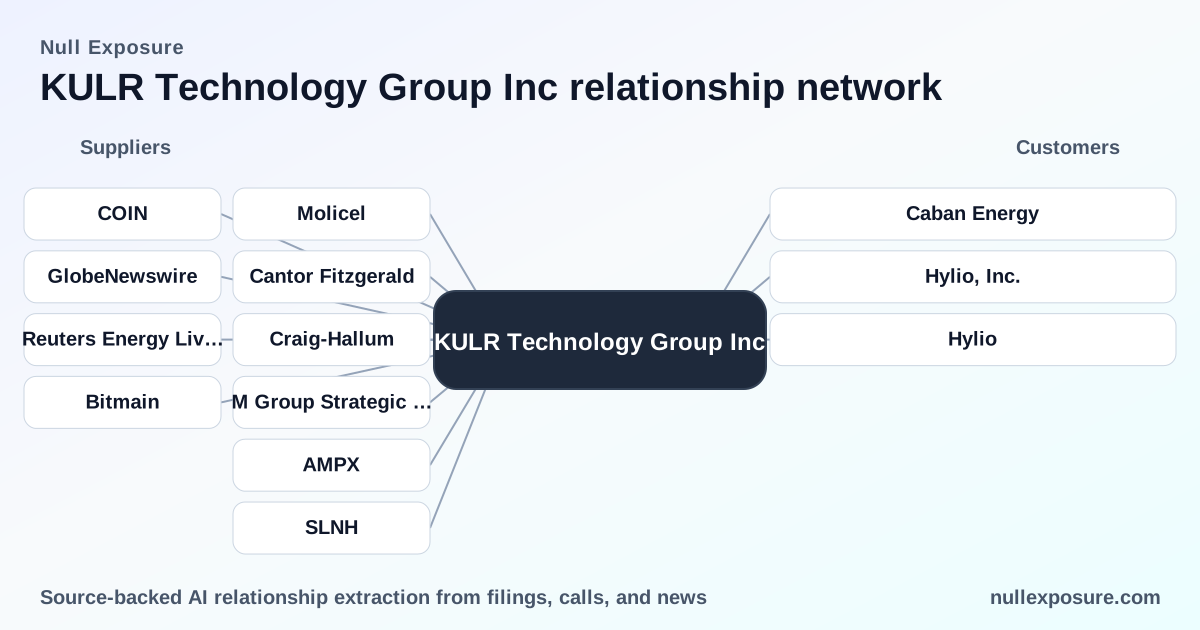
KULR Technology Group: customer relationships that shift revenue from proofs to production
KULR Technology Group sells thermal-management materials, battery systems and related production services to industrial and defense customers and monetizes through product sales, multi‑year licensing agreements and build‑to‑print battery production contracts. Recent customer agreements position KULR to convert R&D and pilot wins into recurring revenue, while its licensing and supply contracts create a mix of predictable, multi‑year cash flows and project‑level revenue volatility. For a compact read on how these customer ties affect valuation and operational risk, see Null Exposure’s research hub: https://nullexposure.com/
Why the customer list matters to investors
KULR’s announced customer relationships reveal a deliberate commercial strategy: pursue multi‑year supply and licensing with enterprise buyers while offering manufacturing-as-a-service to niche OEMs. That strategy raises revenue upside from larger deals but concentrates contractual risk into a smaller number of high‑value counterparty relationships. The company’s FY2025–FY2026 activity indicates a clear push into domestic manufacturing and defense‑grade productization.
- Contracting posture: KULR leverages long‑term licenses and preferred‑supplier supply agreements to lock in demand and justify factory investments.
- Counterparty profile: Customers are enterprise buyers and specialized OEMs across renewable energy, unmanned systems, and aerospace.
- Geographic posture: Licensing revenue shows APAC concentration (notably Japan), while production and U.S. manufacturing expansion push a domestic footprint.
Explore a full set of KULR customer signals and relationship summaries at Null Exposure: https://nullexposure.com/
The customer roll call — what each relationship delivers to KULR’s commercial picture
Caban Energy — five‑year preferred battery supply agreement, ~$30M revenue potential
KULR signed a five‑year preferred battery supply agreement with Miami‑based Caban Energy, expected to generate roughly $30 million in revenue beginning in 2026 and tied to the takeover of Caban’s Plano, Texas manufacturing assets; the deal formally positions KULR as a preferred supplier for critical‑infrastructure battery projects. Source: company press release via GlobeNewswire (Jan 14, 2026) — https://www.globenewswire.com/news-release/2026/01/14/3218625/0/en/KULR-Technology-Group-Awarded-5-year-Preferred-Battery-Supply-Agreement-from-Caban-Energy-Expands-U-S-Manufacturing-Footprint.html
Hylio, Inc. — joint development to produce NDAA‑compliant batteries for UAS
KULR entered a joint development collaboration with Texas‑based Hylio to design, prototype, qualify and domestically manufacture NDAA‑compliant battery systems for Hylio’s unmanned agricultural drones, signaling KULR’s push into U.S. defense‑adjacent supply chains and domestic manufacturing capacity. Source: KULR/Hylio press release via GlobeNewswire (Feb 18, 2026) — https://www.globenewswire.com/de/news-release/2026/02/18/3240208/0/en/KULR-and-Hylio-Announce-Strategic-Collaboration-to-Produce-Texas-Manufactured-Battery-Systems-for-U-S-Built-Unmanned-Agricultural-Drones.html
Robinson Helicopter Company — co‑development for eR66 electric helicopter demonstrator
KULR announced a strategic co‑development collaboration with Robinson Helicopter to develop a next‑generation, high‑performance battery system for an eR66 battery‑electric helicopter demonstrator, which represents an extension into electric aviation OEM programs and larger system integrator partnerships. Source: trade press (VerticalMag) reporting KULR announcement (2026) — https://verticalmag.com/press-releases/kulr-one-battery-architecture-enters-electric-aviation-with-robinson/amp/
SLNH / Soluna Holdings — hosting partnership for Project Sophie bitcoin mining
KULR is involved as a host partner for a 3.3 MW Bitcoin mining operation at Soluna’s Project Sophie, reflecting diversification into data‑center and edge power hosting opportunities where KULR’s energy storage and thermal expertise supports high‑density compute operations. Source: StocksToTrade (report referencing hosting partnership, FY2025) — https://stockstotrade.com/news/soluna-holdings-inc-slnh-news-2025_10_16/
What these relationships signal about KULR’s operating model and business constraints
The relationship set and company disclosures reveal five actionable operating characteristics investors should price into forecasts:
-
Licensing and long tenors: KULR executes long‑term licenses — including a ten‑year license disclosed in late‑2024 for CF Cathode technology — indicating the company pursues durable IP monetization as a growth lever. This shifts revenue mix toward recurring royalties as license portfolios scale. Source: company filing excerpts (Dec 29, 2024) in corporate disclosures.
-
Enterprise counterparty sales cycle: KULR states that its customers are large organizations with multi‑level contract controls, which creates longer sales cycles but larger contract values when closed; governance overhead is baked into go‑to‑market economics. Source: company filing language on customer profile.
-
APAC license concentration versus global product reach: As of Dec. 31, 2024, all license revenue was generated from Japan, exposing that revenue stream to regional concentration risk, while the KULR VIBE product line serves global customers. Investors must model geographic concentration for license income and broader international exposure for product sales. Source: company filing excerpts (FY2024).
-
Dual role: product seller and service provider: KULR sells engineered materials (CFV, TRS, ISC cells, FTI) and also offers battery production as a service (build‑to‑print), meaning margins and capital intensity will vary by contract type — licensing is high‑margin, manufacturing services are capital and labor intensive. Source: product and service descriptions in corporate disclosures.
-
Ticket sizes that matter: The company discloses precedent deals in the $1M–$10M range (for example a $2.35M arrangement with minimum guaranteed license and royalties), indicating mid‑sized contract economics dominate near‑term revenue modeling. Source: company filing excerpts describing the $2.35M deal.
Investor implications: upside, concentration risk, and operational cadence
-
Upside: Preferred supply and NDAA‑compliant manufacturing partnerships convert technical wins into multi‑year revenue streams and justify factory investment. Caban and Hylio relationships materially increase addressable production revenue in 2026–2027.
-
Concentration and execution risk: Licensing concentration in Japan and reliance on a handful of large contracts increase downside if counterparty demand shifts or qualification timelines stretch. KULR’s negative operating margins and recent negative EBITDA require flawless execution of manufacturing scale‑up to absorb fixed costs. Reference financials: Revenue TTM ~$16.2M, EBITDA negative ~$40.6M (company reported latest quarter, FY2025–FY2026).
-
Contracting reality: Expect longer customer qualification cycles for aerospace, defense and hyperscale data center customers; cash conversion will be lumpy and milestone‑driven rather than uniform subscription revenue.
Bottom line and next steps
KULR’s customer roster shows a deliberate move from lab demonstrations toward production‑grade supply and licensing, creating realistic revenue runway if manufacturing scale and counterparty qualifications execute on schedule. Investors should balance the revenue upside from the Caban and Hylio engagements against concentration and execution risk inherent in long‑tenor licenses and capital‑intensive manufacturing services.
For an investor‑grade dossier covering contract timelines, revenue sensitivity and counterparty exposure, visit Null Exposure for the full profile and model inputs: https://nullexposure.com/