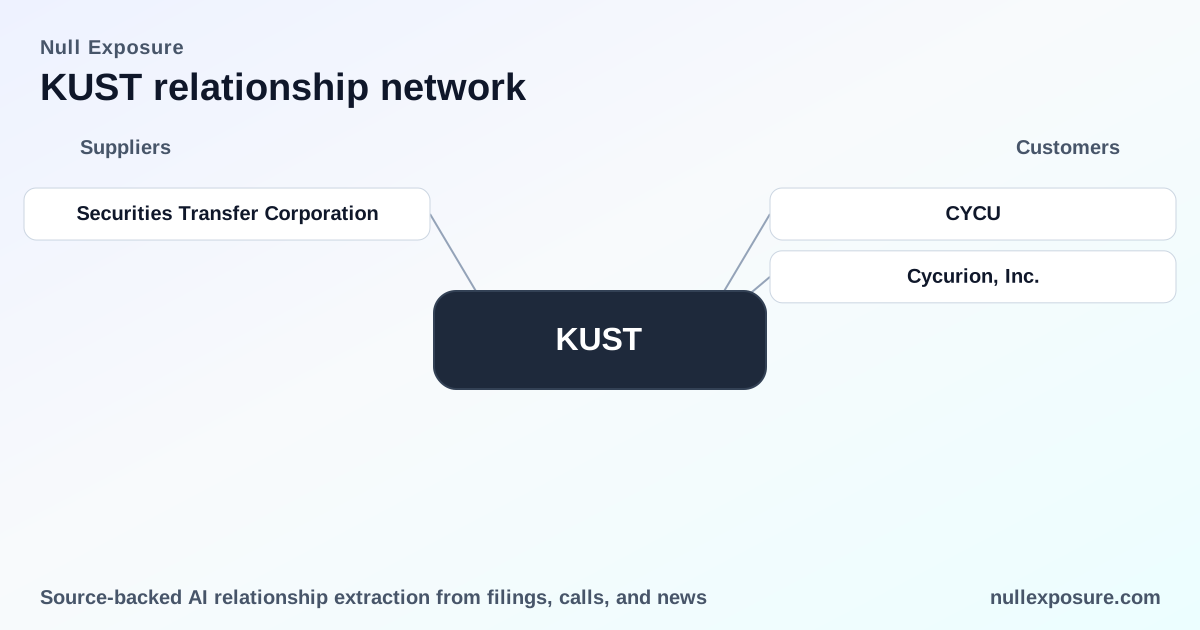
Kustom Entertainment (KUST): Customer relationships centered on a legacy divestiture and subscription-driven revenue
Kustom Entertainment monetizes through three principal streams: recurring subscription and warranty revenues tied to its video solutions cloud and services, hardware sales of cameras and safety equipment, and service fees/reseller margins from entertainment ticketing and revenue-cycle management. The company is executing a strategic pivot that includes divesting the legacy video solutions unit while leaning into subscription economics and ticketing operations to stabilize cash flows and reduce operating loss volatility. For a concise overview of our research platform and source compilation visit https://nullexposure.com/.
The strategic backdrop: selling the legacy video business to sharpen focus
Kustom has executed a series of public announcements in 2026 outlining a non‑binding Memorandum of Understanding (MOU) with Cycurion to transfer its legacy video solutions segment. The communications characterize the transaction as a path to accelerate Kustom’s transition to service and subscription models and to reduce legacy hardware exposure. Multiple press accounts reported consideration in the low‑millions range—some outlets cited $5.5 million, while certain filings and reporting referenced a $6.0–$8.5 million expectation—reflecting reporting differences in the public record (see detailed sources below). The revised MOU announced in April consolidates those earlier terms and sets the timeline for a potential closing under updated conditions.
Key takeaway: The divestiture is material strategically, reducing hardware risk and emphasizing recurring revenue, but the absolute cash proceeds are limited relative to Kustom’s balance-sheet scale.
Every public relationship mention (source-by-source review)
Below are one- to two‑sentence summaries of each relationship mention in the available news coverage and filings. Each item links to the original release or article.
-
Kustom announced a revised, non‑binding MOU with Cycurion to sell the legacy video solutions segment; the release framed the agreement as updated terms for the previously announced sale. Source: TipRanks company announcement (May 3, 2026) — https://www.tipranks.com/news/company-announcements/kustom-entertainment-advances-legacy-video-segment-divestiture-plan
-
A newswire item reported the revised MOU establishing updated terms for the sale of Kustom’s legacy video solutions segment to Cycurion, emphasizing the shift from the January 22 MOU. Source: Manila Times / GlobeNewswire (Apr 17, 2026) — https://www.manilatimes.net/2026/04/17/tmt-newswire/globenewswire/kustom-entertainment-and-cycurion-announce-agreement-on-terms-for-sale-of-legacy-video-solutions-segment/2322675
-
Kustom’s January 22, 2026 GlobeNewswire filing disclosed the original non‑binding MOU with Cycurion to divest its video solutions division, formally initiating the sale process. Source: GlobeNewswire press release (Jan 22, 2026) — https://www.globenewswire.com/news-release/2026/01/22/3223757/10618/en/KUSTOM-ENTERTAINMENT-INC-ANNOUNCES-A-NON-BINDING-MEMORANDUM-OF-UNDERSTANDING-FOR-THE-CONTEMPLATED-DIVESTITURE-OF-ITS-VIDEO-SOLUTIONS-SEGMENT.html
-
The same GlobeNewswire announcement was republished and referenced by other outlets describing the MOU with Cycurion for the video solutions divestiture. Source: GlobeNewswire republished (Jan 22, 2026) — https://www.globenewswire.com/news-release/2026/01/22/3223757/10618/en/KUSTOM-ENTERTAINMENT-INC-ANNOUNCES-A-NON-BINDING-MEMORANDUM-OF-UNDERSTANDING-FOR-THE-CONTEMPLATED-DIVESTITURE-OF-ITS-VIDEO-SOLUTIONS-SEGMENT.html
-
A GlobeNewswire piece on Kustom’s TicketSmarter recognition also noted the recently announced non‑binding MOU with Cycurion for the legacy video division. Source: GlobeNewswire (Feb 10, 2026) — https://www.globenewswire.com/news-release/2026/02/10/3235290/10618/en/KUSTOM-ENTERTAINMENT-S-TICKETSMARTER-NAMED-AMONG-10-BEST-TICKET-RESALE-SITES-OF-2026-BY-FORBES-ADVISOR.html
-
That TicketSmarter press release was republished by other aggregators and again referenced the Cycurion MOU in company commentary. Source: GlobeNewswire repost (Feb 10, 2026) — https://www.globenewswire.com/news-release/2026/02/10/3235290/10618/en/KUSTOM-ENTERTAINMENT-S-TICKETSMARTER-NAMED-AMONG-10-BEST-TICKET-RESALE-SITES-OF-2026-BY-FORBES-ADVISOR.html
-
A subsequent GlobeNewswire release on April 17, 2026 reiterated the revised, non‑binding MOU with Cycurion and summarized the updated terms for the sale of the legacy business. Source: GlobeNewswire (Apr 17, 2026) — https://www.globenewswire.com/news-release/2026/04/17/3276059/0/en/KUSTOM-ENTERTAINMENT-AND-CYCURION-ANNOUNCE-AGREEMENT-ON-TERMS-FOR-SALE-OF-LEGACY-VIDEO-SOLUTIONS-SEGMENT.html
-
A Manila Times AMP repost covered the revised MOU between Kustom and Cycurion, repeating the April 17 announcement to international readers. Source: Manila Times AMP (Apr 17, 2026) — https://www.manilatimes.net/2026/04/17/tmt-newswire/globenewswire/kustom-entertainment-and-cycurion-announce-agreement-on-terms-for-sale-of-legacy-video-solutions-segment/2322675/amp
-
Investing.com reported the revised non‑binding MOU and cited a transaction consideration figure of $5.5 million for the sale of the video unit. Source: Investing.com (May 3, 2026) — https://www.investing.com/news/company-news/kustom-entertainment-to-sell-video-unit-to-cycurion-for-55m-93CH-4620013
-
An automated news aggregation entry described the MOU as Cycurion’s intent to acquire Kustom’s video‑solutions division. Source: Intellectia.ai (Mar 10, 2026) — https://intellectia.ai/en/stock/KUST/news
-
Intellectia’s feed also published the same MOU summary under Cycurion branding, noting acquisition intent. Source: Intellectia.ai (Mar 10, 2026) — https://intellectia.ai/en/stock/KUST/news
-
Yahoo Finance coverage summarized Kustom’s entry into a non‑binding MOU with Cycurion to sell the legacy video solutions unit, reiterating corporate disclosure. Source: Yahoo Finance markets article (May 3, 2026) — https://finance.yahoo.com/markets/stocks/articles/kustom-entertainment-inc-reports-significant-123000488.html
-
TS2.Tech reported on Kustom’s SEC filing and linked it to the Cycurion MOU, noting a press release range for consideration of $6.0M to $8.5M in its writeup. Source: TS2.Tech (Mar 10, 2026) — https://ts2.tech/en/kustom-entertainment-stock-pops-premarket-as-sec-filing-lays-out-2026-pay-option-grants/
-
A GlobeNewswire April 13, 2026 financial update repeated the MOU disclosure that Kustom has entered into a non‑binding MOU with Cycurion to sell its legacy video division. Source: GlobeNewswire (Apr 13, 2026) — https://www.globenewswire.com/news-release/2026/04/13/3272497/0/en/Kustom-Entertainment-Inc-Reports-Significant-Financial-Improprovements-for-Fiscal-Year-2025-and-Files-Annual-Report-on-Form-10-K.html
-
The same April 13 press release was republished and used in company filings and investor materials describing the Cycurion MOU. Source: GlobeNewswire republish (Apr 13, 2026) — https://www.globenewswire.com/news-release/2026/04/13/3272497/10618/en/Kustom-Entertainment-Inc-Reports-Significant-Financial-Improprovements-for-Fiscal-Year-2025-and-Files-Annual-Report-on-Form-10-K.html
-
OpenPR summarized CYCU’s MOU to acquire Kustom’s video unit and described the business scope (body-worn cameras, in‑car video, evidence management). Source: OpenPR (May 3, 2026) — https://www.openpr.com/news/4362197/acquisition-of-kustom-entertainment-inc-nasdaq-kust
-
Sahm Capital’s news summary covered the revised MOU establishing terms for the sale of the legacy video solutions segment. Source: Sahm Capital (Apr 17, 2026) — https://www.sahmcapital.com/news/content/kustom-entertainment-and-cycurion-announce-agreement-on-terms-for-sale-of-legacy-video-solutions-segment-2026-04-17
-
A FinancialContent/markets release described an expected revenue boost and backlog implications tied to CYCU's planned acquisition of Kustom’s video solutions business. Source: Markets.FinancialContent (Apr 22, 2026) — https://markets.financialcontent.com/stocks/article/getnews-2026-4-22-51-million-expected-boost-to-annual-revenue-and-8-million-backlog-via-accelerated-plan-to-acquire-video-solutions-division-of-kustom-entertainment-cycurion-inc-nasdaq-cycu
-
GlobeNewswire’s April 13 investor update again reiterated the MOU between Kustom and Cycurion in the context of financial improvements and Form 10‑K filing. Source: GlobeNewswire (Apr 13, 2026) — https://www.globenewswire.com/news-release/2026/04/13/3272497/0/en/Kustom-Entertainment-Inc-Reports-Significant-Financial-Improvements-for-Fiscal-Year-2025-and-Files-Annual-Report-on-Form-10-K.html
-
GlobeNewswire’s April 27, 2026 LD Micro presentation notice listed the revised MOU as a strategic action alongside other divestitures and streamlining activities. Source: GlobeNewswire (Apr 27, 2026) — https://www.globenewswire.com/news-release/2026/04/27/3281516/0/en/kustom-entertainment-to-highlight-strategic-progress-at-the-16th-annual-ld-micro-invitational.html
What the customer and contract constraints reveal about Kustom’s operating model
- Subscription-first revenue design: Management has explicitly shifted the video segment to a subscription model (cloud and warranty plans typically 3–5 years), which increases revenue visibility and extends customer lifetime value compared with one‑time hardware sales.
- Government as a core end market: Video solutions historically sell into state, local, and federal law enforcement, producing lower credit risk and procurement-driven contracting cycles that lengthen sales timelines but reduce bad‑debt exposure.
- Multi-segment customer mix: Kustom collects transaction fees from individual ticket buyers on its entertainment platform, acts as a principal reseller for inventory tickets, and provides RCM services to medium/large healthcare organizations on a recurring monthly basis—creating diverse revenue streams with different margin profiles.
- Distribution posture internationally: International sales route through independent distributors who buy wholesale and resell, indicating Kustom’s international exposure is channel-mediated rather than direct-contract heavy.
- Concentration and materiality: Reported receivables show no individual customer exceeds 10% of accounts receivable, which signals low single-customer concentration risk at the accounts‑receivable level.
- Roles and revenue recognition: The company operates simultaneously as principal (ticket inventory sales, hardware) and agent (secondary marketplace transactions), which creates mixed margin reporting and operational demands.
- Segment mix: The business remains a hybrid of hardware (legacy video), software/cloud subscriptions, and service (RCM, ticketing fees)—the planned divestiture trims hardware exposure and increases relative weight on recurring services.
Investment implications and a short action list
- The sale to Cycurion accelerates Kustom’s pivot toward recurring revenue, improving predictability but delivering limited immediate proceeds relative to enterprise scale; investors should treat proceeds as strategic working capital rather than a transformational liquidity event.
- Government contracts provide stable cash collection but constrain topline growth pacing; growth depends on subscription uptake and scaling TicketSmarter revenue.
- Operational complexity remains elevated: simultaneous principal/agent roles, distributor channels internationally, and multiple end markets increase execution risk.
- For active investors and analysts: monitor final deal documentation with Cycurion, updates to subscription retention metrics, and quarterly disclosure on revenue composition (hardware vs. subscription vs. services).
For a synchronized view of this coverage and consolidated source links, visit our research hub: https://nullexposure.com/.
Bold final takeaways:
- Kustom is executing a strategic simplification—divesting legacy hardware to emphasize subscription and service cash flows.
- The Cycurion MOU is the pivotal catalyst for that strategy, but transaction proceeds are modest and execution on subscription growth remains the primary value driver.