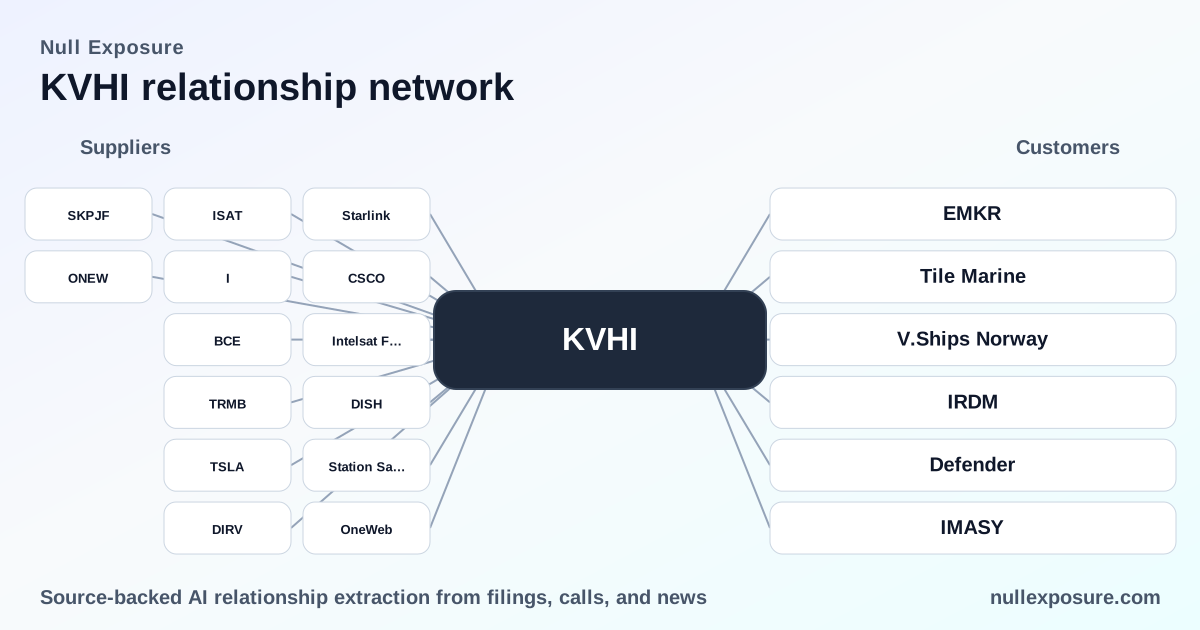
KVH Industries: customer relationships that drive recurring maritime connectivity revenue
KVH Industries designs and sells mobile satellite and hybrid connectivity hardware while monetizing primarily through recurring satellite airtime and managed connectivity services. The company combines subscription-based CaaS (AgilePlans) and usage-based airtime with multi-year equipment leases and an international dealer/distributor network to create a revenue stream that is service-heavy, global, and tied to maritime and government customers. For a focused read on customer exposures and partner dynamics, visit https://nullexposure.com/.
How KVH structures contracts and where the revenue actually comes from
KVH’s operating model is a hybrid of hardware sales and recurring service contracts. Public disclosures show the company recognizes revenue from monthly subscriptions, records usage-based overages, and structures three- to five-year leases that transfer title at term end. These contractual choices produce a predictable, service-dominant revenue mix: services (airtime/HTS) accounted for roughly 71–81% of sales in recent years while product sales represent a modest but strategic portion of revenue (around mid-teens). These are company-level signals drawn from KVH’s filings and investor materials and speak to the firm’s contracting posture: subscription-first, with material usage and lease components, sold globally through dealer and distributor channels.
Customer and partner map — the relationships investors should know
Below are each of the relationships referenced in the source set, summarized in plain English with the originating source cited.
EMCORE Corporation (EMKR)
KVH divested its Fiber Optic Gyroscope (FOG) and Inertial Navigation Systems business to EMCORE, reducing KVH’s exposure to that sensors/gyros product line and concentrating the company on connectivity and services. This transaction was reported in industry press coverage of the acquisition. (Unmanned Systems Technology, coverage of EMCORE acquisition, Aug 2022.)
U.S. Coast Guard
A material government relationship contracted down in Q3 2024, producing a $7.7 million reduction in sales tied to the Coast Guard contract downgrade; the company cited this as a driver in FY2025 results that shifted product/service mix. (KVH press release reporting fourth-quarter and full-year 2025 results, GlobeNewswire, Mar 10, 2026.)
Tile Marine
Tile Marine is a regional services partner in India and the Middle East that became a KVH Watch Solution Partner, reselling and integrating KVH Watch connectivity to augment maritime offerings in those markets. (KVH partnership announcement covered by The Maritime Executive, FY2021.)
V.Ships Norway
V.Ships Norway enrolled 12 oil tankers for KVH linkHUB, deploying onboard media players and licensed entertainment packages (MOVIElink/TVlink) across vessels — an example of a commercial fleet deal that combines hardware and content services. (MarineLink reporting on V.Ships Norway subscription, FY2021.)
MOL Chemical Tankers (MOLCT)
KVH and MOL Chemical Tankers announced a fleet-wide deployment of KVH Link for MOLCT’s in-house managed vessels, signaling enterprise-level adoption of KVH connectivity across a commercial operator’s managed fleet. (MarineLink coverage of KVH Link deployment, FY2026.)
Iridium (IRDM)
KVH reported more than 4,400 land-based subscribers using Iridium services, indicating KVH resells or integrates third-party LEO/MEO offerings alongside its own service stack to address land and maritime customers. (Comments from KVH’s 2025 Q3 earnings call.)
Inmarsat (IMASY)
KVH similarly reported over 4,400 land-based subscribers using Inmarsat services, highlighting KVH’s multi-supplier airtime strategy and reseller relationships for land and maritime subscribers. (KVH’s 2025 Q3 earnings call.)
Fishermen’s Finest (American No.1)
An operator testimonial describes the impact of KVH’s TracPhone V7 and mini-VSAT Broadband on commercial fishing operations, illustrating end-user adoption and service value in working-vessel segments. (SpaceWar news coverage of mini-VSAT launch and customer commentary, FY2026.)
Defender
Defender lists KVH’s TracVision UHD7 for purchase, representing retail/retailer distribution of KVH consumer/leisure marine entertainment hardware through national marine equipment channels. (Product spotlight / retail listing reported on Soundings Online, FY2025.)
What these relationships imply for investors
- Revenue concentration and criticality: KVH’s business is service-centric; public disclosures show HTS/airtime sales composed the majority of consolidated net sales, making airtime buyers and government contracts critical revenue drivers. This implies higher recurring revenue reliability but also exposure to contract timing and renewal dynamics.
- Contracting posture and durable cash flow: The mix of subscription, usage-based billing, and equipment leases provides layered revenue streams—subscriptions supply steady cash, usage produces upside, and leases lock in equipment revenue over multi-year terms, supporting valuation stability for investors oriented to recurring revenue profiles.
- Geographic diversification: KVH operates globally, with meaningful revenue outside North America (notably APAC and EMEA), reducing single-market macro risk but increasing execution complexity and currency/partner risk.
- Distribution and channel strategy: The dealer/distributor network and relationships with fleet managers and regional integrators (Tile Marine, V.Ships, MOLCT, Defender) reveal a go-to-market that blends direct enterprise sales with channel distribution, which scales reach while maintaining product attachment rates.
- Government exposure is material: The U.S. Coast Guard contract downgrade and associated revenue hit demonstrate cyclicality and policy sensitivity in government customers; investors should monitor contract awards and program stability closely.
For investors seeking a concise vendor/partner exposure map or monitoring signals around KVH’s customer base, these relationship updates are the operational levers that move quarterly topline and service mix.
If you want an investor-focused monitoring template or a summarized watchlist for KVH partner activity, explore our coverage at https://nullexposure.com/.
Bottom line
KVH is a connectivity-first maritime vendor with a subscription-heavy revenue profile, meaningful usage and lease components, and a global channel footprint. Customer wins with fleet managers and regional partners accelerate recurring revenue, while government contract volatility and content/entertainment distribution remain important cross-sell areas. Investors should weigh the stability of subscription revenue and the concentration in HTS airtime against the variability in large contract timing when modeling KVH’s forward cash flows.