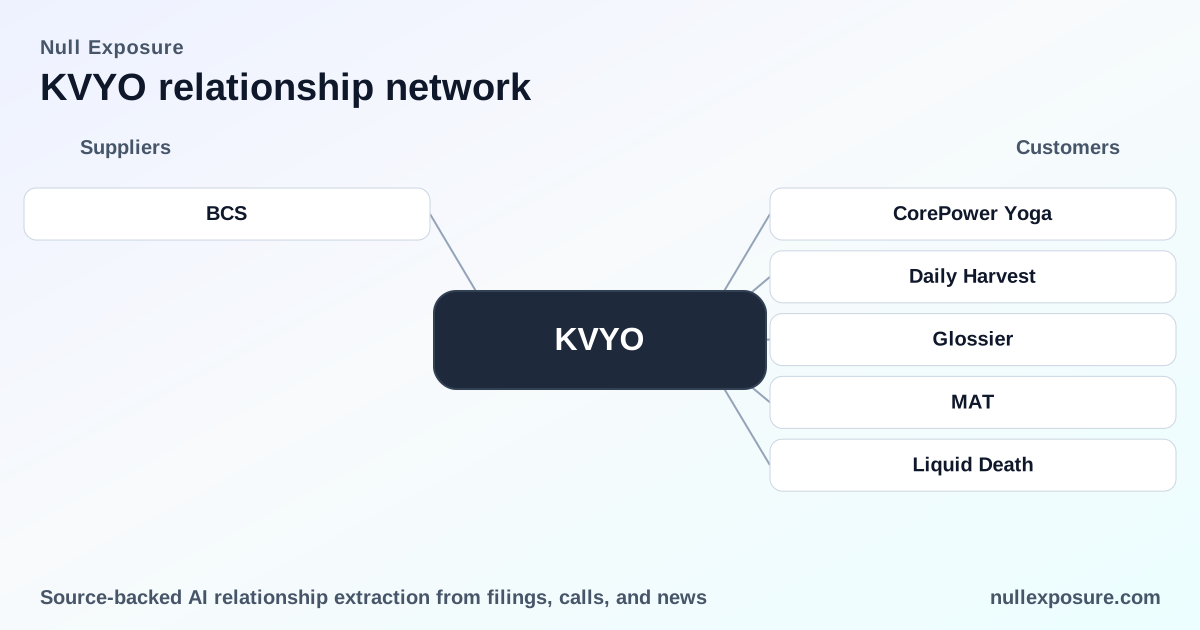
Klaviyo (KVYO) — Customer Relationships and Commercial Positioning
Klaviyo operates a cloud-based SaaS platform that helps consumer-facing brands orchestrate personalized email, SMS, WhatsApp and push campaigns; it monetizes primarily through subscription fees charged per customer for access to the platform and ancillary services. For investors, the critical lens is how broad, multi-tier customer adoption and short-term subscription billing interact with churn and expansion economics to determine top-line durability and margin leverage. For a deeper company-coverage roadmap visit https://nullexposure.com/.
Why customers drive Klaviyo's valuation case
Klaviyo’s value proposition is networked personalization: first-party data consolidation + execution across channels = measurable revenue uplift for clients, which in turn supports recurring subscription pricing and expansion revenue. The company reports a very large customer base—public materials reference over 176,000 brands—which creates scale benefits in product development, analytics, and a self-reinforcing sales motion where successful mid-market and enterprise customers validate higher-tier plans.
Key commercial dynamics for investors:
- Subscription monetization creates predictable recurring revenue but ties reported ARR to retention and net expansion rates rather than one-time deals.
- Monthly-dominant plans imply higher sensitivity to churn and seasonality than multi-year enterprise contracts.
- Diverse counterparty mix (SMB through enterprise) reduces single-buyer concentration risk while making unit economics heterogeneous across cohorts.
- Global footprint (Americas, EMEA, APAC) provides geographic diversification but requires localized go-to-market and compliance investments.
Operating model constraints and what they mean for risk/reward
From Klaviyo’s disclosures and corporate statements, several constraints shape commercial and operational risk:
- Contracting posture: subscription-first, often monthly. Company filings state revenue is generated through subscriptions and that the vast majority of plans are monthly, which increases cash flow volatility and emphasizes the importance of retention and expansion metrics as performance levers.
- Counterparty breadth across SME to large enterprise. Klaviyo intentionally serves entrepreneurs and SMBs while scaling up into mid-market and enterprise accounts; this breadth reduces concentration risks but requires differentiated product tiers and sales resources.
- Service-provider role on data. Klaviyo positions itself as a processor/service provider under privacy laws and relies on subprocessors, so privacy/compliance and uptime are operationally critical to customer trust and retention.
- Global revenue mix. Reported revenue line items highlight the United States, EMEA, and APAC contributions, implying regional go-to-market and regulatory exposures that affect margin realization and expansion priorities.
- Segment focus: software/SaaS. The core is cloud software and CDP/marketing capabilities, keeping capital intensity low but competitive pressure high from adjacent martech players.
Together these signals indicate an operating model that is highly scalable if retention and expansion hold, but sensitive to churn, privacy/regulatory incidents, and sales productivity across customer segments.
Customers and notable relationships referenced in public materials
The following customer mentions were repeatedly used in Klaviyo press materials and news coverage; each is summarized with source context.
Mattel (MAT)
Klaviyo lists Mattel among its brand customers, using the example to illustrate adoption by established consumer product companies and the platform’s relevance to large omnichannel marketers. A BizWire release republished on FinancialContent in October 2025 named Mattel among the companies using Klaviyo.
Source: BizWire distribution via FinancialContent, October 2025.
Takeaway: inclusion of a legacy large-cap consumer brand signals enterprise applicability beyond SMB use cases.
Daily Harvest
Daily Harvest is cited as a relationship-driven brand using Klaviyo to deliver personalized messaging and revenue-driving campaigns; press coverage during Klaviyo’s March 2026 secondary offering mentions Daily Harvest in a customer roster of 176,000+ brands.
Source: Yahoo Finance coverage of Klaviyo’s offering, March 2026.
Takeaway: direct-to-consumer food/meal brands exemplify Klaviyo’s strength in subscription and repeat-purchase categories where personalization monetizes efficiently.
Glossier
Glossier appears in multiple company press statements as a prominent client, underscoring Klaviyo’s traction in beauty and direct-to-consumer retail. The March 2026 offering materials and October 2025 BizWire distribution both list Glossier among headline customers.
Sources: Yahoo Finance (March 2026) and BizWire via FinancialContent (October 2025).
Takeaway: Glossier’s presence underscores that digitally native beauty brands use Klaviyo for sophisticated lifecycle marketing and CRM integration.
CorePower Yoga
CorePower Yoga is cited with other relationship-driven brands to demonstrate vertical breadth into wellness and services that manage memberships and class-based repeat behavior. The company’s press materials in March 2026 list CorePower Yoga among Klaviyo customers.
Source: Yahoo Finance coverage of Klaviyo’s offering, March 2026.
Takeaway: adoption in membership-based service businesses shows Klaviyo’s applicability beyond pure product e-commerce.
Liquid Death
Liquid Death is included by Klaviyo in multiple press lists as an example of a digitally native CPG brand using the platform for aggressive, unconventional marketing. Both the October 2025 BizWire repost and later press notices list Liquid Death among the roster.
Sources: BizWire via FinancialContent (October 2025) and 01net.it press item (May 2026).
Takeaway: presence of bold DTC brands reflects Klaviyo’s appeal to marketers prioritizing creative segmentation and analytics.
Notes on source consistency: multiple press releases and media reposts—Yahoo Finance (March 2026), BizWire/FinancialContent (October 2025), and 01net.it (May 2026)—reiterate the same customer roster of 176,000+ brands, providing consistent market messaging around scale.
What investors should watch next
- Retention and net revenue retention: monthly billing increases reliance on monthly retention and expansion; quarterly disclosures should prioritize cohort performance.
- Enterprise mix and contract terms: evolving share of multi-year enterprise deals would materially reduce churn risk and improve cash flow visibility.
- Privacy and subprocessor governance: as a processor for customer data, Klaviyo’s control of subprocessors and incident management is a direct operating risk to customer continuity.
- Geographic revenue trends: monitor APAC and EMEA growth relative to U.S. concentration to assess international penetration and margin pressures.
If you want ongoing tracking of how customer relationships and contract design feed into Klaviyo’s revenue durability and valuation, visit https://nullexposure.com/ for continuous monitoring and analyst-focused briefs.
Conclusion: Klaviyo’s broad customer base and subscription revenue model create a scalable monetization engine that rewards retention and expansion, while monthly billing and data-processor responsibilities are structural constraints that require active management to convert scale into stable free cash flow.