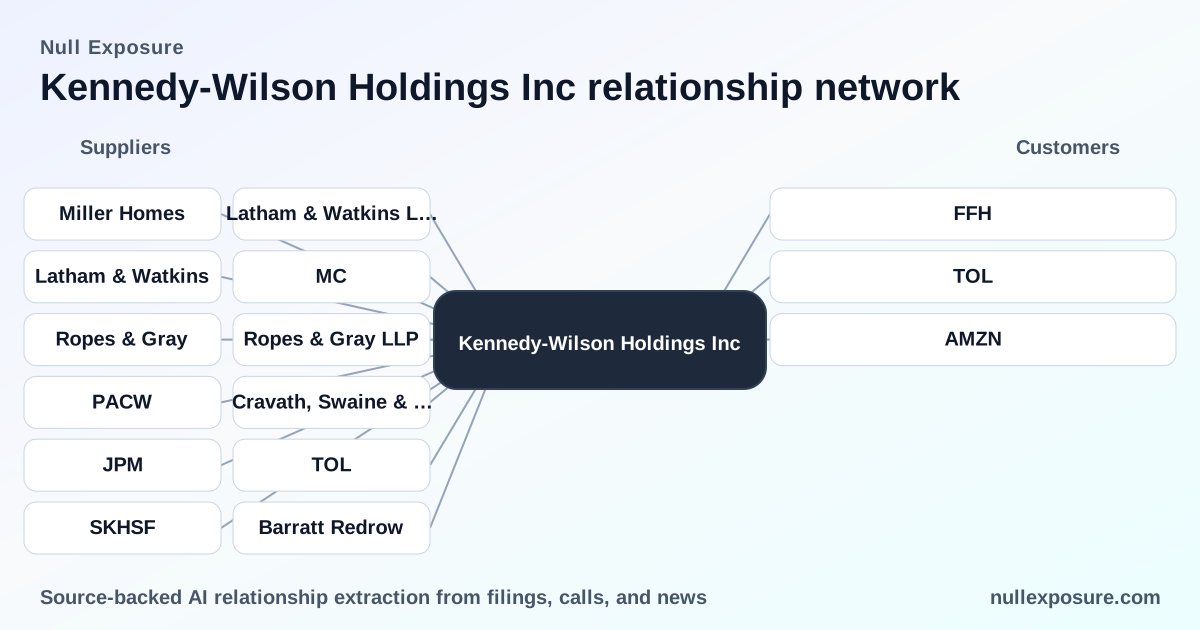
Kennedy-Wilson (KW): Customer relationships that reshape the business profile
Kennedy-Wilson is a dual-mode real estate business that earns recurring cash flows from property leasing and generates fee income as an asset manager by investing alongside clients and managing institutional capital. Recent deal-making—most notably a management-and-Fairfax-led take-private and large AUM wins—reconfigures both its capital structure and the durability of its customer cash flows. For an operator or investor evaluating Kennedy‑Wilson’s customer relationships, the key questions are how those relationships convert into stable management fees, concentrated counterparty exposure, and long‑dated lease receipts. Learn more at https://nullexposure.com/.
How Kennedy‑Wilson monetizes and how that shapes customer importance
Kennedy‑Wilson operates as an owner-operator and an investment manager. The company invests equity in rental housing and commercial properties and collects investment management and asset management fees on funds, co‑investments and separate accounts, typically tied to committed capital or NAV. Leasing revenue from owned properties supplies operating cash flow and long‑term lease payments underpin rent roll stability. According to Kennedy‑Wilson disclosures, the investment management platform generated $98.9 million of asset management fees in 2024, a material recurring revenue stream that places client relationships with institutional investors and developers at the center of cash‑flow forecasting.
This hybrid model produces four operating characteristics investors should treat as given:
- Contracting posture: long‑dated arrangements. Kennedy‑Wilson reports minimum lease payments due on leases with periods greater than one year, embedding long-term cash flow commitments from tenants and providing revenue visibility.
- Counterparty profile: large enterprise counterparties. The firm targets institutional investors across the U.S., Europe and Asia, which elevates the commercial quality and underwriting rigor of its client book.
- Geographic spread: North America and EMEA exposure. The company’s offices and investments span the U.S., UK, Ireland and select continental European markets, so client outcomes are sensitive to regional macro and regulatory dynamics.
- Revenue mix and maturity: asset management growth plus property cash flows. Fees in the $10m–$100m band reflect an asset management line of business at an established scale, while property operations deliver nearer‑term operating margin.
The customer relationships that matter now
Below I summarize every customer relationship item surfaced in public reporting and press coverage, with a one‑ to two‑sentence takeaway per relationship and a source reference.
Fairfax Financial Holdings (FFH) — consortium partner in take‑private (FY2026)
Kennedy‑Wilson agreed to be acquired in an all‑cash transaction by a consortium led by CEO William McMorrow together with Fairfax Financial Holdings, transferring control to a management‑led group with substantial Fairfax backing; the announcement framed this as a strategic exit at $10.90 per share. This transaction materially changes Kennedy‑Wilson’s public governance, liquidity for minority holders, and the capital base supporting its managed portfolios (Latham & Watkins announcement, March 2026; market commentary noting the $10.90 price, May 2026).
Sources: Latham & Watkins press release on the consortium transaction (March 2026); market reporting citing the $10.90 offer (May 2026).
Fairfax Financial — historical loan‑sale counterparty (FY2023)
In a prior, material transaction, Fairfax purchased a 95% interest in a portfolio of Kennedy‑Wilson’s U.S. construction loans in a deal valued at approximately $2.6 billion, demonstrating Fairfax’s deep capital relationship with Kennedy‑Wilson and a precedent for large balance‑sheet transfers. That 2023 transaction established Fairfax as a major financial counterparty to Kennedy‑Wilson and illustrates a pattern of capital recycling via third‑party balance‑sheet participation (Canadian Lawyer Magazine, FY2023).
Source: Canadian Lawyer Magazine coverage of the FY2023 construction‑loan sale.
Toll Brothers (TOL) — AUM and asset‑management mandate (FY2026)
A transaction with Toll Brothers added over $5 billion of AUM to Kennedy‑Wilson, including $1.9 billion from an 11% ownership interest across 18 properties and $3.4 billion in 21 properties that Kennedy‑Wilson will manage on behalf of Toll Brothers, materially expanding the fee base and scale of the firm’s multifamily and student‑housing management platform. This deal accelerates fee revenue growth and increases the company’s management exposure to one large residential developer (AIJourn, FY2026).
Source: Company reporting summarized in AIJourn on FY2026 results.
AMZN / Whole Foods — local joint‑venture equity and leasing relationship (FY2025)
Kennedy‑Wilson contributed $6.6 million for a 10% stake in a venture anchored by a Whole Foods tenant (Whole Foods is an Amazon subsidiary) and will act as asset manager for the venture, collecting standard management fees while controlling leasing and operations at the property level. This transaction combines equity skin with an asset management mandate and ties property cash flow to a single, high‑quality retail tenant (SeattleMedium coverage, FY2025).
Source: SeattleMedium report on the joint venture and asset management role (FY2025).
What the constraints tell investors about execution risk and strength
The public evidence provides company‑level constraints that influence how customer relationships translate to financial outcomes:
- Long‑term contracts are embedded. Reporting of minimum lease payments beyond one year signals a contracting posture that favors revenue stability and predictable tenant cash flows.
- Large enterprise counterparties dominate the client pool. Kennedy‑Wilson’s investor base targets institutional players in the U.S., Europe, Japan and the Middle East, which raises counterparty credit quality and reduces churn risk relative to a retail client mix.
- Geographic diversification across NA and EMEA reduces single‑market concentration but introduces regulatory and currency vectors that affect fee realization and asset valuations.
- Dual relationship roles: seller/lessor and service provider. The company acts as a landlord and as an asset manager simultaneously, which creates diversified revenue lines but also heightens operational complexity and potential conflicts of interest.
- Fee scale is material. With nearly $99 million of asset management fees in 2024, the services segment sits squarely in the $10m–$100m spend band, indicating a mature, institutional fee base that supports fixed costs and growth investment.
Investment implications — what to watch next
- Privatization changes valuation dynamics. The Fairfax‑led take‑private reduces public liquidity and removes near‑term market price discovery; management incentives and capital allocation will re‑center under private ownership.
- AUM accretive deals rebase recurring revenue. The Toll Brothers mandate meaningfully enlarges the fee runway and increases sensitivity to multifamily fundamentals.
- Counterparty concentration versus quality. Large, institutional customers reduce credit risk but increase exposure to a small set of counterparties; monitor client retention and contract renewal terms.
- Operational execution risk rises with dual roles. Managing owned assets while serving as an external manager increases conflicts and execution demands; governance under the consortium will determine control effectiveness.
- Regional exposure matters. EMEA and NA footprints provide diversification but require active currency, regulatory and macro management.
For a deeper read on how these customer relationships translate into recurring revenue and balance‑sheet mechanics, visit https://nullexposure.com/.
Conclusion: Kennedy‑Wilson’s customer relationships are shifting it from a public REIT‑style operator toward a privately‑held, manager‑centric business backed by deep financial capital. Investors and operators should treat the Fairfax partnership and the Toll Brothers AUM win as structural events that increase fee visibility while concentrating counterparty influence—outcomes that reward operational discipline and tight governance under the new ownership structure.