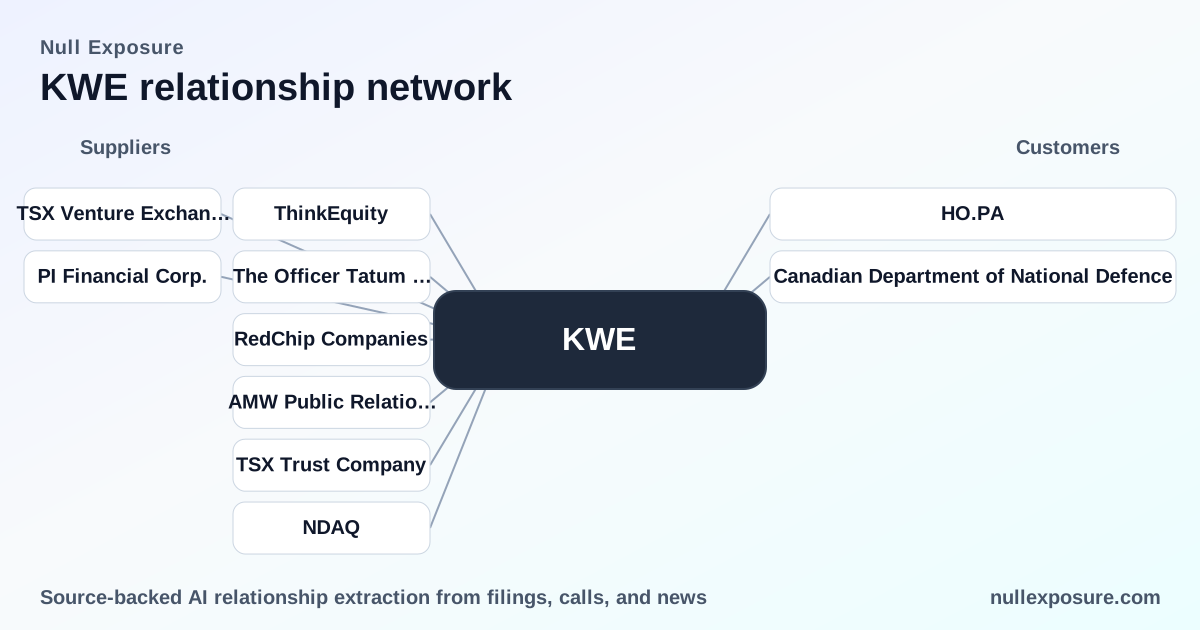
Kwesst Micro Systems (KWE): Customer Relationships — How contracts drive revenue and what investors should know
Kwesst Micro Systems designs and sells next‑generation tactical systems for military, security and personal‑defence markets and monetizes primarily through multi‑year government and contractor agreements, integration services, and follow‑on contract options. Revenue is generated by winning prime and subcontract awards, delivering hardware and systems integration, and capturing option years on multi‑year programs. For investors, the critical questions are contract cadence, partner dependency, and the size and duration of awards that convert into predictable top‑line streams.
For a concise, real‑time view of KWE’s customer map visit the company overview at https://nullexposure.com/.
How Kwesst converts engineering into cash
Kwesst operates as a defense contractor with a hybrid go‑to‑market model: it wins contracts directly with government customers and supplies components or integrated solutions through larger primes. The business model is transactionally driven — contract wins trigger lump‑sum revenue events — but the presence of multi‑year, option‑laden agreements increases revenue visibility once awards are secured. Customer concentration is high because large defense contracts dominate the pipeline; partner relationships are therefore strategic levers for access to prime procurement channels. Contracting posture is defense‑grade: emphasis on compliance, long procurement cycles, and option years that extend lifetime contract value. Execution maturity is improving as Kwesst moves from prototypes to deployable systems under multi‑year arrangements.
The customer relationships on record
The public record for KWE’s customer relationships includes four distinct entries sourced from company press releases and media reports. Each relationship is summarized below with the reporting source.
Thales Canada — prime partner on DND work
InvestorPlace reported that a Kwesst press release confirms Kwesst is working with Thales Canada as a subcontractor for the Canadian Department of National Defence, which positions KWE behind a large prime on government work and provides access to scaled procurement opportunities (InvestorPlace, FY2024).
Source: InvestorPlace coverage of Kwesst press release (FY2024) — https://investorplace.com/2024/06/why-is-kwesst-micro-systems-kwe-stock-up-121-today/
HO.PA — listed in the same press coverage linking KWE to Thales Canada
The same InvestorPlace article includes HO.PA in the context of the Kwesst press release, linking that ticker/name to the reported Thales Canada subcontract relationship; this indicates market reporting connects KWE’s DND engagement to entities named in public media (InvestorPlace, FY2024).
Source: InvestorPlace coverage referencing the Kwesst press release (FY2024) — https://investorplace.com/2024/06/why-is-kwesst-micro-systems-kwe-stock-up-121-today/
CounterCrisis Technology Inc. — three‑year GSAR ICS contract
KWESST announced a three‑year contract awarded by CounterCrisis Technology Inc. to design, develop and implement a core component of a national Ground Search and Rescue Incident Command System (GSAR ICS), which represents recurring multi‑year program revenue and an expansion into public safety/government systems integration (Newsfile press release, FY2026).
Source: KWESST press release reported on NewsfileCorp (FY2026) — https://www.newsfilecorp.com/company/7366/DEFSEC-Technologies-Inc.&pg=6?lang=fr
Canadian Department of National Defence — multi‑year strategic program exposure
KWESST’s corporate statement highlights strategic, multi‑year contracts tied to the Canadian Department of National Defence worth up to $75 million through 2028, delivered with industry partners Thales and Akkodis and including follow‑on option years; that contract scale materially shifts addressable revenue and positions KWE on multi‑year government programs (company release, FY2025).
Source: KWESST press release on NewsfileCorp announcing facility expansion and name change (FY2025) — https://www.newsfilecorp.com/release/256837/KWESST-Announces-Intention-to-Change-Corporate-Name-At-Opening-of-Expanded-New-Facility
What the relationship set tells investors about KWE’s operating model
- Contracting posture is partner‑centric and prime‑led. Multiple references to Thales and Akkodis demonstrate that KWE gains access to large DND procurement through established primes, which accelerates contract scale but increases dependency on partner dynamics.
- Concentration risk is material. Publicly disclosed revenue opportunities are dominated by a handful of government programs and prime partnerships, creating upside when awards are captured and downside if a prime wins but excludes KWE from scope.
- Customer criticality is high. Work tied to the Department of National Defence and national GSAR systems is mission‑critical, elevating the strategic importance and defensibility of delivered systems once qualified.
- Program maturity is advancing. Multi‑year awards and three‑year development contracts indicate a progression from R&D to operational procurement, improving revenue visibility as contracts move into option years and integration/delivery phases.
No explicit operational or contractual constraints were supplied in the records reviewed; this absence is itself a company‑level signal that public disclosures focus on awards and partnerships rather than granular delivery obligations or financial covenants.
Investor implications: what to watch next
- Revenue visibility will track contract conversions and exercised options. Large headline figures (for example, the referenced $75M opportunity through 2028) become real revenue only as option years are exercised and integration milestones are met.
- Partner dependency is both a growth enabler and concentration risk. Thales/Akkodis links accelerate access to DND programs but create single‑point dependency that can impact margins and pipeline control.
- Execution risk centers on systems integration and certification. Delivering to national defense standards drives cost, schedule and compliance pressures; successful milestone delivery is the primary driver of valuation re‑rating.
- Public safety contracts (GSAR ICS) diversify addressable markets beyond pure defense and increase the company’s relevance to civil agencies.
If you want continuing coverage that synthesizes contract awards, partner exposure and event‑driven valuation impacts, explore our analysis hub at https://nullexposure.com/.
Bottom line
Kwesst’s disclosed customer map shows a clear and concentrated revenue pathway driven by government contracts and prime partnerships. For investors, the portfolio of relationships — Thales Canada and Akkodis as prime partners, direct engagements with the Canadian Department of National Defence, and a three‑year systems contract with CounterCrisis — translates into meaningful upside if KWE executes on integration and option‑year exercises, and into concentrated risk if partner access or program deliveries falter. Monitor contract milestone delivery, exercised options, and any changes in prime relationships as the primary indicators of durable cash flow growth.