Quaker Chemical (KWR): Aerospace approvals strengthen an already global specialty-chemicals services franchise
Quaker Chemical (branded Quaker Houghton) manufactures and markets specialty industrial process fluids and provides chemical management services (Fluidcare) to heavy manufacturing sectors; the company monetizes through product sales, recurring chemical-management contracts, and distributor channels across a global footprint. Revenue mix combines direct sales and service-recurring streams, and the business benefits from OEM approvals that create high switching costs in critical metalworking and composites applications. For a quick company-wide view, see NullExposure.
Business model and operating posture
- Quaker Houghton operates as a manufacturer, seller, and service provider — supplying formulated fluids and delivering on-site chemical-management services that are recognized over time as services are performed. This creates a recurring revenue component tied to operational uptime at customer plants.
- The company is global and diversified by geography: non-U.S. subsidiaries accounted for roughly 63–65% of consolidated net sales over the past three years, and operations span the Americas, EMEA, and Asia/Pacific, supporting OEMs and large industrial clients.
- Concentration is modest: the five largest customers represented about 12% of consolidated net sales in 2024, with the largest single customer only about 3% of sales — indicating a low single-customer revenue dependency.
- Contracting posture and maturity: the mix of Fluidcare and direct sales, plus formal OEM approvals for products, implies mid-to-long-term commercial relationships and product qualification cycles that favor incumbents once approvals are obtained.
- Spend-band signal: Quaker’s customer economics generally place large accounts in a $10M–$100M annual spend band across multiple subsidiaries and divisions, consistent with industrial OEM procurement scales.
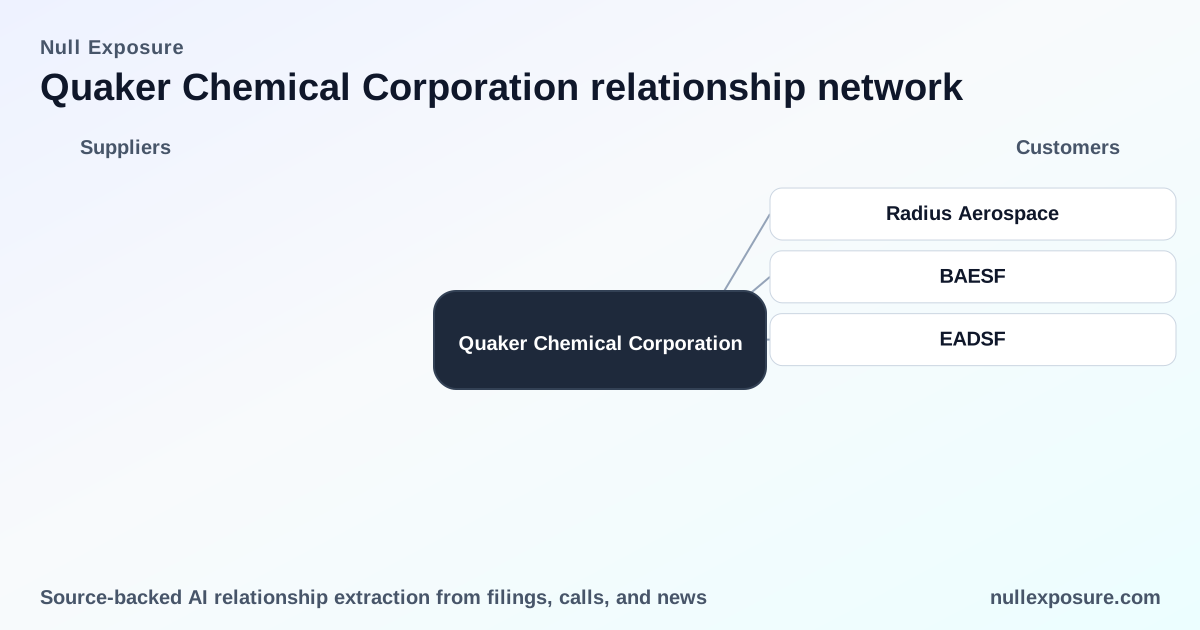
Customer relationship coverage (every relationship in the dataset) Below are every relationship identified in the data payload with a short, plain-English summary and a source citation.
-
Radius Aerospace — FY2026
Radius Aerospace selected Quaker Houghton as its supplier for industrial process fluids, leveraging Quaker Houghton’s track record with OEMs and Tier‑1 suppliers in aerospace manufacturing. Source: Aero Magazine, “The Power of Collaboration,” March 2026 (article referencing Radius Aerospace’s decision to turn to Quaker Houghton). -
BAESF (BAE Systems) — FY2026 (Aero Magazine piece)
Quaker Houghton announced that its HOCUT 4260 metalworking soluble coolant received additional global approvals from BAE Systems, expanding qualification coverage for aerospace grinding and machining applications. Source: Aero Magazine, “The Power of Collaboration,” March 2026 (approval mention for BAE Systems). -
BAE Systems — FY2026 (Aero Magazine piece)
The company publicized new approvals for HOCUT 4260 from BAE Systems as part of broader aerospace endorsement activity, enhancing Quaker Houghton’s position as a qualified supplier for defense and commercial aircraft manufacturing. Source: Aero Magazine, “The Power of Collaboration,” March 2026. -
BAESF (BAE Systems) — FY2025 (Approval under specification)
BAE Systems awarded HOCUT 4260 approval under specification BAE AMS AM00-00-01, covering grinding and machining for aluminium, steel, and titanium used in BAE and F‑35 manufactured components. This is a technical approval that supports sales into high-spec defense manufacturing. Source: Aero Magazine, “Quaker Houghton coolant receives approvals from aerospace leaders,” March 2025/2026 (approval detail). -
BAE Systems — FY2025 (Specification approval)
Under the same AMS specification, BAE Systems’ approval confirms HOCUT 4260 is qualified for critical aerospace alloys and processes, reinforcing product criticality for Tier‑1 and OEM machining lines. Source: Aero Magazine, “Quaker Houghton coolant receives approvals from aerospace leaders,” March 2025/2026. -
Airbus — FY2026 (Aero Magazine piece)
Quaker Houghton reported that Airbus granted additional global approvals for HOCUT 4260, broadening the coolant’s qualified use cases across Airbus manufacturing sites. Source: Aero Magazine, “The Power of Collaboration,” March 2026. -
EADSF (Airbus) — FY2025 (AIPS spec approval)
Airbus approved HOCUT 4260 under AIPS00-00-010 for machining plastics and composites — including PEEK, PTFE, and various reinforced materials — enabling Quaker Houghton to participate in composite machining workflows across Airbus production. Source: Aero Magazine, “Quaker Houghton coolant receives approvals from aerospace leaders,” March 2025/2026. -
Airbus — FY2025 (AIPS spec approval)
Airbus’s formal AIPS approval for composite and plastic machining confirms product suitability for advanced materials used across commercial aircraft assemblies, an important endorsement for market access. Source: Aero Magazine, “Quaker Houghton coolant receives approvals from aerospace leaders,” March 2025/2026.
What these customer relationships imply for investors
- Approval-driven revenue capture is strategic and sticky. OEM approvals from BAE Systems and Airbus are high-value gatekeepers: once a coolant or fluid is qualified under OEM specifications, the vendor gains privileged access to production lines and long procurement lead times. These approvals materially increase the product’s commercial criticality.
- Global footprint reduces single-market risk. With roughly two-thirds of sales generated outside the U.S., Quaker Houghton benefits from diversified geographic exposure; however, this also requires sophisticated regional supply and regulatory management.
- Channel mix balances direct recurring services and distributor reach. The company sells through direct Fluidcare programs (recurring service revenue) and through distributors, enabling scale and reach while preserving customer intimacy where Fluidcare is deployed.
- Concentration and spend profile point to stable, mid-size account economics. The top-five-customer share (~12% of sales) and the largest customer at ~3% imply no single counterparty dependency, yet the customer base includes multiple large enterprises whose procurement decisions can materially affect regional revenue trends.
- Operational risk is non-trivial but manageable. The company disclosed a past production interruption from an electrical fire at a North American facility in 2021, underscoring manufacturing operational exposure; the global manufacturing footprint and distributor channels help mitigate localized disruptions.
Key takeaways for investors
- Approvals from Airbus and BAE Systems materially enhance addressable aerospace revenue and create competitive barriers to entry for challengers.
- The business generates recurring, services-linked revenue (Fluidcare) that smooths cyclicality typical to commodity chemical sales.
- Geographic diversification and modest customer concentration reduce single-market and single-customer risk, though industrial end-market cyclicality and manufacturing incidents remain execution risks.
For additional relationship intelligence and structured customer coverage on KWR, explore the research hub at NullExposure for investor-oriented summaries and source-linked reporting.