Kymera Therapeutics (KYMR): Customer relationships that fund the pipeline
Kymera discovers small-molecule protein degraders and monetizes primarily through collaborative licensing agreements with large pharmas that pay upfronts, milestones and fund development while Kymera retains discovery-stage upside. Recent partner activity has converted discovery work into near-term cash milestones and shifted clinical development risk onto collaborators — a business model that converts scientific optionality into staged cash flows and de‑risking events for investors. For deeper customer intelligence on partner economics and revenue attribution, visit https://nullexposure.com/.
How Kymera’s commercial engine actually works
Kymera’s operating model is collaboration-first: the company discovers molecular glue and degrader candidates, signs option-and-license deals with large biopharma partners, and recognizes collaboration revenue as performance obligations are met. When a partner exercises an option, Kymera typically receives an option exercise fee or milestone, and the partner assumes responsibility for development, manufacturing and commercialization, leaving Kymera with potential downstream milestone and royalty upside. This contracting posture reduces Kymera’s capital requirements for advancing late-stage programs while concentrating near-term revenue on a small set of partnerships.
The partner roster in plain English
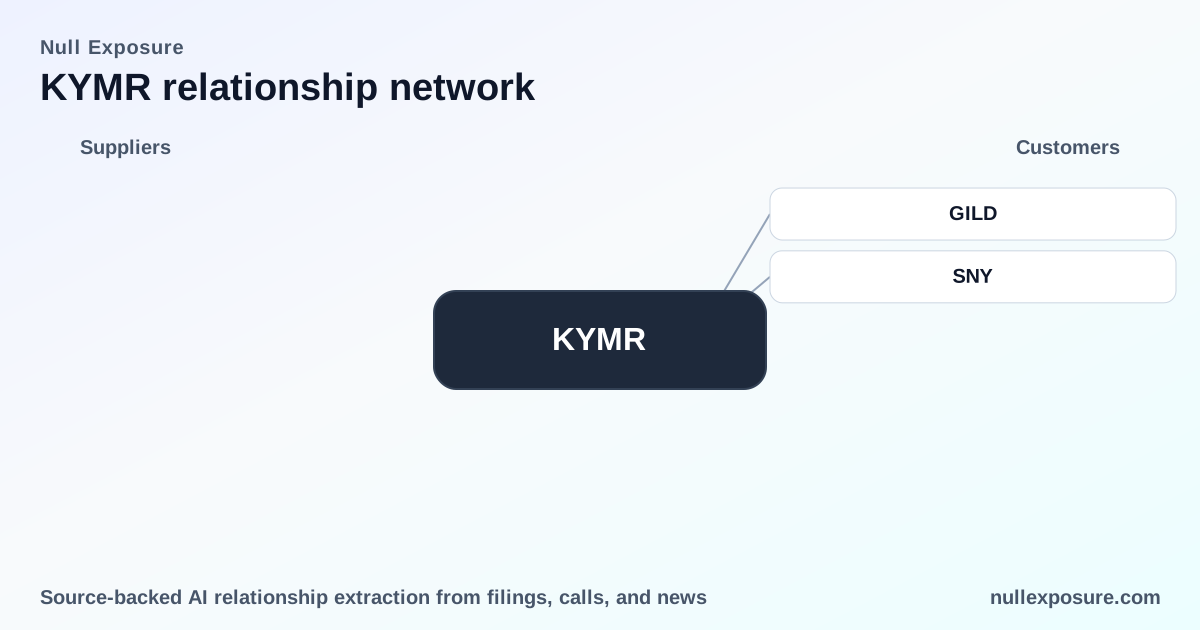
Below I cover every customer relationship cited in public reporting and media over the last year. Each entry is a short, plain-English summary with a source.
Gilead Sciences (GILD)
Gilead exercised its exclusive option to license Kymera’s KT-200, a first-in-class oral CDK2 molecular glue degrader, triggering a $45 million milestone payment to Kymera and moving the program into IND-enabling studies targeting an IND filing in 2027. Gilead will assume responsibility for further development, manufacturing and commercialization under the collaboration terms. (Reported in FierceBiotech and multiple market reports, May 2026; Kymera press releases summarized by InvestingNews, April 2026.)
Sanofi (SNY)
Sanofi is advancing KT‑485/SAR447971, an oral IRAK4 degrader discovered by Kymera, and selected the asset to progress into clinical studies; historic collaboration revenue recognition shows Sanofi accounted for prior-year collaboration payments to Kymera. (Noted in Kymera’s results and external coverage — TradingView and InvestingNews summaries of Kymera filings, March 2026; Finviz reporting on prior-quarter revenues.)
What those relationships imply for Kymera’s operating profile
Treat the partner set as the primary lever driving near-term cash and de-risking events. From the evidence above, several company-level characteristics are clear:
- Contracting posture — option-and-license model: Kymera pursues deals that allow partners to exercise options and then assume development responsibility, which generates discrete milestone receipts to Kymera while transferring late‑stage clinical and commercial risk to the partner.
- Revenue concentration — limited partner base drives reported collaboration revenues: Public filings and quarter commentary attribute the majority of collaboration revenue to Sanofi and Gilead, indicating high concentration of partner-derived income rather than broad, recurring commercial revenues.
- Criticality — partner advancement accelerates program maturity: When partners exercise options or select assets for clinical development (Sanofi advancing IRAK4; Gilead exercising KT‑200), Kymera receives cash and validation while losing on‑going operational control of those programs — a trade that accelerates de‑risking for investors but limits Kymera’s share of late-stage economics.
- Maturity profile — discovery-to-IND cadence: The partnerships demonstrate a clear pipeline cadence: discovery → option exercise → IND‑enabling studies/Phase I. Recent moves show programs progressing from discovery into IND enabling and Phase I within a timeframe that produces near-term milestones (2026–2027) rather than distant royalty tails.
Financial signals tied to partners
Kymera’s collaboration revenue profile and the Gilead milestone together illustrate the direct monetary impact of partner activity:
- Kymera reported collaboration revenue of roughly $39.2 million in a recent SEC filing summary, described as primarily attributable to the Sanofi and Gilead agreements. (TradingView summary of Kymera’s 10‑K reporting, March 2026.)
- The $45 million option exercise by Gilead is a discrete cash event that materially supplements Kymera’s near‑term cash flow; quarter commentary also attributed a $2.9 million Q4 collaboration recognition to Gilead. (FierceBiotech and InvestingNews coverage of the April 2026 announcement; earnings call transcript summaries, March 2026.)
These events show how partner milestones are the principal short‑term cash catalysts for the company.
Risks and operational constraints investors should price in
- Concentration risk: A small number of collaborators contribute the bulk of collaboration revenue, so partner decisions (option exercises, program prioritization) exert outsized influence on Kymera’s cash flow and reported revenue.
- Revenue punctuated, not recurring: Milestone payments are discrete and timing‑sensitive; revenue will be lumpy and tied to partner development calendars and strategic choices.
- Loss of control over late‑stage economics: Option exercises transfer development costs and execution risk to partners but also limit Kymera’s share of downstream commercial returns to milestones and tiered royalties.
- Clinical and timing execution: Partner selection to advance assets into clinical studies accelerates validation but also means Kymera’s valuation will track partner execution (IND filings, clinical readouts) rather than Kymera’s standalone trial execution.
Bottom line — what investors and operators should take from the partner set
Kymera has structured its model to convert discovery-stage scientific optionality into partner-funded milestones and de‑risking events. Gilead’s $45 million option exercise on KT‑200 and Sanofi’s advancement of KT‑485 into clinical work are the concrete manifestations of that strategy: cash inflows today and clinical progression handled by large pharmas. For investors, the stock’s near-term value drivers are partner milestones, IND timelines and the cadence of option triggers, not recurring product sales.
For actionable customer intelligence and trend tracking on partner payments and revenue attribution, see NullExposure’s research hub at https://nullexposure.com/. If you are evaluating customer concentration, partner milestone timing or the sequencing of INDs versus option payments, NullExposure provides primary‑source rollups and relationship-level alerts to support investment decisions.
Investors should weight the benefits of milestone‑driven de‑risking against concentration and timing risk when sizing positions in KYMR.