Kazia Therapeutics (KZIA): Licensing-first commercial strategy anchored in out‑licensing and milestone flows
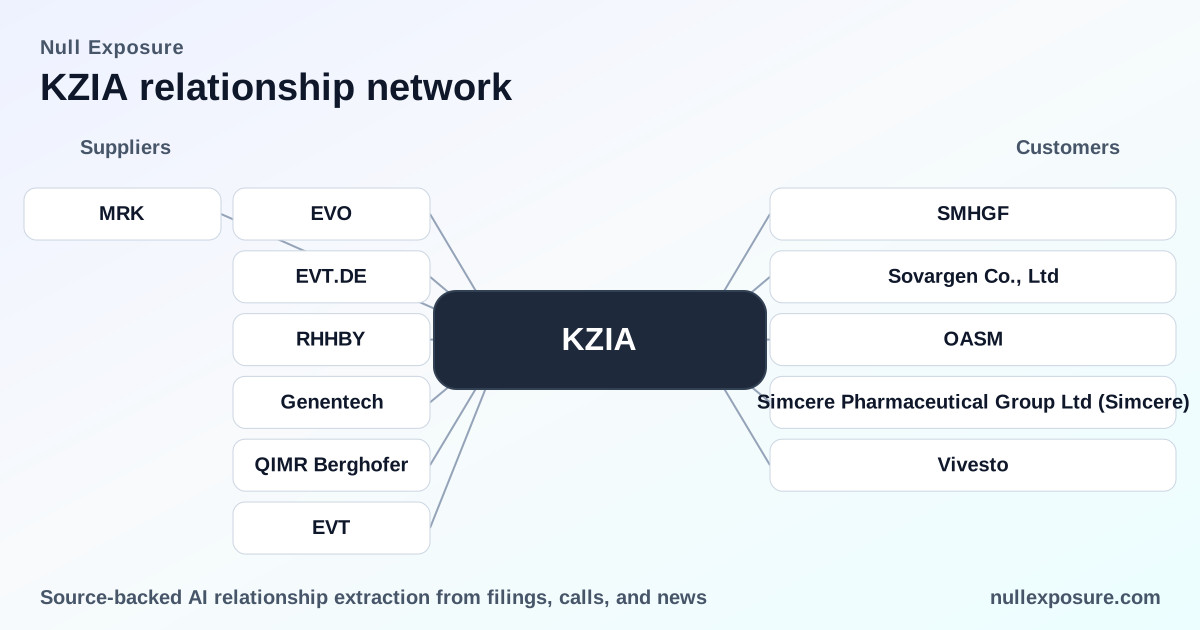
Kazia Therapeutics develops oncology-focused small molecules and monetizes primarily through strategic licensing agreements that transfer development and commercialization responsibilities to regional partners in exchange for upfront payments, milestones and royalties. For investors evaluating customer relationships, the company’s revenue mix is transactional and partnership-driven, with recurring cash generation dependent on partner execution and milestone realization rather than product sales from Kazia itself. For a consolidated view of partner exposure and contractual posture, see the roundup below — and for broader counterparty intelligence and monitoring, visit https://nullexposure.com/.
How to read Kazia’s partner map: licensing, regional rollouts and milestone economics
Kazia’s business model is concentrated around a small number of intellectual property assets (notably paxalisib and Cantrixil) and an outsized reliance on licensees to convert clinical progress into commercial economics. That model produces lumpy revenue (upfronts and milestones), low near‑term operating income, and outsized sensitivity to partner regulatory and commercial execution. A mid‑cap biotech with limited in‑house commercialization, investors should treat partnership announcements as the primary value catalysts.
For fast access to mapped relationships and monitoring tools, check https://nullexposure.com/ for ongoing partner tracking.
Relationship rundown — every result in the record, one by one
SMHGF (PR Newswire announcement; fiscal note FY2021)
Kazia announced a licensing agreement granting rights to develop and commercialize paxalisib in Greater China to a partner reported under the symbol SMHGF, positioning the company to capture upfront and regional milestone payments while offloading local development and commercialization risk. Source: PR Newswire release reporting the Greater China paxalisib license (FY2021).
Sovargen Co., Ltd (PR Newswire; fiscal note FY2024)
Kazia entered an exclusive license with Sovargen to develop, manufacture and commercialize paxalisib for intractable epilepsy indications (focal cortical dysplasia type 2 and tuberous sclerosis complex), extending paxalisib’s indication set beyond oncology and creating a non‑oncology revenue pathway via indication expansion. Source: PR Newswire announcement (FY2024).
Simcere Pharmaceutical Group Ltd (PR Newswire; fiscal note FY2021)
Kazia licensed paxalisib rights in Greater China to Simcere, which centralizes regional regulatory responsibility and establishes a commercial partner expected to fund development in that market while Kazia retains upside through contingent payments and royalties. Source: PR Newswire release on the Greater China licensing deal (FY2021).
Oasmia Pharmaceutical AB (BioSpace; fiscal note FY2021)
Kazia granted Oasmia rights to Cantrixil with an upfront payment of USD 4 million, contingent milestones up to USD 42 million, and double‑digit royalties, signaling Kazia’s use of milestone‑based monetization for its non‑core assets. Source: BioSpace coverage detailing the Cantrixil license (FY2021).
OASM (BioSpace; fiscal note FY2021)
The same Cantrixil transaction is reported using the ticker OASM, confirming the commercial assignment to Oasmia and reiterating the same financial architecture — modest upfront, material upside through milestones and royalties on commercial sales. Source: BioSpace article referencing the Cantrixil license (FY2021).
Simcere (BioSpectrumAsia; fiscal note FY2021)
Regional press coverage likewise reported Kazia’s Greater China licensing of paxalisib to Simcere, which reinforces that Greater China is a structurally outsourced market for Kazia and that partner selection includes listed regional pharma groups with local commercial capabilities. Source: BioSpectrumAsia report (FY2021).
Vivesto (BioSpace press release; fiscal note FY2025)
Vivesto licensed exclusive global development and commercialization rights for Cantrixil from Kazia in March 2021, another example of Kazia extracting near‑term non‑dilutive funding through global out‑licensing of select candidates. Source: BioSpace press release highlighting the Cantrixil licensing (FY2025).
What these relationships reveal about Kazia’s operating model and risk posture
- Contracting posture: Kazia operates in a licensing‑first posture — transferring regulatory, manufacturing and commercial responsibilities to third parties while retaining financial upside via upfronts, milestones and royalties. That reduces Kazia’s fixed commercial cost base but increases counterparty dependency for value realization.
- Revenue concentration and lumpy economics: The company’s reported Revenue TTM (~USD 1.9m) and market capitalization (~USD 153.7m) indicate current revenues are small and episodic, driven by discrete licensing cash flows rather than product sales. Investor returns will be binary and milestone‑driven.
- Criticality and counterparty selection: Partners named (Simcere, Oasmia, Sovargen, Vivesto) are regional specialists or developers that assume critical roles in their territories or indications, making partner performance a primary driver of Kazia’s success.
- Maturity and strategic focus: The pattern of deals — multiple out‑licenses of different assets and indication expansion through specialist partners — signals a small biotech focused on de‑risking assets through partnerships rather than building in‑house commercialization infrastructure.
- Absence of explicit constraints: There are no constraint excerpts provided in the available relationship record; that absence is a company‑level signal indicating limited third‑party constraint data in this feed, not an assertion about contractual terms or exclusivity beyond what the press releases describe.
Investment takeaways — where value and risk concentrate
- Value drivers: Continued milestone receipts and successful regional regulatory/commercial progress by licensees (especially for paxalisib in Greater China and indication expansions like CNS disorders) are the immediate value catalysts.
- Key risks: Kazia’s upside is contingent on partner execution; missed development or regulatory timelines by licensees can delay or eliminate milestone payments. The company’s small revenue base and negative operating margins highlight cash sensitivity absent further licensing or financing.
- Balance sheet and multiple expansion: Market valuation implies high optionality relative to trailing revenue; investors should price in binary outcomes tied to partner milestones rather than steady revenue growth.
Bottom line
Kazia’s investor thesis is simple and clear: a licensing‑centric biotech that monetizes innovation through regional and indication‑specific partners. That model preserves capital and upside but concentrates risk in a handful of counterparties and milestone events. For operators and researchers tracking counterparties and contract flow, these relationships define the commercial runway for paxalisib and Cantrixil and should be the focus of due diligence.
For continuous partner tracking and a structured view of counterparty exposure, explore the platform at https://nullexposure.com/.