Kezar Life Sciences (KZR): Strategic customer and asset dispositions reshape value capture
Kezar Life Sciences operates as a clinical-stage small-molecule biotechnology company focused on immune-mediated disease and oncology; the company monetizes through licensing, asset sales and strategic M&A rather than product sales, generating upfront license proceeds, milestone-contingent receipts and, most recently, acquisition consideration. Recent transactions — an announced acquisition by Aurinia Pharmaceuticals and the sale of Sec61 assets to Enodia coupled with an Everest Medicines collaboration — reconfigure Kezar’s cash position and risk profile and materially affect investor return pathways. For a concise corporate intelligence view, visit https://nullexposure.com/.
Why the deal flow matters for investors
Kezar’s capital and return story is now transaction-driven: value is realized through exit events (asset sales and acquisition) and contingent payments tied to clinical progress rather than recurring revenue. The combination of an outright corporate acquisition and earlier asset monetizations compresses time-to-liquidity for shareholders, increases near-term cash inflows and concentrates future upside into a smaller set of development pathways (notably zetomipzomib CVR and Everest-related rights).
What these relationships reveal about Kezar’s operating posture
- Contracting posture: Kezar executes asset sales and collaborations to de-risk balance-sheet exposure and convert preclinical and early-stage assets into cash and contingent upside.
- Concentration: A large portion of shareholder value is now concentrated in a small number of counterparty agreements (Aurinia acquisition terms and Everest/Enodia deals).
- Criticality: The Sec61 asset sale divests a preclinical pillar of discovery-stage optionality while the zetomipzomib-related CVR embeds development-critical upside in the Aurinia transaction.
- Maturity: The company is transitioning from a research/clinical-stage rare biotech into an entity whose near-term maturity is defined by transactional milestones and integration into a larger biopharma (Aurinia).
Complete relationship review (each relationship covered)
Aurinia Pharmaceuticals — definitive merger agreement and acquisition consideration
Aurinia agreed to acquire Kezar for $6.955 in cash per share plus a non-transferable contingent value right (CVR) that entitles Kezar shareholders to potential payments linked to the clinical development or disposition of zetomipzomib, proceeds from the Everest collaboration and Kezar’s closing net cash above $50 million (net of CVR expenses). According to CityBiz and corroborated in market reports, the deal is structured as cash plus CVR consideration and was announced in early May 2026 (CityBiz, May 2026; Investing.com, May 2, 2026).
Enodia Therapeutics — purchase of Sec61-based discovery and development program
Enodia acquired Kezar’s Sec61-focused portfolio, including the preclinical candidate KZR‑261, for $1 million upfront and up to $127 million in milestone payments under an asset purchase agreement; some reports characterize the total consideration as approximately $130 million. The asset sale transfers Sec61 discovery assets out of Kezar’s balance sheet and converts preclinical optionality into structured contingent liabilities and upfront cash (PharmiWeb press release, March 12, 2026; BioCentury and FierceBiotech coverage, May 2026).
Everest Medicines — license/collaboration revenue and upfront payment
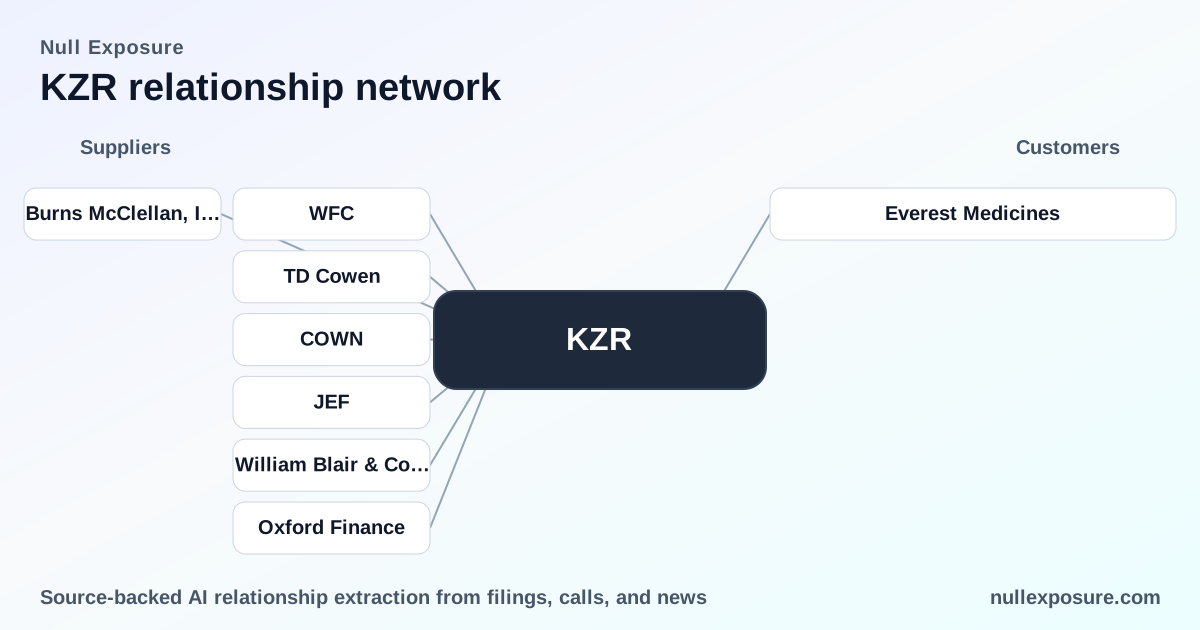
Kezar recognized collaboration revenue originating from an upfront payment under a license agreement with Everest Medicines, with potential future milestone and royalty streams tied to development and commercialization success. This contract supplied non-dilutive, near-term cash and aligns Kezar to a partner responsible for later-stage development and ex‑US commercialization (TradingView summary of Kezar SEC 10‑Q, March 2026).
How these transactions alter investor outcomes
The Aurinia acquisition converts equity value into immediate cash consideration and contingent upside via CVR, creating a distinct liquidity event for shareholders while preserving contractual upside for specific programs. The Enodia transaction removes a preclinical discovery platform from Kezar’s internal pipeline but converts that optionality into structured milestone payments and upfront proceeds. The Everest license is a classic biotech approach to monetize rights regionally, providing upfront cash and potential downstream royalty streams that will no longer depend on Kezar’s internal development capacity.
Key takeaway: investors should treat KZR’s remaining upside as concentrated in CVR-linked development milestones and third‑party development outcomes rather than in a diversified internal pipeline.
Financial and governance context that matters to buyers and partners
Kezar shows characteristics typical of small-cap clinical-stage biotech: market capitalization around $54.6 million, negative EBITDA and operating losses, and no recurring product revenue (company filings through FY2025/2026). Institutional ownership stands above 60% and insiders retain roughly 15.8% of the float, creating a share register where institutional influence and insider alignment are material to transaction outcomes (company overview). Analysts have a median target near $6, which closely tracks the announced transaction consideration and frames market consensus around the acquisition valuation.
Operational risks and upside drivers for investors
- Risk — concentration of upside: The CVR and milestone structure centralize upside in a small number of development readouts and partner actions.
- Risk — pipeline shrinkage: Selling Sec61 assets reduces Kezar’s internal discovery breadth, shifting future optionality to third parties.
- Upside — de‑risked balance sheet and liquidity: Upfront payments and acquisition consideration materially improve cash position and accelerate shareholder realization events.
- Upside — contingent multipliers: Well-structured milestone payments and royalties (Enodia and Everest) preserve asymmetric upside if partners advance programs successfully.
Constraints and company-level signals
No explicit contractual constraints were present in the provided relationship payload; as a company-level signal, the absence of disclosed covenants or encumbrances in these summaries suggests Kezar had operational flexibility to negotiate asset sales, a full corporate disposition and licensing without disclosed legal encumbrances. Investors should verify filing-level detail for any hidden indemnities or escrow arrangements, but transaction press coverage and SEC references indicate straightforward asset and stock transaction mechanics.
For ongoing monitoring and tailored counterparty risk analysis, visit https://nullexposure.com/ to view structured relationship intelligence and alerts.
Bottom line for investors evaluating KZR counterparty posture
Kezar’s recent counterparty activity transforms the company from a pure R&D biotech into an entity defined by monetization transactions and a near-term acquisition exit. Investors should value KZR primarily on announced deal economics, CVR mechanics and partner execution risk rather than on internal revenue growth, and update probability-weighted scenarios to reflect concentrated upside through Aurinia’s CVR, Enodia milestones and Everest-derived royalties.