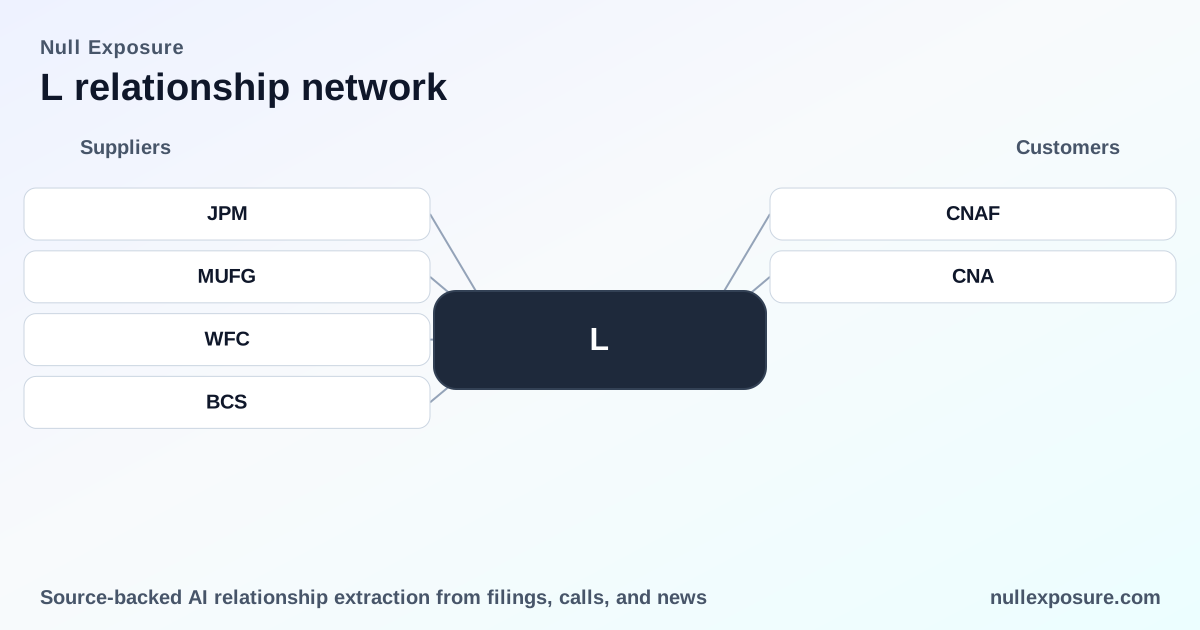
Loews Corp (L): Customer Relationships and What They Signal for Investors
Loews Corporation is a diversified holding company that monetizes through majority and controlling stakes in insurance (CNA Financial), energy midstream (Boardwalk Pipelines), offshore services (Diamond Offshore), hospitality (Loews Hotels) and packaging (Altium). The conglomerate’s cash flow profile leans on insurance underwriting and investment income from CNA, plus fee-based pipeline and hospitality revenues that include a meaningful proportion of long-term contracted receipts. For investors focused on counterparty concentration and contract durability, the CNA relationship and Boardwalk’s long-term transport contracts are the two dominant customer dynamics to monitor. Visit https://nullexposure.com/ for deeper relationship analytics and tagging across Loews’ holdings.
Why Loews’ customer footprint matters to valuation
Loews is not a pure-play insurer or pipeline operator: it is a parent company whose value derives from how its operating subsidiaries are contracted, concentrated and capitalized. Revenue durability is split between insurance premiums (variable, actuarial) and service-based, contract-backed cash flows (stable, predictable). That hybrid model underpins Loews’ lower beta and below-market cyclicality while leaving idiosyncratic exposure to underwriting cycles at CNA and project execution at Boardwalk.
- Contracting posture: Boardwalk’s business emphasizes long-term firm capacity agreements that lock in cash flows for multi-year horizons, while CNA’s revenue is primarily premium and broker-distributed, exposing Loews to underwriting volatility.
- Concentration and criticality: CNA contributes the majority of consolidated revenue, so underwriting performance and capital support for CNA are core valuation drivers.
- Geography and customer mix: The operating footprint tilts North American for physical assets, while insurance distribution is global through agents and brokers—producing diversified revenue channels but concentrated underwriting risk.
What the recent headlines say about CNA and Loews’ support
Loews’ customer relationships captured in recent coverage are concentrated on CNA Financial; the items below cover every mention in the results set.
AM Best upgrade highlights parental support (ReinsuranceNews, Mar 10, 2026)
AM Best’s upgrade commentary emphasized the positive view of CNA’s supportive ownership and historical financial backing from Loews Corporation, which holds a roughly 92% ultimate stake in the captive structure, reinforcing that Loews’ balance sheet is a recognized credit anchor for CNA. (ReinsuranceNews coverage of AM Best action, Mar 10, 2026 — https://www.reinsurancene.ws/am-best-upgrades-credit-ratings-of-cna-financial-and-subsidiaries/)
Corporate filing language reiterates Loews’ backing for CNA (ReinsuranceNews, Mar 10, 2026)
The same AM Best note quoted in market coverage reiterated that CNA’s rating benefits from Loews’ diversified ownership and historical capital support, an explicit signal that parent-level liquidity and capital allocation decisions matter materially to CNA’s solvency profile. (Market reporting on AM Best, Mar 10, 2026 — https://www.reinsurancene.ws/am-best-upgrades-credit-ratings-of-cna-financial-and-subsidiaries/)
Quarterly results flag CNA underwriting pressure and revenue concentration (WIMZ, Feb 9, 2026)
Loews’ quarterly commentary and third-party reporting emphasize that most consolidated revenue is generated by CNA Financial, where underwriting weakness drove headline softness in the quarter, drawing investor attention to underwriting margin trends. (WIMZ report on Loews quarterly results, Feb 9, 2026 — https://wimz.com/2026/02/09/loews-reports-quarterly-weakness-on-cnas-underwriting-woes/)
Investor note on revenue concentration: CNA is the top revenue engine (WIMZ, Feb 9, 2026)
Analysts cited by the report show that Loews’ revenue profile is dominated by CNA, with Loews owning more than a 90% stake and consolidated results tied to the insurer’s performance, underlining why CNA’s underwriting cycle and claims experience drive short-term earnings volatility. (WIMZ coverage, Feb 9, 2026 — https://wimz.com/2026/02/09/loews-reports-quarterly-weakness-on-cnas-underwriting-woes/)
Constraints that define Loews’ customer operating model
Loews’ relationship data and supporting excerpts reveal a mix of firm-contract revenue, scale customers, and service-provider roles that together define risk and optionality:
- Long-term, firm contracts are a material source of cash flow. Boardwalk Pipelines reports that a large share of revenue is derived from capacity reservation fees under executed precedent or long-term firm transportation agreements, with explicit growth projects tied to contracted volumes and billions of dollars of anticipated revenue under those agreements. This is a company-level signal that the midstream asset base provides durable, predictable cash flows.
- Usage-based revenue exists but is secondary. Boardwalk also operates interruptible and usage-based services alongside firm contracts, creating a blended revenue stream that can flex with demand cycles.
- Counterparty mix spans small to large enterprises. CNA distributes products through agents, brokers and MGUs to a broad client base—small businesses through large enterprises—producing diversification in end markets but concentrated underwriting risk at the company level.
- Geographic footprint is predominantly North American with global insurance reach. Physical operations (pipelines, hotels) are US-centric, while insurance distribution is international, giving Loews both domestic asset stability and global underwriting exposure.
- Service provider posture vs. principal operations. Subsidiaries act as service providers (pipeline transportation, hotel management) and principals (insurer underwriting), a dual posture that tempers capital intensity in some segments while amplifying capital needs in insurance.
- Spend and revenue buckets run large. The filings and roll-ups reference material revenue lines such as Boardwalk’s transportation and storage entry and a non-insurance warranty line tied to CNA Financial—each listed in the filings with figures cited as $2,263 and $1,577 respectively—indicating high-value intercompany and customer contracts that support consolidated revenue.
Investment implications: what drives upside and what to watch
Loews’ valuation compresses and expands with two primary drivers: CNA underwriting performance and Boardwalk’s contracted cash flows. The current mix gives investors a defensive tilt via contract-backed midstream cash flows and hotel management fees, offset by the cyclicality of insurance results.
- Upside catalysts: sustained improvement in CNA combined ratio, realization of Boardwalk growth projects that add contracted capacity, and disciplined capital returns enabled by strong consolidated cash generation.
- Key risks: persistent underwriting losses at CNA that erode surplus, project execution delays or cost overruns at Boardwalk, and concentrated revenue exposure to a single insurance platform that dominates consolidated top-line.
Bold takeaway: investors should treat Loews as a conglomerate whose credit and valuation are heavily influenced by one operating kingpin—CNA—while Boardwalk’s long-term contracts underwrite a layer of cash-flow stability.
For a detailed breakdown of subsidiary-level customer exposures and contract tenors, see our relationship dashboards at https://nullexposure.com/.
Bottom line
Loews is a capital allocator whose equity value hinges on insurance underwriting outcomes and the realization of contract-backed midstream cash flows. The public reporting and market coverage consistently emphasize parental support for CNA and the predominance of CNA in consolidated revenue, while Boardwalk’s long-term firm agreements represent a counterbalancing source of durable cash. Investors evaluating Loews should prioritize monitoring CNA’s underwriting margin and capital position, alongside Boardwalk’s project execution and contract backlog, to anticipate near-term earnings volatility and longer-term valuation inflection points.