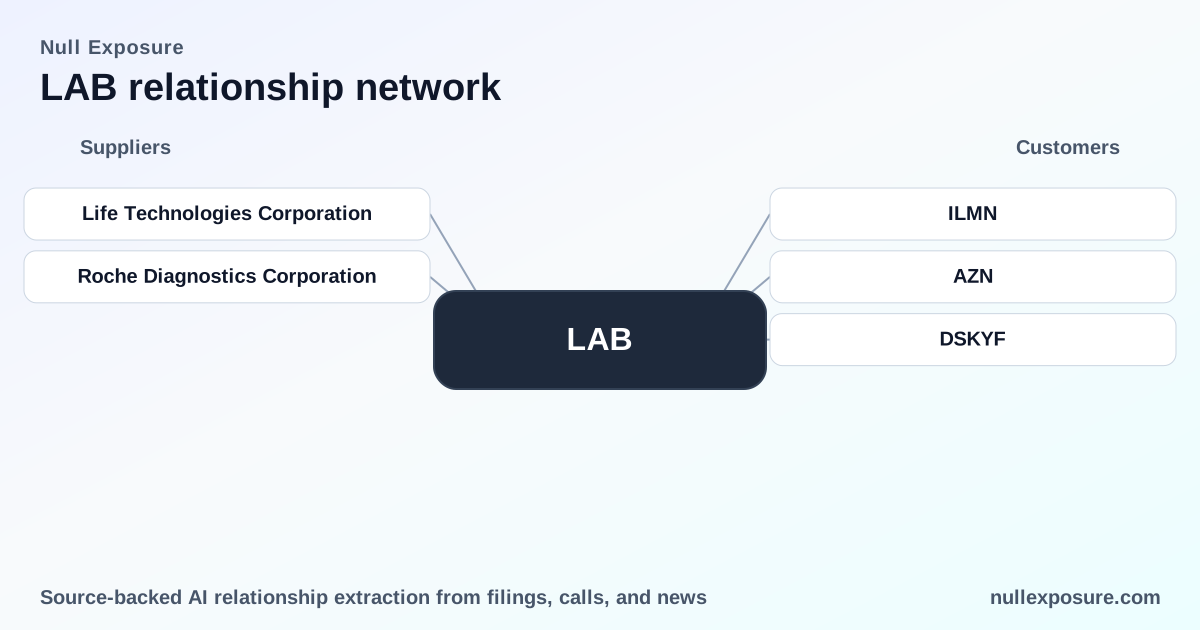
Standard BioTools (LAB): Customer relationships after the SomaLogic divestiture
Standard BioTools operates and monetizes through a three-legged commercial model: it sells instrumentation and consumables, licenses technologies and collects royalties, and provides lab and field services (including the SomaScan assay until its sale). The company captures revenue from recurring consumables and multi-year service contracts while also monetizing intellectual property through licensing and milestone payments—an approach that produces a mix of product, services and licensing cash flows. For investors and operators, the recent divestiture of SomaLogic reshapes cash reserves and partner exposure while concentrating the core business on mass cytometry and microfluidics hardware, consumables and services.
(Explore more on NULL Exposure: https://nullexposure.com/)
Why the Illumina transaction matters for customers and capital structure
Standard BioTools completed a strategic sale of SomaLogic to Illumina that delivered $350 million in upfront cash and up to $75 million in near-term earnouts, plus specified royalties. This transaction materially strengthens Standard BioTools’ balance sheet and removes the direct operating and commercial responsibilities for SomaScan from Standard BioTools’ customer relationship book. According to the company’s January 30, 2026 press release, the deal closed with the cash and earnout structure noted above (GlobeNewswire / PR Newswire, January 30, 2026). This is the defining customer/partner event in the dataset and transforms how investors should view LAB’s exposure to proteomics-as-a-service revenues going forward.
- Key takeaway: the Illumina deal converts a customer-service and IP position into near-term cash and potential royalty streams, reducing operating overhead and shoring liquidity (GlobeNewswire, Jan 30, 2026).
How Standard BioTools sells and serves customers (company-level business model signals)
Standard BioTools’ customer and contracting posture shows a mix of licensing, multi-year service contracts, and product sales through direct and distributor channels. Company disclosures describe license and royalty revenue recognized when customers can use the licensed IP, and field services revenue recognized on a time-elapsed basis over one- to four-year service contract terms. The business is global, with roughly half of recent revenue generated outside the U.S., and customers span government, academic/non-profit, pharmaceutical and biotech labs. The firm operates across hardware, services and software lines—each with different margin dynamics and contractual maturity.
- Operational constraints and implications: licensing generates high-margin but lumpy income; long-term service contracts produce predictable recurring revenue and tie-up installed base economics; distributor channels extend reach but dilute control; global sales increase market opportunity and regulatory complexity. These are company-level signals drawn from the firm’s revenue recognition and customer descriptions.
Relationship inventory: every counterparty referenced in the public record
Below I cover each counterparty cited in the available results with a concise summary and a readable source reference.
Illumina / ILMN / Illumina, Inc.
Standard BioTools completed the sale of SomaLogic to Illumina for $350 million in cash at closing plus up to $75 million in additional near-term earnouts and specified performance-based royalties, transferring the SomaScan business and related assets to Illumina and converting an operating asset into cash and contingent payments. This divestiture closed in January 2026, and company filings and press releases note that subsequent financial statements reflect continuing operations excluding SomaLogic (GlobeNewswire and PR Newswire, Jan–Feb 2026; Investing.com reporting, 2026).
AstraZeneca / AZN
AstraZeneca is cited in Standard BioTools’ earnings commentary as a collaborator in clinical research where the SomaScan assay demonstrated predictive potential for serious lung complications associated with cancer treatment—an example of how enterprise customers and pharma partners used SomaScan data in translational and clinical studies (Standard BioTools 2025 Q1 earnings call transcript, 2025Q1).
Daiichi Sankyo / DSKYF
Daiichi Sankyo is referenced alongside AstraZeneca in the company’s discussion of clinical trials: joint or parallel Phase II/III research used SomaScan outputs to explore biomarker-driven safety and monitoring endpoints, indicating pharma-level adoption of the assay in development-stage programs (Standard BioTools 2025 Q1 earnings call transcript, 2025Q1).
What these relationships imply for investors and operators
-
Revenue profile shift. The Illumina sale removes direct lab-services revenue associated with SomaScan and substitutes cash, contingent milestones, and royalties—improving near-term liquidity but reducing recurring services revenue. Company releases around February 2026 explicitly state that financials were restated to reflect continuing operations after the SomaLogic sale (GlobeNewswire, Feb 24, 2026).
-
Customer concentration and criticality. Prior traction with major pharma (AstraZeneca, Daiichi Sankyo) demonstrates commercial validation of the SomaScan technology in high-value clinical programs, but the divestiture transfers those downstream customer relationships to Illumina for the SomaScan product line. For the remaining core business (mass cytometry and microfluidics), Standard BioTools retains relationships across academic, government and industry labs—a diversified buyer base that supports recurring consumable sales and multi-year service contracts (company disclosures on customer types and global revenue mix, 2024–2025).
-
Contracting posture and maturity. The company operates a mix of licensing and long-term service contracts (typically one to four years) that produce both predictable revenue streams and episodic licensing milestones—an important duality for cash flow forecasting. Licensing revenue recognition language in filings confirms that license transfers generate discrete recognition events while field services recognize revenue over time.
-
Distribution and go‑to‑market. Standard BioTools sells through a direct sales force and distributors in select territories, balancing control of high-value accounts with broader geographic coverage via partners. Distributors reduce marginal sales cost but increase exposure to channel dynamics.
Risk and opportunity—what to watch next
-
Watch royalties and earnouts from Illumina. The near-term earnouts and royalty terms tied to the SomaLogic sale are a liquidity upside; track disclosures and Illumina’s commercial rollout of SomaScan products for realized payments (GlobeNewswire / PR Newswire, Jan 2026).
-
Focus on core margins. With the SomaLogic asset off the balance sheet, profitability hinges on hardware consumable sell-through, improved manufacturing efficiency, and services margin expansion. The company reported negative operating margins in trailing metrics, making operational discipline essential (company TTM figures, 2025).
-
Monitor enterprise adoption in pharma. Ongoing use cases in oncology and safety monitoring referenced with AstraZeneca and Daiichi Sankyo validate the scientific utility of the platform, which is a sales lever for other customers even after the divestiture (earnings call, 2025Q1).
If you want a compact, comparable map of LAB’s customer relationships and how they feed into cash flow and risk profiles, see our broader coverage at https://nullexposure.com/ — the platform houses relationship-level summaries and primary-source links for quick diligence.
Bold, verifiable events—particularly the Illumina acquisition of SomaLogic—reframe Standard BioTools’ customer exposure from operating lab services to a capitalized IP/royalty stake and a focused hardware/services business. For investors, the question becomes whether the balance-sheet relief and refocused go‑to‑market materially accelerate pathway to profitable scale; for operators, the priority is converting installed base dynamics into predictable consumable and service revenue.