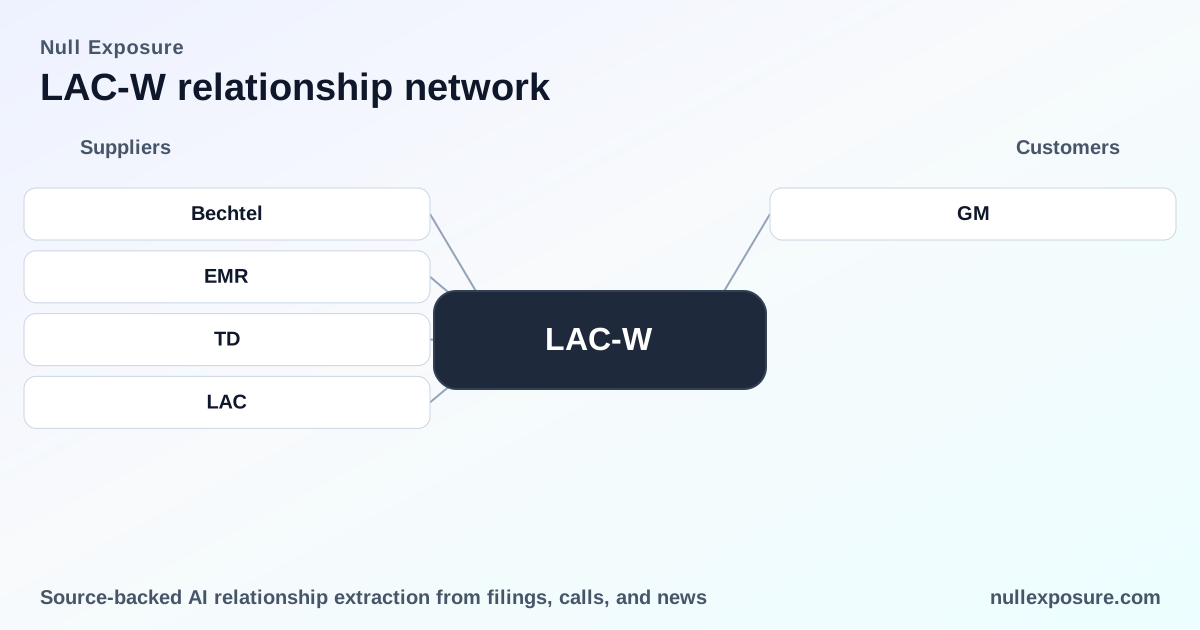
LAC‑W: Why General Motors is the customer relationship that underwrites Thacker Pass value
Lithium Americas builds and monetizes large‑scale lithium projects by combining capital raises, joint‑ventures and long‑dated offtake contracts to de‑risk development and secure project economics. The company’s Thacker Pass project is financed through a mixture of federal loan assistance, equity partners and offtake commitments—most materially General Motors’ equity stake and long‑term purchase rights, which anchor demand and underwrite access to capital. For investors and operators evaluating LAC‑W customer dynamics, the GM relationship is the single largest counterparty exposure and the primary commercial signal for future cash flows.
Explore deeper coverage at https://nullexposure.com/
The commercial reality: one partner dominates the demand profile
Lithium Americas’ contracting posture is concentrated and strategic: a large automaker holds equity, preemptive purchase rights and amended offtake terms, which converts project output into bankable demand. That concentration accelerates financing but increases counterparty concentration risk—if the automaker’s commitment shifts, government loan conditions and project bankability shift with it. Amendments to GM’s offtake and equity commitments in FY2025–FY2026 show the relationship is evolving from delivery timing and construction support into formalized, long‑dated purchase obligations. This is a commercial relationship of high criticality and significant influence over project financing.
Line‑by‑line: every reported customer relationship in the record
Below are the individual source entries captured in our record. Each item is presented with a concise, plain‑English summary and the corresponding source citation.
-
The Nevada Independent (March 10, 2026) reports the DOE’s $2.3 billion loan for Thacker Pass is conditional and that federal officials are asking General Motors to agree to a long‑term purchase clause binding the automaker to buy a set amount of lithium over the next two decades as a condition for loan sign‑off. (FY2025)
Source: The Nevada Independent, March 10, 2026. -
The same Nevada Independent item is captured again under the shorthand “GM,” repeating that DOE sign‑off is tied to a potential GM take‑or‑pay commitment to secure the $2.3 billion federal loan. (FY2025)
Source: The Nevada Independent, March 10, 2026. -
A Lithium Americas press release republished in The Globe and Mail (Q3 2025 results) states the company and General Motors Holding LLC amended GM’s lithium offtake agreement to provide additional support to the Thacker Pass project. (FY2025)
Source: The Globe and Mail – Lithium Americas Q3 2025 press release. -
That same Globe and Mail press release is recorded again referencing General Motors Holding LLC as the JV partner and noting the offtake amendment provides incremental project support. (FY2025)
Source: The Globe and Mail – Lithium Americas Q3 2025 press release. -
The Free Beacon (March 2026) reports DOE concerns and notes an offer to sign off on the loan if General Motors—Lithium Americas’ lead investor—accepts a “take or pay” clause obligating purchases over two decades. (FY2025)
Source: Free Beacon, March 10, 2026. -
A duplicate Free Beacon capture labels the company shorthand as “GM” and reiterates the reporting that DOE wants a binding GM purchase commitment before approving the loan. (FY2025)
Source: Free Beacon, March 10, 2026. -
Resource World (May 3, 2026) summarizes that the joint venture and GM entered an amendment to GM’s offtake agreement with Lithium Americas (LN) to provide additional support to the project, indicating formal contractual adjustments to strengthen project financeability. (FY2025)
Source: Resource World, May 3, 2026. -
CarbonCredits (March 2026) frames policy alignment between Washington and EV makers like General Motors as a means to ensure supply security and offtake agreements for Thacker Pass. (FY2025)
Source: CarbonCredits, March 2026. -
AA.com.tr (March 2026) reports GM invested $625 million for a 38% stake and secured a 20‑year preemptive right for production from phase one and part of phase two, underlining GM’s long‑term purchase priority. (FY2025)
Source: AA.com.tr, March 10, 2026. -
CNBC (Sept 24, 2025; captured March 2026) notes GM holds a 38% stake and has agreed to buy offtake from the mine when operational, signaling equity‑plus‑offtake alignment. (FY2025)
Source: CNBC, September 24, 2025 (reported in FY2025 coverage). -
A duplicate CNBC capture repeats that GM’s 38% stake comes with an offtake commitment for operational output. (FY2025)
Source: CNBC, September 24, 2025. -
The Globe and Mail business profile (FY2023 capture, surfaced March 2026) reports GM invested US$650 million in January (year noted in that article) and locked in exclusive supplies of lithium carbonate produced during the first 10 years, illustrating earlier negotiated exclusivity. (FY2023)
Source: The Globe and Mail (business profile), FY2023 reporting. -
A duplicate Globe and Mail capture reiterates GM’s near‑10% shareholder status in an earlier phase and the exclusive supply terms for the first decade of operation. (FY2023)
Source: The Globe and Mail (business profile), FY2023 reporting. -
The AA.com.tr piece is captured again and restates that GM intends to use the extracted lithium in EVs, with a reported $625 million investment and 20‑year preemptive purchase rights for early phases. (FY2025)
Source: AA.com.tr, March 10, 2026. -
CarbonCredits’ article is recorded a second time, emphasizing that aligning policy with EV makers like GM helps secure offtake arrangements and supply security for the U.S. lithium push. (FY2025)
Source: CarbonCredits, March 2026. -
Electrek (Sept 24, 2025; captured March 2026) records Lithium Americas confirming discussions with DOE and GM about drawing from the federal loan, noting GM’s 38% stake and right to buy mine output. (FY2025)
Source: Electrek, September 24, 2025. -
Electrek is captured again under the shorthand “GM,” repeating that GM’s stake includes purchase rights and that talks with DOE concern accessing the loan. (FY2025)
Source: Electrek, September 24, 2025. -
Another Globe and Mail article (FY2023) notes that GM invested US$650 million to fund development and in return locked in future supply—an early contractual commitment that set the commercial foundation. (FY2023)
Source: The Globe and Mail (FY2023 coverage). -
A final duplicate Globe capture repeats that GM’s early investment locked in future lithium supply for its EV manufacturing pipeline. (FY2023)
Source: The Globe and Mail (FY2023 coverage).
What the relationships collectively say about operating constraints
The record contains no separate constraint excerpts; that absence is itself a company‑level signal. Publicly reported coverage in FY2023–FY2026 focuses on equity injections and offtake amendments with General Motors, and the concentrated set of articles documents evolving contract terms and loan conditions rather than a broad ecosystem of independent customers. From a financing and operational perspective that implies:
- Concentration risk: GM is the dominant counterparty—both equity investor and primary offtaker—so project cash flows depend on GM’s continued commitment.
- Criticality to finance: Federal loan approval is tied to commercial assurances involving GM, which makes GM’s contractual posture central to project bankability.
- Contract maturity: Multiple amendments and long‑dated rights (10–20 years) indicate contracts have moved from preliminary commitment to formalized offtake support, reducing early‑stage execution risk.
- Information gap signal: The dataset did not capture independent constraint documents; investors should treat public reportage as the principal source for counterparty assessment until filings or definitive agreements are produced.
Investment implications and final takeaways
- GM is the de‑risking partner and the lever for Thacker Pass financeability. Their equity and preemptive purchase rights are the primary commercial guarantee investors should value when modeling future revenues.
- The DOE loan conditionality ties project financing to GM contractual behavior. Any change to GM’s willingness to accept long‑dated obligations would materially affect project funding and timing.
- Concentration is a double‑edged sword: it shortens the path to predictable offtake but increases single‑counterparty exposure.
For readers who want a structured feed on counterparty relationships and how they affect project valuations, visit https://nullexposure.com/ for ongoing monitoring and headline‑level summaries.
Bold headline takeaway: General Motors is not just a customer—GM is the commercial backbone that makes Thacker Pass bankable.