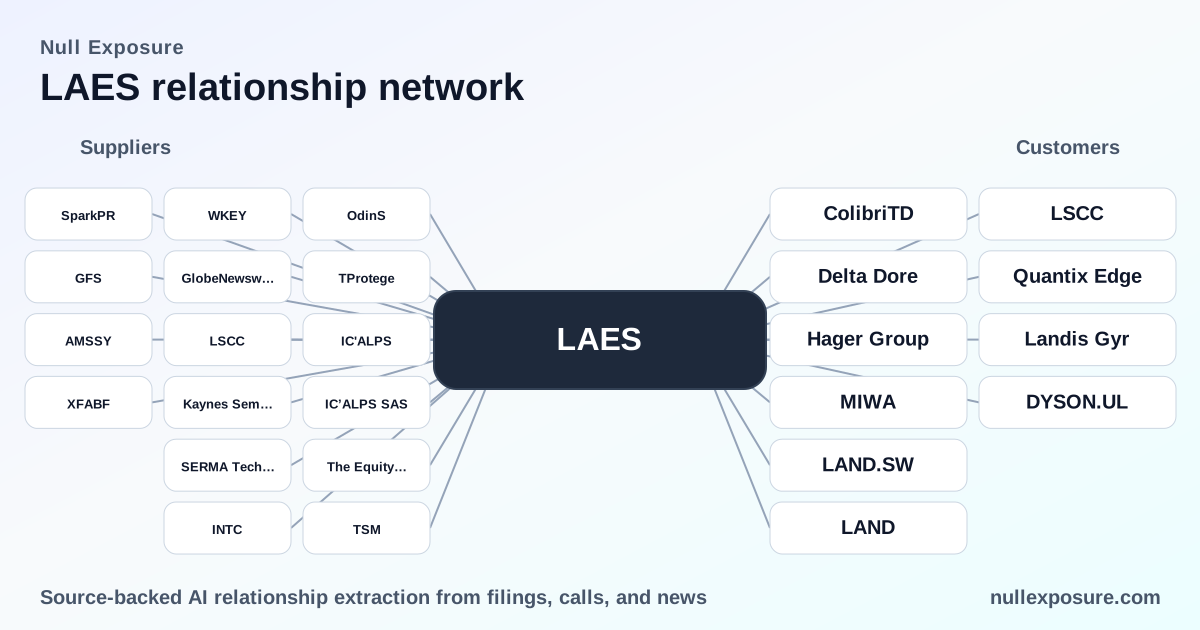
SEALSQ (LAES): Commercial relationships that convert IP into predictable revenue
SEALSQ (NASDAQ: LAES) sells post‑quantum secure semiconductors, PKI services, and lifecycle certificate-management to OEMs and infrastructure customers; it monetizes through multiyear supply agreements for secure elements, recurring PKI/certificate services, and strategic collaborations that push its chips into smart meters, consumer devices, FPGAs and sovereign programs. Revenue today is a mix of product sales (secure ICs and TPM/QS chips) and fast‑growing recurring services (PKI, device attestation and lifecycle management)—a hybrid model that supports both high gross margins on silicon and predictable annuity‑style services.
Explore the company overview and customer map at https://nullexposure.com/ for the underlying source links and filing references.
Why these partnerships matter to investors
SEALSQ’s disclosed relationships show a deliberate go‑to‑market: sell secure silicon into device OEMs and lock in recurring revenue via PKI and certificate lifecycle services, while simultaneously embedding its technology into standards consortia and strategic sovereign projects. This combination reduces single‑buyer concentration risk over time and raises commercial barriers for competitors through certification and integration.
For a fuller look at the customer relationships and primary sources, visit https://nullexposure.com/.
Customer relationships — full list and plain‑English takeaways
-
Delta Dore — SEALSQ reported a multiyear supply agreement that includes Delta Dore among a set of major OEM customers, indicating commercial traction in smart‑home and building controls. Source: LAES 2025 Q2 earnings call (transcript, Mar 2026).
-
ColibriTD — SEALSQ invested in ColibriTD and is collaborating on quantum simulation techniques to improve semiconductor wafer yields, signaling a research‑to‑manufacturing collaboration that could lower production costs or improve yields. Source: LAES 2025 Q2 earnings call (transcript, Mar 2026).
-
MIWA — MIWA is cited as part of a multiyear supply slate, suggesting SEALSQ’s secure elements are entering industrial device OEM channels beyond metering. Source: LAES 2025 Q2 earnings call (transcript, Mar 2026).
-
Hager Group — Included in the same multiyear supply announcement, Hager Group represents industrial electrical and building automation exposure for SEALSQ’s secure ICs. Source: LAES 2025 Q2 earnings call (transcript, Mar 2026).
-
LAND.SW — SEALSQ describes a PKI deployment with Landis+Gyr for 30 million utility users in Asia and ongoing U.S. market development, pointing to large‑scale recurring certificate and lifecycle service revenue. Source: LAES 2025 Q2 earnings call (transcript, Mar 2026).
-
Landis+Gyr — The company reiterates Landis+Gyr as a strategic smart‑meter partner, with PKI and secure element deployments that underpin recurring certificate services and installed‑base upgrades. Source: LAES 2025 Q2 earnings call (transcript, Mar 2026).
-
WKEY (WISeKey) — Multiple press reports link SEALSQ technology into WISeKey ecosystems, including post‑quantum chips embedded into satellite and artwork‑protection projects; this reflects strategic integration with a larger identity and root‑of‑trust ecosystem. Source: WISeKey and related press (QuantumZeitgeist and GlobeNewsWire, Mar–May 2026).
-
Lattice Semiconductor (LSCC) — Lattice is listed among prospective customers evaluating the QS7001 and is an announced collaboration to integrate SEALSQ TPM capabilities into select Lattice FPGA solutions—an important channel into industrial and edge compute customers. Source: SEALSQ press release and industry coverage (GlobeNewswire / Investing.com, Feb–May 2026).
-
Connectivity Standards Alliance (CSA) — SEALSQ is an approved Product Attestation Authority (PAA) for Matter devices, providing Device Attestation Certificates (DACs) and PAIs, which accelerates adoption in smart‑home markets through standards certification. Source: SEALSQ press release (Business Insider / GlobeNewswire, Mar 2026).
-
ECHONET Consortium — SEALSQ joined the ECHONET Consortium as a PKI services provider for Japanese smart‑home and energy networks, signaling regional standards play and targeted market entry. Source: SEALSQ press release (Business Insider / GlobeNewswire, Mar 2026).
-
Wi‑SUN Alliance — SEALSQ membership and certification activity with Wi‑SUN positions the firm for utility and smart‑grid certificate management and device authentication revenue. Source: SEALSQ press release (GlobeNewswire / Business Insider, Mar 2026).
-
LAND (Landis & Gyr, alternative listing) — Corporate communications emphasize expanded semiconductor or PKI contracts with Landis & Gyr as a driver of revenue growth and deployment across regions. Source: Company preliminary FY2025 financials (GlobeNewswire, Mar 2026).
-
EeroQ — SEALSQ states it has strategic investments in EeroQ (electrons‑on‑helium quantum processors) to ensure compatibility between future quantum processors and SEALSQ post‑quantum secure elements, demonstrating forward‑looking product roadmap alignment. Source: SEALSQ press coverage (The Globe and Mail, May 2026).
-
Quobly — The collaboration with Quobly (silicon spin qubits) aims to integrate hardware root‑of‑trust and post‑quantum cryptography into future quantum processors, positioning SEALSQ in the secure‑quantum hardware stack. Source: SEALSQ press release (The Globe and Mail, Nov 2025 / May 2026).
-
Quantix Edge — SEALSQ flagged initial revenue expectations from sovereign semiconductor and Quantix Edge projects, indicating early traction in government or defense‑adjacent deployments. Source: SEALSQ FY2025 report and press (Globe and Mail / company release, Mar 2026).
-
Paradrone — Engagements with Paradrone extend SEALSQ root‑of‑trust capabilities into autonomous UAV systems where resilient, trusted communications are mission‑critical. Source: Q4 2025 earnings call transcript coverage (InsiderMonkey, May 2026).
-
Dyson (DYSON.UL) — Dyson is named among OEM customers under multiyear supply agreements, signaling access to premium consumer appliance channels for secure ICs and attestation services. Source: LAES 2025 Q2 earnings call (transcript, Mar 2026).
-
Multiple Landis/land variants entries — Across several press items and earnings commentary, SEALSQ consistently references Landis & Gyr (variously styled) and Landis Gyr as a cornerstone partner for smart‑meter rollouts and PQC compliance—supporting both product sales and recurring PKI. Sources: GlobeNewswire, Investing.com, InsiderMonkey (Feb–May 2026).
What the relationship map implies about operating model and execution
- Contracting posture: Multiyear supply agreements and standards‑body roles show SEALSQ pursues binding commercial contracts and certification lock‑in rather than one‑off software projects; that increases revenue visibility and switching costs for customers.
- Revenue concentration and diversification: Early revenue is concentrated in secure elements and a handful of large OEM/utility partners, but expansion into standards consortia, FPGA partnerships and sovereign programs signals deliberate diversification across verticals and geographies.
- Criticality: Deployments into smart meters (tens of millions of units) and device attestation for Matter/Wi‑SUN indicate high operational criticality—customers integrate SEALSQ at the device‑identity layer where failures have regulatory and service implications.
- Maturity: The mix of product sales, recurring PKI services, and industry collaborations suggests a company transitioning from pure R&D to commercial scale with repeatable sales motions; commercialization of QS7001 and QVault TPM lines is the next maturity milestone.
Investment implications and risk considerations
- Upside drivers: Certification partnerships (CSA, ECHONET, Wi‑SUN), large smart‑meter deployments with Landis & Gyr, and FPGA integrations with Lattice create multiple scalable revenue channels. If SEALSQ converts trials with Lattice and OEMs into production volumes, margin expansion and service annuities should follow.
- Key risks: Execution on semiconductor commercialization, customer concentration in early years, and the need to convert standards membership into paid services are the primary operational risks investors must monitor.
For an indexed view of LAES customer links and primary source documents, visit https://nullexposure.com/.
Bold, direct customer wins and standards positioning are the clearest signals in SEALSQ’s commercial narrative: the company is monetizing hardware and identity services in parallel, and the disclosed relationships give investors visible paths to scale.