Lakeland Industries (LAKE): Customer Map and Commercial Signals for Investors
Lakeland Industries manufactures and sells industrial and public-sector protective clothing and accessories and monetizes through direct product sales, distributor resale, and recurring service contracts (turnout gear maintenance and decontamination). The company combines short-cycle purchase orders with a large global distributor footprint and targeted public-sector relationships to deliver revenue across North America, Europe, Asia and Latin America. For a tactical investor, the key facts are: sales are transaction-driven, government customers provide strategic credibility rather than material concentration, and aftermarket services add margin durability. Learn more or evaluate coverage at https://nullexposure.com/.
How Lakeland actually earns revenue and what that means for durability
Lakeland sells finished protective apparel and associated services. Revenue flows from three commercial vectors: (1) direct sales to government and industrial buyers, (2) resellers and independent distributors who carry inventory and serve local end users, and (3) services such as PPE decontamination and turnout gear maintenance for municipal fire departments. The company’s public disclosures describe sales based on individual purchase orders and largely short-term contracts, which establishes a transactional, low-commitment contracting posture rather than a model built on multi-year take-or-pay arrangements.
Company-level signals drawn from filings and public excerpts:
- Short-term / spot orientation: Lakeland states that virtually all contracts are short-term and sales are made by individual purchase orders that can be modified or cancelled, so revenue recognition is transactional and timing-sensitive.
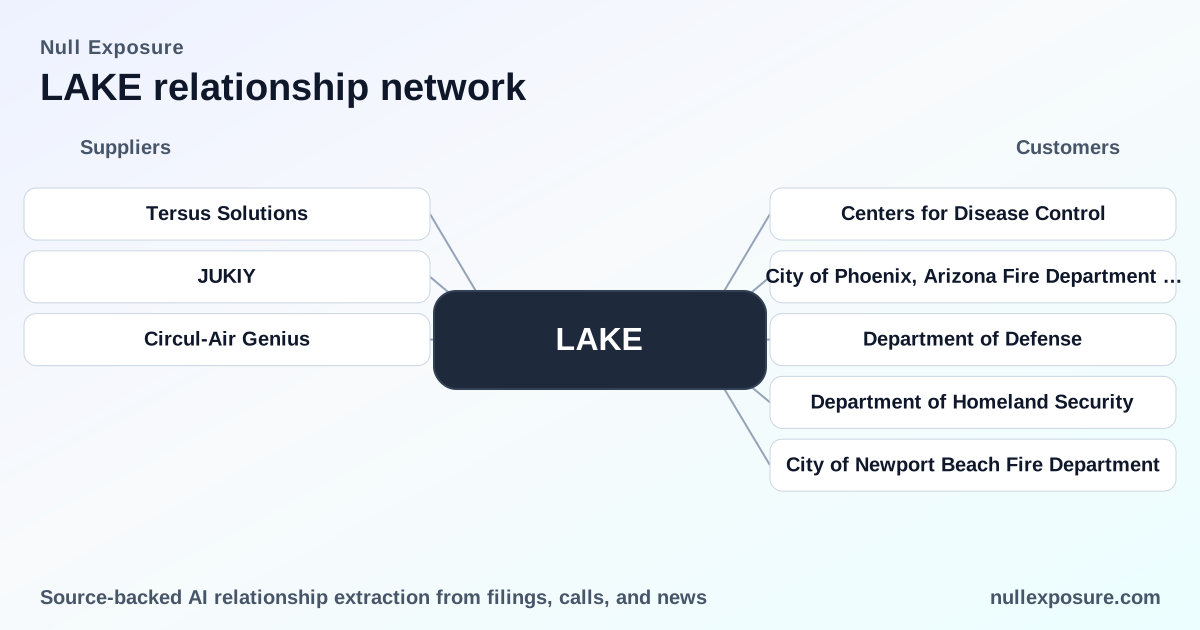
- Government counterparty presence: Lakeland explicitly lists federal, state and local agencies — including the Department of Defense, Department of Homeland Security and the Centers for Disease Control — as part of its customer base, indicating a deliberate penetration of public-safety procurement channels.
- Global distribution and geography mix: Reported region-level line items include roughly USA Operations ~$60.4M, Europe ~$42.1M, Latin America ~$21.2M and Asia ~$13.9M, and Lakeland operates sales representatives in 23 countries and sells in more than 50 countries, underscoring a diversified geographic footprint.
- Distributor-led go-to-market: The company leverages over 2,000 safety and industrial supply distributors, which supports local inventory and rapid service but also reduces direct pricing control.
- Low single-customer concentration: For FY2024–FY2025, no single customer exceeded 10% of sales, so customer concentration is immaterial at the corporate level.
These operational characteristics produce a revenue profile that is broad but shallow at the single-customer level and sensitive to order timing and municipal purchasing cycles, while aftermarket services and government contracts supply higher-margin recurring elements.
Customer relationships that matter — five names investors should track
Centers for Disease Control (CDC)
Lakeland lists the Centers for Disease Control among federal agencies it supplies, signaling participation in public-health procurement channels for protective apparel and related products. Source: Bitget coverage of Lakeland FY2026 disclosures (March–May 2026).
Department of Defense (DoD)
The company includes the Department of Defense in its roster of federal customers, indicating defense procurement as a named end-market for specialized protective garments. Source: Bitget and FirefighterNation references to FY2026 disclosures (March–May 2026).
Department of Homeland Security (DHS)
Lakeland specifically cites the Department of Homeland Security as a recipient of its protective clothing products, supporting the company’s exposure to homeland security and critical-infrastructure customers. Source: Bitget and FirefighterNation reporting tied to FY2026 commentary (March–May 2026).
City of Phoenix, Arizona Fire Department (Phoenix Fire Dept.)
Lakeland has supported the Phoenix Fire Department with PPE advanced decontamination, inspection and repair services for ten consecutive years, demonstrating an installed-service relationship that drives recurring revenue and deep municipal operational ties. Source: Bitget coverage of the company’s FY2026 press (March 10, 2026).
City of Newport Beach Fire Department
Lakeland Fire Safety’s California PPE business was selected to provide turnout gear maintenance and decontamination cleaning services for the City of Newport Beach Fire Department, a concrete example of the company’s local government service contracts. Source: GlobeNewswire press via The Manila Times (February 18, 2026).
What these customer relationships imply about risk and upside
- Government customers add credibility and recurring service revenue but are not a single-point concentration risk. Lakeland names multiple federal agencies and municipal fire departments among customers, but the company also documents that no customer represented more than 10% of sales in recent years, so government business supports growth and reputation without creating outsized dependence.
- Contracting posture is transactional and short-term. The company explicitly states that virtually all contracts are short-term and sales are driven by purchase orders, which creates predictability challenges and greater sensitivity to quarter-to-quarter order timing and public procurement cycles.
- Distributor strategy trades margin control for reach. A global network of more than 2,000 authorized distributors improves speed-to-market and local inventory depth but reduces direct negotiation leverage and can compress gross margins relative to a pure direct-sales model.
- Services are a margin stabilizer and operational differentiator. Long-running municipal maintenance contracts (Phoenix, Newport Beach) provide recurring cashflow and improve stickiness because gear maintenance is operationally critical for first responders.
- Geographic diversification mitigates localized demand swings. With meaningful revenue reported across North America, Europe, Latin America and Asia and sales presence in 50+ countries, Lakeland reduces country-specific demand volatility while increasing execution complexity.
Investment takeaways and action points
- Positive: diversified global revenue mix, government and municipal service relationships, and an aftermarket services business that supports margins and retention.
- Watchlist: the short-term, spot-nature of contracts increases revenue volatility and places a premium on inventory and working-capital management; reliance on distributors limits pricing power.
- For investors or operators performing diligence, prioritize analysis of quarterly order patterns, backlog (if any), and the scale of municipal service contracts, and monitor procurement cycles for the DoD/DHS/CDC channels cited by the company.
If you need a deeper, transaction-level view of LAKE customers and contract structures, NullExposure maintains consolidated coverage and signals for investor diligence — see https://nullexposure.com/ for more.
Conclusion: Lakeland’s customer relationships combine institutional public-sector buyers and a broad distributor network to deliver a resilient but transactional revenue model; the most investible features are recurring municipal service contracts and geographic diversification, while the principal risks are order-timing volatility and constrained margin leverage from distributor resales.