Lanvin Group Holdings (LANV): Investor Brief on Customer Relationships and the Caruso Disposal
Lanvin Group Holdings manufactures and sells luxury apparel, accessories and fragrances and monetizes through retail and wholesale product sales under its brand portfolio. The company generates topline from its fashion operations while capital structure and cash needs are shaped by high insider control, ongoing outflows reflected in negative EBITDA, and selective asset disposals that reshape the portfolio and cash position. For a concise view of company signals and relationship-level developments, see NullExposure’s research hub: https://nullexposure.com/.
Quick take: where the numbers leave investors
Lanvin reported trailing revenue of $240.5 million and gross profit of $139.9 million, but negative EBITDA of $106.1 million and a deeply negative net margin, producing an EPS of -$1.77 and a market capitalization near $218 million. Insider ownership is very high (79%) while institutional ownership is low (9.7%), amplifying governance and liquidity implications for minority investors. Price-to-sales at ~0.9 and an EV/EBITDA metric that is negative reflect both distress and potential upside if operations stabilize.
What the customer-relationship data shows
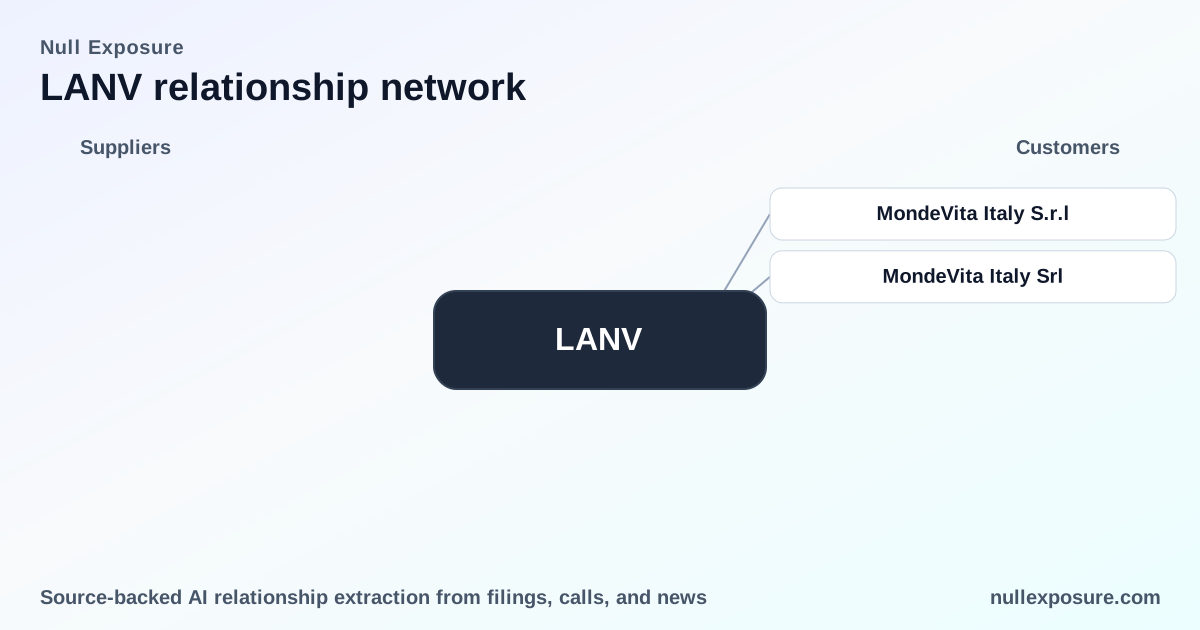
The set of relationship records in the public feed centers on a single counterparty: MondeVita Italy S.r.l (MondeVita Italy Srl / MondeVita Italy S.r.l). All entries document the same corporate action — Lanvin’s sale of Raffaele Caruso S.p.A to MondeVita — reported across multiple outlets. Below are the discrete items from the feed, each summarized in plain English with source context.
MondeVita Italy S.r.l — SimplyWallSt mention (FY2022)
MondeVita Italy S.r.l is recorded as the acquirer of Raffaele Caruso S.p.A from Lanvin Group Holdings, with the transaction referenced in a SimplyWallSt company note covering FY2022. According to the SimplyWallStreet entry dated March 2026, the item is recorded as an outright sale by Lanvin to MondeVita Italy S.r.l. (SimplyWallSt news page, first seen March 10, 2026).
MondeVita Italy Srl — Yahoo Finance report (FY2026)
Yahoo Finance reported that Lanvin Group sold Raffaele Caruso SpA to MondeVita Italy Srl, which is part of Mondevo Group founded by Hussam Otaibi and Fabio Brambilla; the story ran on March 10, 2026 and frames this as a corporate divestiture by Lanvin in FY2026. (Yahoo Finance Singapore, March 10, 2026).
MondeVita Italy S.r.l — MarketScreener advisory (FY2022)
MarketScreener carried a matching note that MondeVita Italy S.r.l acquired Raffaele Caruso S.p.A from Lanvin, appearing in news aggregation on March 10, 2026 and tying the transaction back to Lanvin’s FY2022 disclosures in the aggregate feed. (MarketScreener news item, March 10, 2026).
Why the Caruso sale matters to investors
The sale of Raffaele Caruso S.p.A to MondeVita is an explicit portfolio pruning event that removes an operating unit from Lanvin’s perimeter and converts an asset into cash or receivables depending on transaction structure. Public reporting across multiple outlets confirms the counterparty and the completion of the deal; investors should treat this as a realized strategic disposition rather than an exploratory negotiation.
- Capital impact: Proceeds from the sale are a direct lever on liquidity and deleveraging prospects; Lanvin had signaled funding expectations in related filings cited by news aggregation.
- Operational impact: Divesting a branded unit reduces revenue base but can simplify operations and lower working capital demands. Given Lanvin’s negative EBITDA, this shift is material to near-term cash dynamics.
Operating model and company-level constraints (signals)
There are no explicit constraint entries attached to relationships in the feed. Treat the following as company-level signals drawn from the corporate profile and public financials:
- Contracting posture: Lanvin operates in the luxury goods segment where relationships with distributors, suppliers, and wholesale partners are often governed by brand agreements and inventory commitments; the sale of a brand asset indicates an active approach to restructure commitments and conserve cash.
- Concentration and control: High insider ownership (79%) suggests strategic decisions—including disposals—are driven by insiders rather than market forces, which can accelerate restructuring but also raise minority-holder governance considerations.
- Criticality: The company’s negative margins and EBITDA show operations are not cash-generative; therefore, asset disposals and funding events are critical levers for sustaining operations and executing strategic priorities.
- Maturity and liquidity: Small market cap, negative profitability, and low institutional float point to a company in transition: operationally mature in product lines but financially immature with material liquidity and earnings risk.
Risk and opportunity checklist
- Risk — Earnings weakness: Negative operating margin and EPS indicate structural profitability issues that necessitate either cost reduction or further asset sales.
- Risk — Governance concentration: Large insider stake concentrates control, which can speed strategic moves but increases execution risk for minority investors.
- Opportunity — Balance-sheet rebuilding: The Caruso disposal demonstrates management willingness to monetize non-core assets; successful redeployment of proceeds could meaningfully reduce liquidity stress.
- Opportunity — Re-rating potential: If margins turn positive and EBITDA recovers, current multiples leave room for a re-rating given the P/S near 0.9.
Final read and recommended investor focus
The transaction with MondeVita is a clear, attributable corporate action: Lanvin sold Raffaele Caruso S.p.A to MondeVita Italy, and that disposition now sits in the public record across multiple outlets. For investors and operators evaluating the relationship set, the sale is significant because it signals active portfolio management under duress: management is monetizing assets to address negative cash flow and rebuild flexibility.
Track these items next: (1) detailed use of sale proceeds disclosed in Lanvin filings, (2) follow-on divestitures or refinancing announcements, and (3) any changes in minority governance protections given the high insider stake. For ongoing monitoring and relationship-level intelligence on LANV, visit NullExposure’s research center: https://nullexposure.com/.