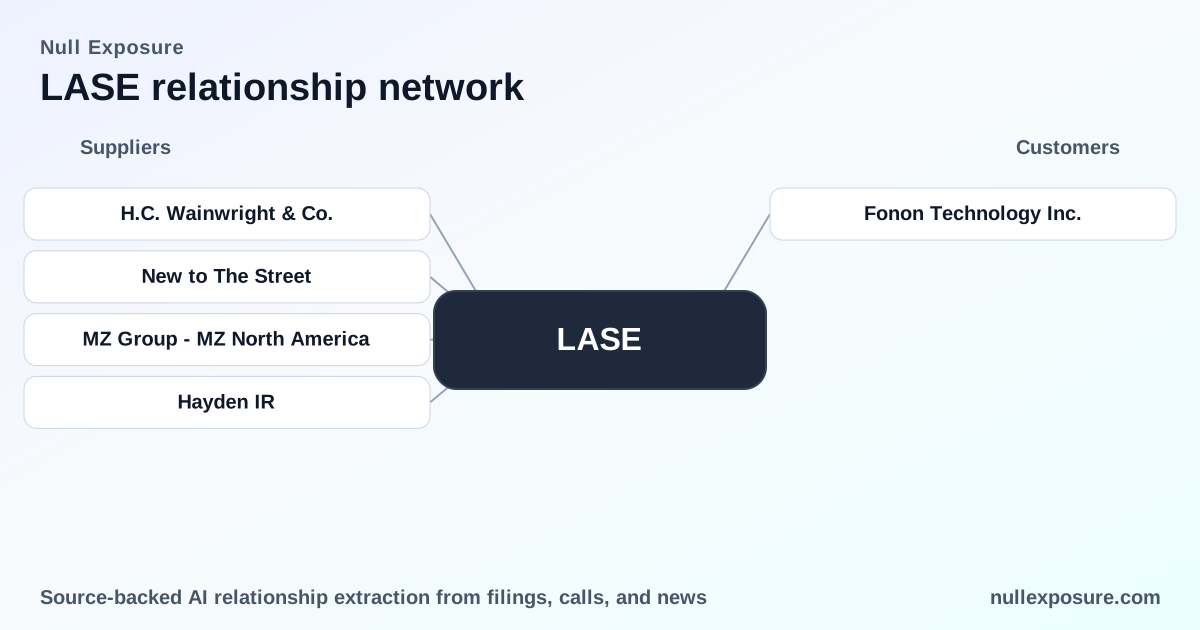
Laser Photonics (LASE): Customer Relationships That Drive Product Adoption and Revenue Optionality
Laser Photonics (NASDAQ: LASE) manufactures and sells industrial and defense-grade laser systems—principally laser cleaning and counter‑UAS/anti‑drone solutions—monetizing through equipment sales, occasional equipment repurchase commitments, and follow‑on orders from large enterprises and government agencies. The company operates a hybrid sales model: direct strategic account management for big-ticket customers, a network of distributors and resellers for broader reach, and targeted government contracting for defense and special operations programs. For investors assessing customer risk and upside, the mix of high‑value government engagements and recurring enterprise maintenance use cases is the key dynamic. [https://nullexposure.com/]
Why customers matter for valuation: revenue concentration, contract types, and win barriers
Laser Photonics shows a capital equipment business profile: high ticket; product‑led adoption; and sales structured around purchase orders, distributor agreements, and occasional finance/repurchase terms. The company’s trailing twelve‑month revenue of roughly $8.34M, negative EBITDA, and a small market capitalization mean each meaningful customer win materially affects near‑term performance and perceived growth runway. Government and defense customers create higher margins and strategic defensibility, but they also introduce program timing and procurement risk; commercial large accounts drive steadier aftermarket and maintenance revenue.
Key investor takeaway: LASE’s customer roster combines defense prime pathways and industrial OEM/maintenance relationships—this mix supports asymmetric upside if conversion and scale follow‑through occur, but it also concentrates execution risk on a small number of program outcomes.
What the public filings and press releases show about operating posture
Company statements and recent filings indicate a mixed contracting posture: revenue recognition on FOB origin (spot/transactional), primary reliance on purchase orders (short‑term), and a discrete set of financed equipment arrangements with repurchase commitments not exceeding 36 months. The firm markets globally through a U.S.‑based direct sales force, but current operations are U.S.‑centric, which reduces FX exposure while concentrating operational footprint domestically. Laser Photonics is vertically integrated—manufacturing critical components in‑house—while also expanding distribution and reseller channels to scale. These signals point to a company transitioning from prototype and pilot programs into broader commercial and government adoption, with balance‑sheet and execution sensitivity during that shift.
Customer roster — each named relationship and what it implies
Cummins
Laser Photonics has integrated its CleanTech laser cleaning system into Cummins’ engine maintenance operations, reflecting a commercial adoption in heavy‑duty industrial maintenance workflows. Reports from Investing.com on May 3, 2026, and international press coverage confirmed the system’s deployment at a Cummins facility, signaling a meaningful large‑enterprise customer win for industrial aftermarket services. (Investing.com, May 3, 2026; Bitget summary, May 3, 2026)
U.S. Marine Corps
The company reported securing orders tied to aerospace and defense and cited the U.S. Marine Corps as a named customer in partnership with Fonon Technologies, indicating penetration into military maintenance and procurement channels. This disclosure was made in a shareholder letter published via AccessWire in early May 2026. (AccessWire shareholder letter, May 2026)
U.S. Navy
Laser Photonics disclosed orders from the U.S. Navy—again noted in the same shareholder communication—and identified that engagement as coordinated with a partner (Fonon Technologies), which suggests the Navy sales are being pursued through teaming arrangements rather than pure direct procurement. (AccessWire shareholder letter, May 2026)
Fonon Technology Inc.
The company’s SEC‑filed materials reference transactions with affiliates such as Fonon Technology Inc., highlighting an existing affiliate or partner relationship used to route defense and government opportunities. That affiliation appears in a March 2026 filing summary reported through TradingView referencing the SEC 10‑Q. (TradingView summary of SEC 10‑Q, March 2026)
U.S. Special Operations Command (USSOCOM)
In connection with its LSAD anti‑drone program, Laser Photonics submitted technical drawings and system documentation to U.S. Special Operations Command for the REPTILE 26 counter‑UAS experiment, demonstrating active engagement with special operations acquisition pathways. The company noted these submissions in an April 2026 press release covering the LSAD milestone. (ACCwireCQ / FinancialContent, April 2026)
Naval Special Warfare Command
Laser Photonics reported that it submitted materials under Naval Special Warfare Command’s Commercial Solutions Opening as part of the LSAD program effort—evidence the product is being positioned against specialized naval SOF requirements, with the potential for follow‑on evaluations or procurement. (ACCwireCQ / FinancialContent, April 2026)
How these relationships shape commercial and execution risk
- Contracting mix: Public statements and filings show spot and short‑term sales dominate (FOB origin; purchase order basis), but there are limited financed equipment repurchase commitments with terms generally capped at 36 months—this creates a blend of transactional revenue and short financing liability that influences working capital dynamics.
- Customer concentration and criticality: Government contracts (Navy, Marine Corps, USSOCOM, Naval Special Warfare Command) increase strategic value and potential margin, but they concentrate program risk around procurement cycles and partner‑led execution. Large enterprise wins like Cummins validate commercial applicability and create aftermarket service opportunities.
- Channel and go‑to‑market: The firm is vertically integrated as a manufacturer yet uses distributors and resellers alongside a direct strategic account team—this dual channel model supports scale but requires execution on partner enablement and inventory/fulfillment.
- Geographic posture: While marketed globally, LASE currently operates without overseas facilities—this makes logistics simpler but limits fastest routes to international revenue expansion.
- Sales pipeline signal: The company disclosed a sales pipeline with $41.1M in industrial products and $19.9M in military and government sales, which the company described as capable of supporting up to roughly $10M of revenue per year—a company‑level indicator of opportunity depth, not a guaranteed conversion. (Company disclosure in filing/letter, FY2024/25 pipeline figures referenced in 2026 communications)
Financial context and investor implications
Laser Photonics’ most recent reported TTM revenue is $8.34M with negative EBITDA and diluted EPS of approximately ‑$1.02, reflecting the early commercial stage and investment phase. Customer wins in defense and large industrial maintenance clients are therefore disproportionally important: successful program conversions and aftermarket service capture can rapidly improve unit economics, while procurement delays or partner integration issues would pressure near‑term cash flows.
Bottom line: LASE’s customer base is strategically attractive—combining defense special operations experiments and naval procurement pathways with commercial OEM maintenance integrations like Cummins—but returns hinge on the company’s ability to convert pipeline opportunities into recurring revenue and to manage financing commitments tied to equipment sales.
For a deeper read on how customer relationships map to program value and risk for small‑cap industrial technology names, visit [https://nullexposure.com/]. If you are evaluating strategic counterparties or procurement timelines for LASE, our coverage and primary‑source summaries provide a concise way to prioritize due diligence.