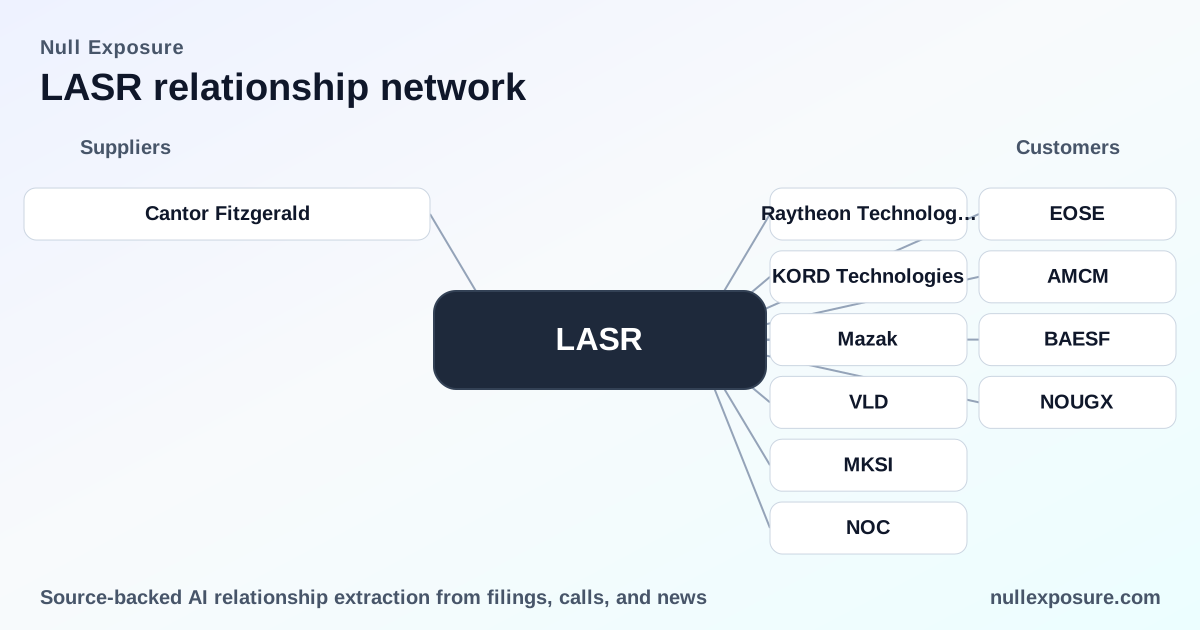
nLIGHT (LASR) — Customer map, concentration and strategic implications
nLIGHT designs, manufactures and sells fiber and semiconductor lasers to industrial OEMs, additive-manufacturing vendors and aerospace & defense primes and governments, monetizing primarily through product sales and contract deliveries; revenue is recognized at a point in time for standard product sales and on a percentage-of-completion basis for long-term contracts. The business mixes high-margin OEM relationships with concentrated defense and government exposure, short-term order behavior for commercial customers, and a growing strategic role inside metal additive manufacturing systems. Learn more at https://nullexposure.com/.
Why customers drive nLIGHT's risk-reward profile
nLIGHT’s customer roster creates a clear investment axis: government and defense programs provide stable, material backlog and technical validation, while industrial OEMs and AM partners provide volume and route-to-market. The company discloses that it generally operates off short-term purchase orders, which gives customers leverage on timing and creates cyclicality in revenue; at the same time, longer-term contracts exist and are accounted for using cost-to-complete methods, introducing program execution risk. Regional revenue is concentrated in North America, with meaningful Asia-Pacific and EMEA sales, so macro and export dynamics across those regions affect demand and supply cadence.
Relationship-by-relationship breakdown (plain English, sourced)
Raytheon Technologies
Raytheon is a large defense prime that accounted for 10% of nLIGHT’s revenues in 2024, making it a material strategic customer in aerospace and defense programs. According to nLIGHT’s FY2024 Form 10‑K, Raytheon is listed among the company’s global customers and specifically reported as a 10% revenue contributor in 2024. (nLIGHT 10‑K, FY2024)
KORD Technologies
KORD Technologies is a significant customer that represented 12% of revenue in 2024, indicating concentrated commercial contracts with this supplier of defense and aerospace systems. nLIGHT’s FY2024 10‑K identifies KORD as a top customer and quantifies its revenue share for 2024. (nLIGHT 10‑K, FY2024)
Mazak
Mazak is named among nLIGHT’s global customers and represents the company’s traction with industrial machine-tool OEMs that embed lasers into manufacturing equipment. The FY2024 10‑K lists Mazak in the customer roster without a percentage attribution. (nLIGHT 10‑K, FY2024)
Velo3D (VLD)
Velo3D is an additive-manufacturing customer whose strategic review of its business in 2024 forced nLIGHT to reduce sales expectations; this highlights commercial sensitivity to AM partners’ go-to-market changes. Optics.org reported in March 2026 that nLIGHT had cut 2024 sales guidance after Velo3D reviewed its strategy. (Optics.org, March 2026)
Northrop Grumman
Northrop Grumman is a named aerospace & defense prime and appears on nLIGHT’s list of major customers, reinforcing nLIGHT’s role as a supplier into defense systems. The FY2024 10‑K lists Northrop Grumman among global customers. (nLIGHT 10‑K, FY2024)
BAE Systems
BAE Systems is cited as a global customer and part of the defense-prime cohort purchasing nLIGHT’s lasers for military and aerospace applications. The FY2024 10‑K includes BAE Systems in the customer roster. (nLIGHT 10‑K, FY2024)
U.S. Government
The U.S. Government is the single largest named customer group, accounting for 19% of revenues in 2024, which creates both revenue stability and dependency on defense budgets and procurement cycles. nLIGHT’s FY2024 10‑K explicitly states the U.S. Government’s 19% contribution for the year. (nLIGHT 10‑K, FY2024)
MKS Instruments
MKS Instruments is included among nLIGHT’s global customers and represents the industrial equipment channel that purchases lasers as integrated subsystems. The FY2024 10‑K lists MKS among named customers. (nLIGHT 10‑K, FY2024)
EOS (EOSE)
nLIGHT signed a collaboration such that its programmable laser sources will be used inside EOS additive-manufacturing systems, representing a strategic OEM partnership that moves nLIGHT from component supplier to embedded system supplier. Optics.org covered the EOS collaboration in March 2026, noting that nLIGHT’s programmable sources will be integrated into EOS AM systems. (Optics.org, March 2026)
EOSE (duplicate EOS listing)
A separate news listing references EOSE with the same March 2026 Optics.org coverage, underscoring industry reporting on the nLIGHT–EOS collaboration and its implications for AM channel penetration. (Optics.org, March 2026)
AMCM (EOS subsidiary)
AMCM, an EOS subsidiary, already offered nLIGHT’s programmable AFX laser in its metal AM systems and the new agreement frames an evolution of that existing relationship — a tactical win for nLIGHT’s embedded-laser strategy in metal AM. Optics.org describes AMCM’s prior use of nLIGHT’s AFX laser and the expanded collaboration in March 2026. (Optics.org, March 2026)
BAESF (BAE Systems class/share listing)
BAESF is listed in the filings as the security-class reference for BAE Systems; the company appears in both the customer roster and the 10‑K customer list, confirming BAE’s commercial relationship across filings. The FY2024 10‑K includes BAE Systems / BAESF as a named customer. (nLIGHT 10‑K, FY2024)
NOUGX (U.S. Government vehicle/identifier)
NOUGX appears as the identifier tied to the U.S. Government customer disclosure; the 10‑K uses this identifier when reporting that the U.S. Government comprised 19% of revenues in 2024. The FY2024 10‑K includes NOUGX in the top-customer disclosure. (nLIGHT 10‑K, FY2024)
Raytheon / TradingView mention (sector context)
A May 2026 TradingView / Zacks write-up reiterated that nLIGHT’s top customers include Raytheon, Northrop Grumman, BAE and the U.S. Government, framing the company’s revenue mix as defense-led while sensing and industrial programs fuel the next phase. (TradingView/Zacks, May 2026)
Operational constraints and what they signal for investors
- Contracting posture is customer-favorable and short-term: nLIGHT states it “generally does not enter into long-term purchase agreements” and operates on short-term purchase orders, which increases revenue volatility and gives customers timing leverage. This is a company-level signal from the FY2024 10‑K.
- Long-term program exposure exists and is accounted for over time: For contracts that are long-term, nLIGHT recognizes revenue on a percentage-of-costs basis, introducing execution and margin-risk on multi-year programs. This is a company-level accounting signal.
- High government concentration is explicit and material: The U.S. Government’s ~19% revenue share in 2024 is an explicit, named constraint and creates both defensibility and budget-dependent risk. (nLIGHT 10‑K, FY2024)
- Global footprint with regional concentration: Sales are concentrated in North America, with material Asia‑Pacific and EMEA sales; this geography mix affects export controls, currency and regional demand cycles. (nLIGHT 10‑K, FY2024)
- Relationship roles: nLIGHT operates primarily as a seller of lasers and systems to both end users (government, primes) and OEM integrators (AM vendors, machine-tool companies), which diversifies routes-to-market but retains concentration risk in a few large buyers.
For a detailed view of how these customer dynamics translate into program risk and revenue volatility, visit https://nullexposure.com/.
Investment implications — clear tradeoffs
nLIGHT’s customer base delivers technical validation and sticky program revenue via defense primes and the U.S. Government, while AM and OEM partnerships are the primary growth vector for higher-volume commercial sales. Investors should weigh the benefit of defense-backed revenue and program-level credibility against short-term PO-driven cyclicality, customer concentration (KORD, Raytheon, U.S. Government) and sensitivity to AM customers’ strategic shifts (e.g., Velo3D). The EOS collaboration is a positive channel-development signal that reduces single-customer exposure in AM over time.
If you need a tracker of customer concentration or a concise briefing tailored to an investor committee, I can produce a one-page risk-and-opportunity memo.