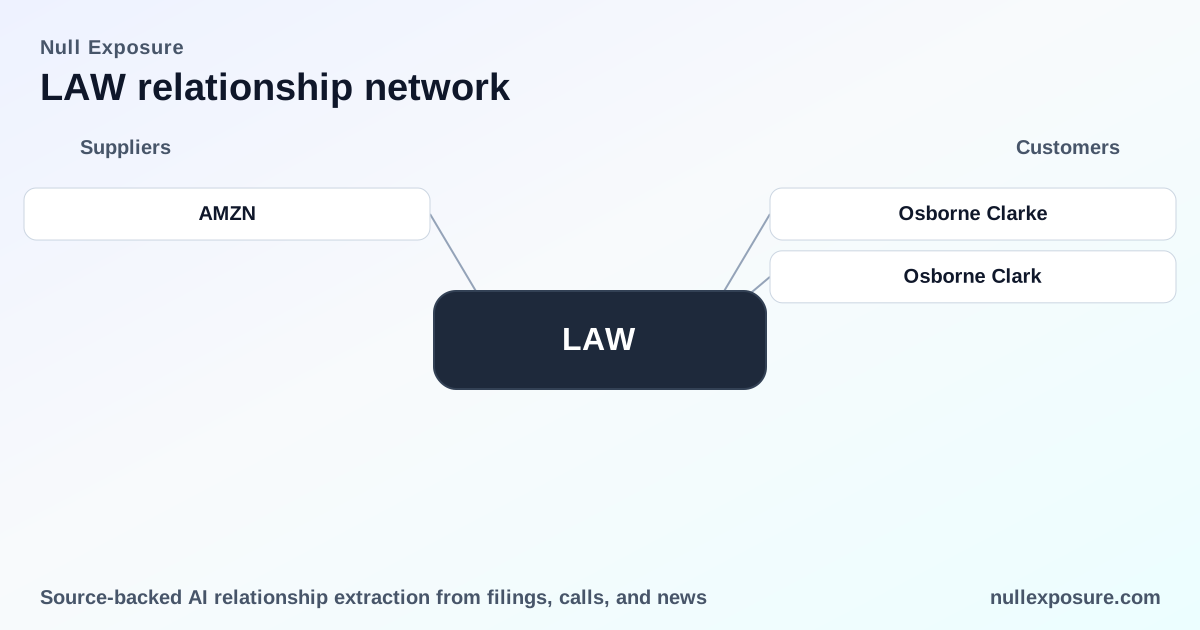
LAW (CS Disco): Customer relationships that validate a usage-based legal-tech growth model
Thesis: CS Disco sells cloud-native, AI-driven legal software and complementary services to law firms, enterprises and governments, and monetizes primarily through a usage-based pricing engine that drives revenue expansion as matters and spend per client grow. The company’s economics are driven by a concentrated base of large customers that generate the bulk of revenue, with software revenue materially larger than services—status that both amplifies upside when clients expand usage and concentrates commercial risk. For a concise vendor view and data-driven signals, visit https://nullexposure.com/.
Recent client wins that matter to the revenue story
Two customer relationships reported in public coverage during FY2026 provide direct colour on CS Disco’s commercial playbook: upsell into existing law-firm workflows and conversion as a preferred eDiscovery vendor for mid-sized firms.
Osborne Clarke — from small matters to a major expansion
Osborne Clarke more than doubled the number of matters it handles on DISCO during 2025, began using DISCO’s Cecilia AI and Auto Review features, and increased total spend by more than four times versus 2024, reflecting a deeper product footprint and value capture inside a single law firm. Source: MarketBeat coverage of CS Disco’s Q4 earnings highlights and management commentary (March 2026), and an earnings call transcript summarized by InsiderMonkey (March 2026) — https://www.marketbeat.com/instant-alerts/cs-disco-q4-earnings-call-highlights-2026-02-28/ and https://www.insidermonkey.com/blog/cs-disco-inc-nyselaw-q4-2025-earnings-call-transcript-1704038/.
Mound Cotton — named eDiscovery provider of choice
Mound Cotton publicly selected DISCO as its eDiscovery provider of choice on April 30, 2026, signaling new account wins in the legal-services segment and validating DISCO’s go-to-market with midsize firms. Source: BusinessWire announcement circulated via Finviz and MarketBeat in late April–early May 2026 — https://finviz.com/news/293014/is-cs-disco-law-one-of-the-best-performing-new-tech-stocks-to-buy-now and embedded BusinessWire reference.
What these client stories reveal about the operating model
The relationship evidence aligns tightly with CS Disco’s disclosed commercial architecture and revenue mix. Key operating signals derived from company disclosures:
- Usage-first revenue engine. Company disclosures state that usage-based revenue represented 89% of total revenue for both 2023 and 2024, with subscription fees making up the remainder; management emphasizes a transparent usage-based model that incentivizes incremental spend as matters scale.
- Large customers drive results. As of December 31, 2024, 315 customers qualified as “large” (>$100k in trailing 12‑month revenue) and those large customers accounted for approximately 76% of revenue—illustrating a high concentration of dollars in a defined cohort that is the primary monetization vector.
- Software-led economics with services as a smaller complement. For the year ended December 31, 2024, software revenue totaled $120.1M and services $24.7M, underscoring a product-first margin profile.
- US revenue dominance and modest international exposure. Less than 10% of revenue was generated outside the United States in 2024, concentrating geopolitical and regulatory exposure in North America.
- No single customer exceeds 10% of revenue. Despite concentration among large customers, the company reports no individual customer representing more than 10% of total revenue for 2024.
- Customer type breadth includes government. Disclosures list governments among customer categories, which introduces procurement, compliance and contracting complexity relative to purely commercial buyers.
- Active, usage-based seller posture. The firm defines customers by revenue recognition in the preceding month, consistent with an active, seller-driven usage model where actual client activity determines billing.
These facts are drawn from CS Disco’s FY2024 disclosures and recent FY2026 management commentary; they form the basis for evaluating how the documented client wins convert to durable revenue.
Commercial implications: concentration, upsell and retention
The Osborne Clarke expansion and the Mound Cotton selection illustrate two complementary motions that drive CS Disco’s economics:
- Expansion-first growth: The Osborne Clarke case confirms that core clients expand usage (and spend) by adding advanced AI modules like Cecilia and Auto Review—precisely the high-margin, high-leverage behavior that a usage-based model captures.
- New-account penetration: The Mound Cotton win shows success in winning new firms as preferred providers, which increases the base of large customers and reduces over-dependence on a handful of legacy accounts.
- Concentration trade-off: Large customers generate the bulk of revenue, creating meaningful dependence on maintaining and growing accounts in that 315‑customer cohort; however, the lack of a single >10% customer reduces single-counterparty risk.
- US-focused revenue funnel: Geographic concentration in North America simplifies go-to-market and product compliance, but reduces growth optionality from international expansion in the near term.
How investors and operators should monitor customer health
Actionable indicators to watch that will reflect these relationships in quarterly results:
- Net dollars retained among the top 100–300 customers and changes in matters per client.
- Adoption rates for Cecilia AI and Auto Review as measured in management commentary or product usage disclosures.
- New large-customer additions and their time-to-scale (how quickly they move from initial deployment to material spend).
- Government contract wins or procurement milestones, which carry different renewal dynamics.
- International revenue traction to test the sub‑10% baseline.
For ongoing signals and synthesized customer intelligence, see https://nullexposure.com/.
Bottom line: a concentrated, usage-driven growth engine
CS Disco’s FY2026 relationship evidence is consistent with a company that monetizes usage expansion inside a concentrated base of large legal customers, converting technical advantages in AI and review automation into incremental spend. The Osborne Clarke expansion exemplifies internal expansion dynamics; the Mound Cotton selection underscores repeatable account acquisition. Together these relationships reinforce the core investment narrative: high upside from upsell, balanced against concentration and U.S.-centric execution risk.
Sources referenced above include CS Disco’s FY2024 disclosures and FY2026 public coverage: MarketBeat and InsiderMonkey summaries of the Q4 earnings call (March 2026) and BusinessWire announcements captured by Finviz and MarketBeat (April–May 2026).