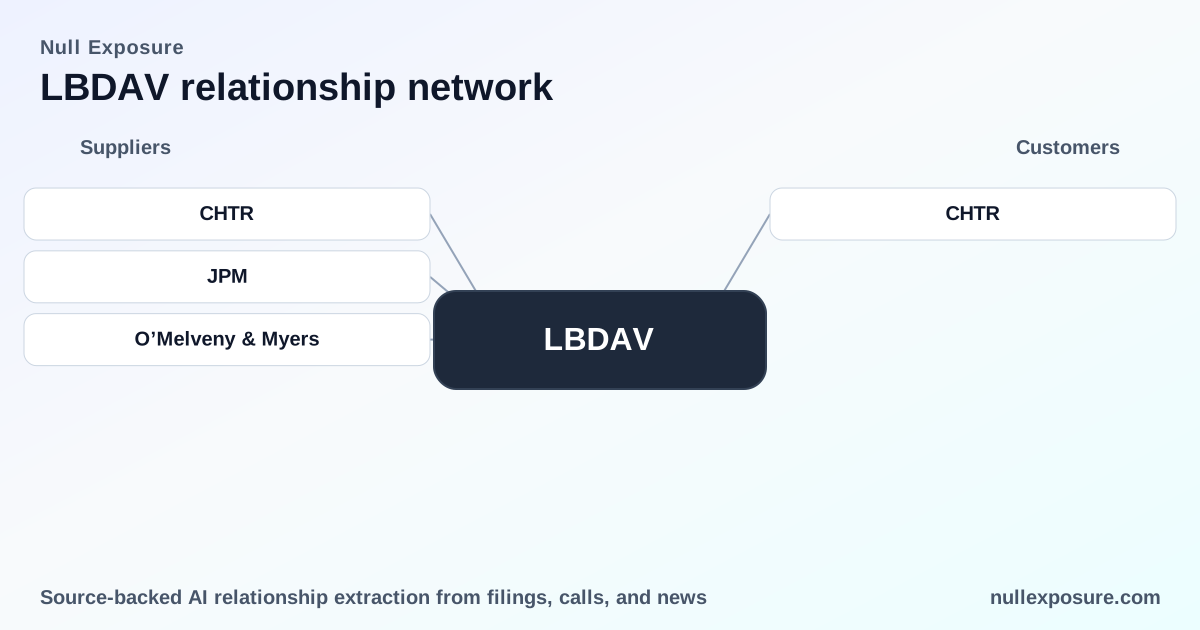
Liberty Broadband (LBDAV) — customer relationships and what investors should price in
Liberty Broadband (LBDAV) operates as an investment vehicle whose economic engine is a concentrated equity stake in Charter Communications; the company monetizes through equity value realization, structured share repurchases and the distribution of proceeds around a planned combination with Charter. Recent reporting shows Liberty is relying on a structured monthly repurchase program from Charter to service debt and bridge to a closing transaction, a detail that materially affects near-term liquidity and capital structure dynamics. For a concise vendor-relationship view tailored to investors, see Null Exposure’s research hub: https://nullexposure.com/.
The simple commercial reality: Charter underwrites Liberty’s near-term balance sheet
Liberty Broadband’s profile is fundamentally that of a single-counterparty investor. The relationship with Charter is not a routine supplier/customer link; it is the operating lever for cash flows and governance actions tied to an announced combination. Charter’s commitment to repurchase roughly $100 million of shares monthly from Liberty provides predictable liquidity to repay Liberty’s debt ahead of closing, which converts a strategic ownership stake into a structured cash-management arrangement for the investor company. According to coverage in the Hollywood Reporter (May 3, 2026) and contemporaneous reporting in Yahoo Finance (March 10, 2026), the repurchase cadence and governance adjustments have been formalized as part of the path to combination.
Every recorded customer relationship (explicit mentions in the source set)
-
Charter Communications — Hollywood Reporter (May 3, 2026): Charter will repurchase Charter shares from Liberty Broadband at approximately $100 million per month, with adjustments and incremental repurchases or loans as needed to allow Liberty to repay debt in advance of the companies’ combination at closing. This creates a clear, contract-like liquidity stream for Liberty ahead of the transaction. (Source: Hollywood Reporter, May 2026)
-
Charter Communications — Yahoo Finance (March 10, 2026): Reporting documents that Charter and Liberty Broadband revised governance and structured a monthly repurchase program of about $100 million, explicitly to help Liberty pay down debt until the closing of the transaction. This corroborates the structured repurchase mechanism referenced elsewhere. (Source: Yahoo Finance, March 2026)
-
CHTR (Charter) — Yahoo Finance duplicate (March 10, 2026): The same March 2026 Yahoo Finance piece is captured again under the ticker CHTR, restating the monthly repurchase arrangement and its role in facilitating Liberty’s debt paydown prior to closing. This duplicate mention reinforces the consistency of public reporting on the repurchase program. (Source: Yahoo Finance, March 2026)
If you want a consolidated dossier and time-ordered document links for diligence, Null Exposure maintains a live research portal at https://nullexposure.com/.
What these relationships tell you about Liberty’s operating model
-
Contracting posture: Transaction-oriented and highly contingent. Liberty’s near-term cash flows are structured through a counterparty arrangement (Charter share repurchases) that has the characteristics of a debtor liquidity covenant rather than a market-derived cash flow. That places emphasis on contractual execution and counterparty performance.
-
Concentration: Extreme single-counterparty concentration. Liberty’s economics and liquidity are concentrated in one counterparty — Charter — which elevates counterparty concentration risk and makes Liberty effectively a vehicle for Charter-related outcomes.
-
Criticality: The Charter relationship is critical to balance sheet normalization. The repurchase schedule is embedded to service debt ahead of a combination; disruption would have immediate implications for Liberty’s deleveraging strategy.
-
Maturity: Late-stage transactional posture. The presence of governance changes and a formalized repurchase schedule indicates an advanced stage of corporate combination planning, with cash-management mechanics already in place to bridge the period to closing.
These are company-level signals derived from disclosure and press coverage; they are not isolated to a single line item but define how Liberty operates as an investor going into a corporate combination.
Risk factors and what investors should watch next
-
Execution risk on repurchases is counterparty risk. Liberty’s ability to retire debt and deliver on the planned combination flows from Charter’s execution of the monthly repurchases and any incremental loans or purchases the parties agreed upon. Monitor Charter’s cash generation and any public amendments to the repurchase timetable.
-
Governance and closing mechanics matter. The governance changes referenced in public reporting imply negotiated control provisions and timing mechanics that will affect minority protections, timing of value realization, and the legal route to combination.
-
Concentration compresses optionality. With a single material relationship driving liquidity, Liberty’s optionality to pursue alternative capital markets or third-party buyers is constrained until the combination closes or the repurchase program is complete.
Investment implications — how to price LBDAV exposure
For investors and operators, the primary valuation lever is execution around the Charter combination and the repurchase schedule that provides short-term liquidity. Price the security as a transaction-exposure vehicle rather than a broadly diversified media play: track Charter’s operational performance, any amendments to the repurchase cadence, and public filings that formalize governance and closing terms. Because the arrangement is structured and time-limited, short-term downside is concentrated in counterparty performance and closing risk; upside accrues if the combination proceeds smoothly and repurchases execute as scheduled.
Conclusion — what matters to stakeholders right now
The headline for investors: Liberty Broadband’s immediate financial path is driven by Charter’s $100 million-per-month repurchase commitment, which converts an equity stake into a predictable liquidity mechanism to pay down debt ahead of a planned combination (Hollywood Reporter, May 2026; Yahoo Finance, March 2026). That dynamic reduces near-term refinancing risk if repurchases execute, but it concentrates risk squarely in the Charter relationship and the successful completion of the corporate combination. For ongoing monitoring, prioritize Charter’s public performance metrics, any amendments to repurchase mechanics, and formal SEC or corporate filings that finalize governance and closing terms.
For deeper, linkable research on the transaction mechanics and relationship signals, visit Null Exposure’s research hub: https://nullexposure.com/.