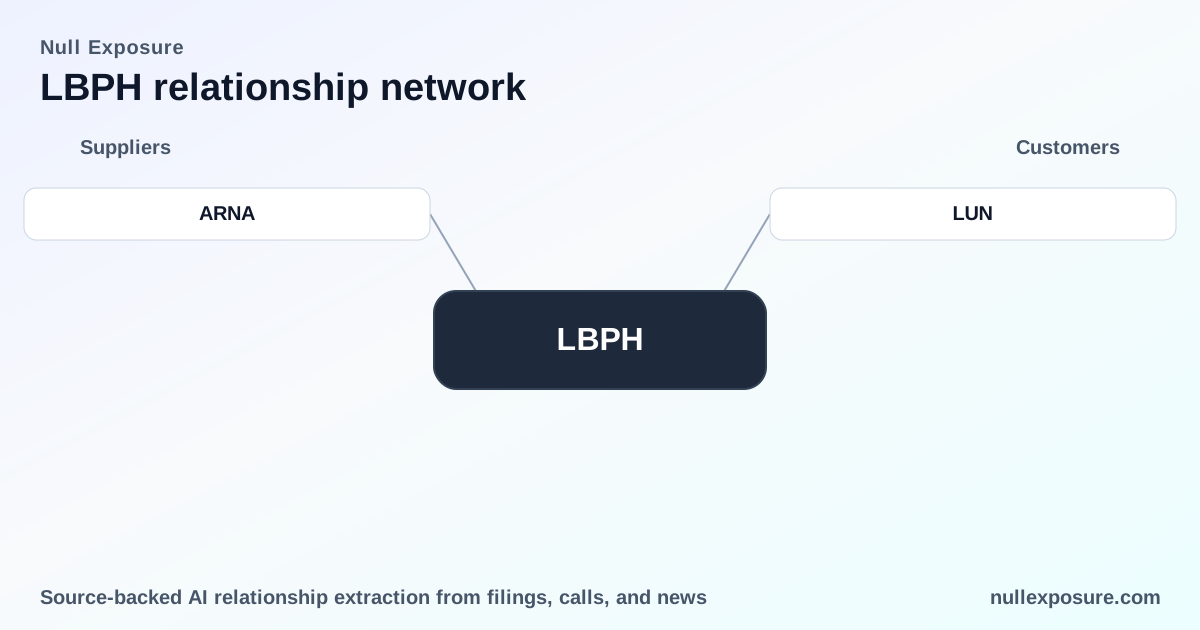
Longboard Pharmaceuticals (LBPH): Strategic relationships reshape value before commercialization
Longboard Pharmaceuticals builds value through a late-stage neuroscience pipeline focused on rare developmental and epileptic encephalopathies (DEEs) and monetizes through licensing, equity financings, and ultimately exit events that convert clinical-stage assets into acquirer-controlled revenue streams. The company’s business model has transitioned from stand‑alone clinical development to being an acquisition target, shifting counterparty risk from a small investor base to a strategic pharmaceutical buyer. For more on coverage and signals across counterparties, visit https://nullexposure.com/.
A single deal that rewrites the playbook
H. Lundbeck A/S agreed to acquire Longboard in a transaction valued at roughly $2.6 billion equity value (about $2.5 billion net of cash on a fully diluted basis), converting Longboard’s development runway and optionality into a strategic neuroscience asset for Lundbeck. That transaction converts Longboard’s upside—previously granular and investor‑driven—into consolidated enterprise value under an established neuroscience specialty player, materially changing commercialization exposure and partner negotiation leverage. Contracts and revenue capture will now sit under Lundbeck’s operational umbrella, not Longboard’s independent structure (European Biotechnology and Contract Pharma, March 10, 2026).
Key takeaway: the Lundbeck acquisition is the primary value crystallizer for LBPH investors and is the dominant counterparty event shaping risk and upside.
Investor backstop ahead of the exit
Prior to the acquisition, Longboard completed a private placement in March 2024 with an affiliate of Farallon Capital Management for 2,850,000 non‑voting shares at $21.00 per share, producing approximately $59.9 million in gross proceeds. That financing provided capital to advance late‑stage programs and reduced short‑term dilution risk for strategic buyers to negotiate consolidation terms from a funded development position (InvestingNews, March 2024).
Key takeaway: institutional capital providers such as Farallon materially funded near‑term development, improving deal readiness for a strategic acquirer.
How Longboard’s counterparties appear in the public record
The following relationships are the universe of counterparties referenced in public coverage and filings for the LBPH customer/investor scope.
- H. Lundbeck A/S (LUN) — Multiple press reports state Lundbeck signed an agreement to acquire Longboard for roughly $2.6 billion equity value, integrating Longboard’s late‑stage programs for DEEs into Lundbeck’s neuroscience pipeline; the deal is presented as strategic M&A to accelerate Lundbeck’s rare‑disease portfolio (European Biotechnology and Contract Pharma, March 10, 2026).
- Lundbeck (reported interchangeably with H. Lundbeck A/S) — Pharmaceutical‑Technology and other outlets reiterate that Lundbeck will pay $2.6 billion for Longboard’s equity value, underscoring consistent market messaging across trade press and confirming the strategic positioning of the assets within Lundbeck’s business plan (Pharmaceutical‑Technology, May 2026).
- Farallon Capital Management, L.L.C. — Longboard completed a private placement with a Farallon‑affiliated fund in March 2024, raising $59.9 million from the sale of non‑voting common stock, which strengthened Longboard’s balance sheet and supported late‑stage program advancement ahead of a strategic sale (InvestingNews, March 2024).
Each of these relationships is captured in primary press coverage and corporate communications; the Lundbeck relationship is transactional (acquisition), while Farallon’s involvement is capital provision prior to the M&A event.
What the relationship mix implies for operating posture and risk
With no formal constraints recorded at the company level, the public signals define the operating model and material business characteristics:
- Contracting posture: Transitioned from stand‑alone sponsor to acquisition target and now into acquirer control; Longboard’s previous external contracting (investor financings, CRO agreements) funnels into Lundbeck’s governance, reducing Longboard’s independent contracting footprint as of the acquisition announcement.
- Concentration: Counterparty concentration was high by design—late‑stage biotechs commonly have concentrated counterparties (lead investors and a single strategic buyer). The Lundbeck transaction centralizes value with one strategic partner, which reduces dispersion of commercialization risk but increases dependency on Lundbeck’s execution.
- Criticality: Longboard’s assets were described as late‑stage and high‑impact for rare DEEs, creating acute criticality for development milestones; this elevated therapeutic importance is why a strategic buyer committed substantial capital to acquire the program rights.
- Maturity: The combination of a large private placement (March 2024) and a 2026 strategic acquisition signals a typical biotech progression from venture financing to strategic exit, representing pre‑revenue scientific maturity achieved through sponsored development rather than commercial market traction.
These are company‑level signals rather than itemized contractual constraints; they describe how counterparties and capital events shaped Longboard’s operating and commercial posture.
Risk profile for investors and operators
- Execution risk transfers to Lundbeck. Post‑deal, clinical development and regulatory execution are Lundbeck’s responsibility; Longboard’s standalone execution risk is replaced by counterparty execution risk tied to Lundbeck’s capital allocation and R&D prioritization.
- Concentration risk crystallized as strategic exposure. The acquisition eliminates multiple small counterparty risks (investor dilution, small‑scale partnerships) but introduces dependency on a single large buyer to commercialize assets effectively.
- Balance‑sheet improvements before exit reduced deal friction. Farallon’s March 2024 placement strengthened Longboard’s negotiation posture and reduced immediate capital stress, improving the conditions for a strategic sale.
Bottom line — investment judgment in a single‑deal outcome
Longboard’s public counterparties reflect a classic biotech path to value realization: institutional financing to advance clinical programs, followed by a strategic acquisition that converts development optionality into consolidated enterprise value. For investors and operators, the Lundbeck acquisition is the defining event that reallocated both upside and operational responsibility away from Longboard’s independent structure. The Farallon financing is a relevant prelude that materially improved deal readiness.
For a concise, structured view of how counterparties and events affect biotech exit economics and counterparty risk, explore the coverage on the site: https://nullexposure.com/.
Bolded takeaway: the Lundbeck transaction is the single dominant driver of LBPH’s realized value and of the risk profile investors must evaluate going forward.