LBRDP: Who Liberty Broadband Does Business With and What That Tells Investors
Liberty Broadband (ticker LBRDP, Preferred Stock) operates as a U.S.-based cable and broadband company that monetizes primarily through recurring service fees for video, Internet and voice offerings to residential and business customers, supplemented by corporate management arrangements and other investment-related flows. For investors evaluating customer and intercompany exposures, the company’s public filings show a compact set of formal relationships that reinforce a recurring-revenue operating model and a reliance on a tightly managed corporate services structure.
If you want a concise dossier of Liberty Broadband’s partner footprint, start with the company 10‑K — the primary disclosure that details the intercompany services agreement that matters most to financial and operational modeling. For more context on relationship exposures across the telecom sector, visit https://nullexposure.com/.
The single material relationship investors should know about
-
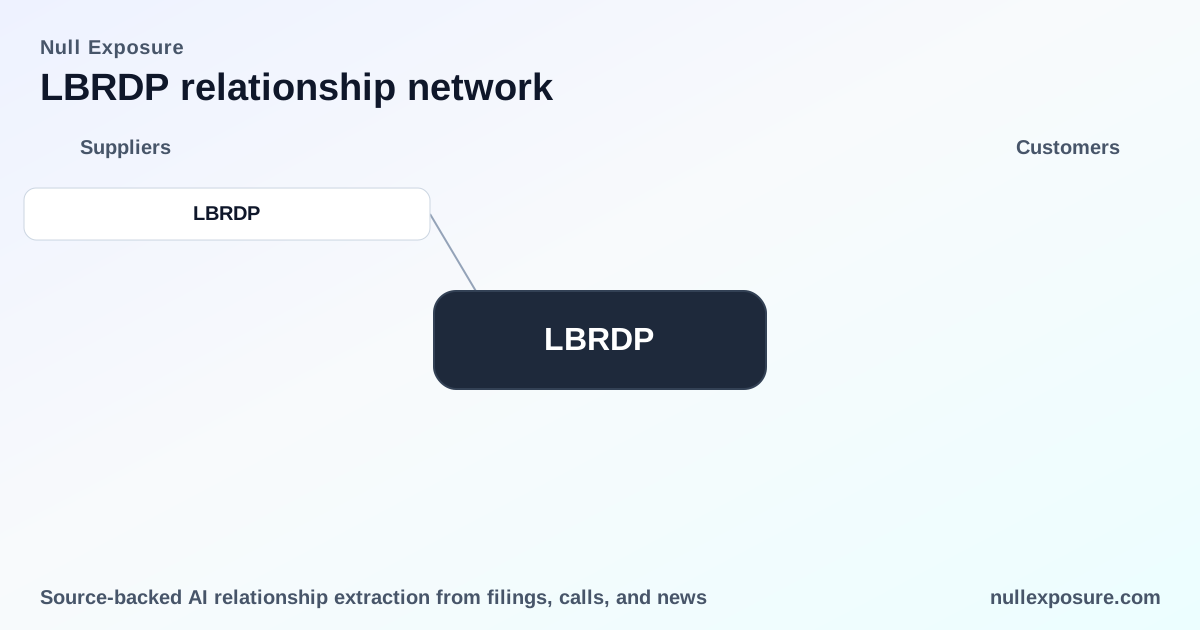
Liberty (services agreement): Liberty Broadband is party to a services agreement with Liberty, under which 74 Liberty corporate employees provide management services to Liberty Broadband for a determined fee. This is an explicit intercompany management-services contract disclosed in Liberty Broadband’s FY2025 10‑K filing. According to the FY2025 10‑K (filed February 2026), the arrangement transfers defined corporate functions and associated costs through a contractual fee.
Source: Liberty Broadband FY2025 Form 10‑K (disclosure excerpt filed 2026‑02‑14).
Why this relationship matters: the arrangement signals centralized corporate governance and cost allocation via a formal services contract rather than ad hoc support; that structure materially affects reported operating expense, internal control disclosures, and cash flows between related entities.
What the broader disclosure signals tell investors about operating posture
The corpus of constraints and excerpts gathered around Liberty Broadband and adjacent industry filings yields several company-level signals that clarify contract economics and counterparty exposure:
-
Recurring subscription revenue is the dominant contract model. Excerpts describing the industry indicate that service economics are driven by monthly fees and bundled pricing for Internet, mobile, video and voice. That implies predictable top-line visibility and sensitivity to churn metrics and ARPU dynamics rather than one-off project revenue.
-
Customer mix spans individuals to government and enterprise. Language in related filings highlights a spectrum of counterparty types — residential consumers, small and mid-market businesses, large enterprises and government entities. That breadth reduces single-segment concentration risk while introducing multi-channel sales and billing complexity.
-
Geography is North America‑centric. The statements point to service availability across 41 U.S. states; Liberty Broadband’s commercial footprint is therefore domestically focused, which concentrates regulatory and competitive risk within U.S. telecom policy and market dynamics.
-
Service-provider relationships and managed-services positioning are part of the ecosystem. Excerpts reference high-capacity last‑mile offerings and managed service solutions, signaling frequent interactions with network partners and wholesale customers. For investors, this means operational dependence on network quality and peering/wholesale agreements even where revenue is ultimately subscription-based.
These are company-level operating signals gathered from public disclosures and industry descriptions; they frame how to stress-test revenue durability and cost allocation in forecasts without attributing any single signal to the intercompany services agreement unless explicitly named in the filing.
Contracting posture, concentration, criticality and maturity — what to assume when modeling
-
Contracting posture: Predominantly subscription contracts with explicit fee structures. Modeling should emphasize recurring revenue, contract renewal dynamics, and equipment-related one-time charges.
-
Concentration: Low to moderate customer concentration at the retail level because the customer base includes millions of residential endpoints, but higher concentration for intercompany and wholesale flows — a material services agreement exists with Liberty as a defined counterparty.
-
Criticality: Services are mission-critical to end users and business clients; network reliability, customer service KPIs, and regulatory compliance are core to revenue retention.
-
Maturity: The business lives in an established, low-growth-to-stable-growth segment where churn reduction and ARPU expansion (bundling, higher-speed tiers, mobile add-ons) drive incremental value more than rapid subscriber growth.
Each of these characteristics should be incorporated into scenario analysis and stress testing, particularly in preferred‑security valuations where coupon coverage and downside protection are the priorities.
Quick inventory: every reported customer or partner relationship (compact list)
- Liberty — Under a services agreement, 74 Liberty corporate employees provide management services to Liberty Broadband for a fee; the contract formalizes intercompany management support and cost allocation. Source: Liberty Broadband FY2025 Form 10‑K (filed 2026).
This item represents the complete set of explicit relationship disclosures returned in the FY2025 customer-focused review.
Investment implications and risk considerations
-
Positive: Predictable cash flows. Subscription-based billing and a broad retail footprint produce recurring revenue that supports preferred security coverage assumptions where stability of distributions is front-of-mind.
-
Negative: Intercompany dependency and allocation risk. The explicit services agreement with Liberty creates an internal cost transfer mechanism; shifts in fee structure or allocation methodology could materially affect reported operating income and free cash flow available to stakeholders.
-
Operational risk tied to network and wholesale relationships. Even with widespread retail subscription revenue, Liberty Broadband’s economics are sensitive to network performance, wholesale pricing, and regulatory changes affecting incumbent and competitive carriers.
-
Geographic/regulatory exposure. A U.S.-centric footprint focuses upside and downside on domestic telecom policy and competitive dynamics; investors should stress-test models for potential changes in net neutrality, franchise/regulatory fees, and state-level tax exposure.
For readers wanting ongoing monitoring of Liberty Broadband’s relationship disclosures and counterparties, the 10‑K and quarterly filings remain the authoritative sources. If you want automated tracking and a summarized view of counterparty exposures, visit https://nullexposure.com/ for research services and relationship monitoring.
Bottom line
Liberty Broadband’s public disclosures show a recurring-revenue, subscription-driven business with a concise set of formalized intercompany arrangements — notably a services agreement with Liberty that centralizes management support. For investors and operators, the critical modeling levers are churn/ARPU dynamics, the economics of intercompany fee allocation, and the quality of network and wholesale relationships that underpin service delivery.