Liberty Oilfield Services (LBRT): customer relationships that move the P&L
Liberty Oilfield Services operates hydraulic fracturing, proppant logistics, wireline, field gas processing and related completions services across North America and selective international basins; it monetizes through a mix of project-based completions contracts, recurring logistics/software subscriptions (PropConnect™), goods from sand mines, and increasingly through power development and capacity-reservation arrangements. Revenue is driven by large enterprise E&P customers and structured master-service agreements, with meaningful concentration at the top end of the book — an operating profile that generates high revenue leverage in up cycles and exposes the company to discrete-contract and basin-risk dynamics. For fuller coverage and data-driven relationship monitoring visit https://nullexposure.com/.
Two customer relationships that deserve investor attention
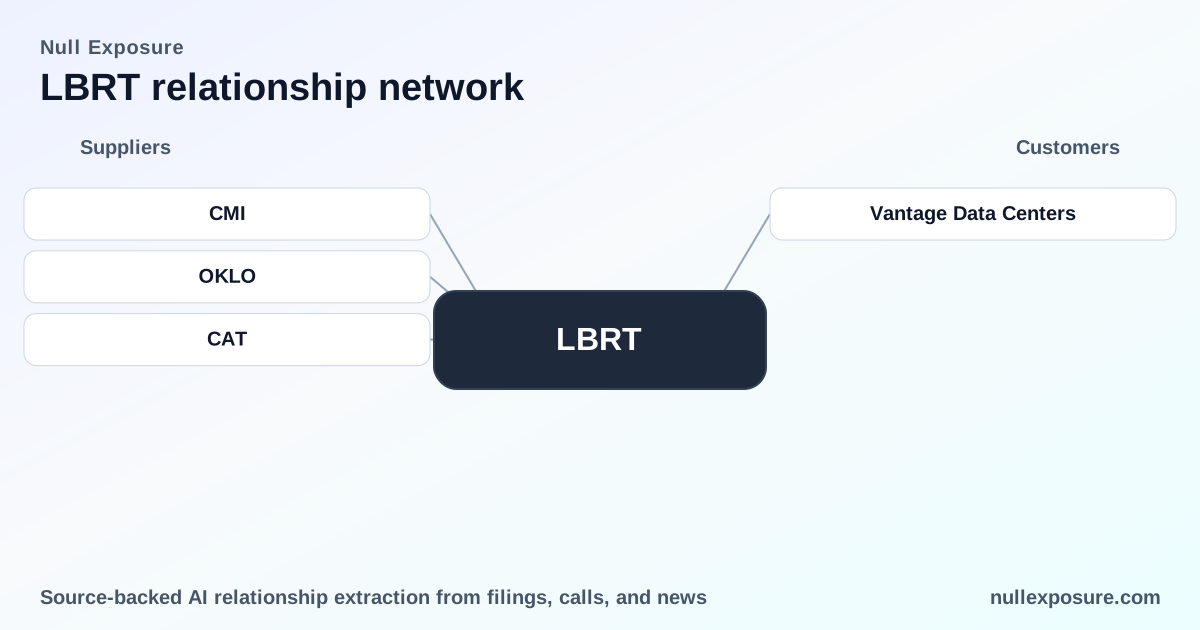
Vantage Data Centers — 1 GW power development anchored by a 400 MW firm reservation
Liberty announced a 1 gigawatt power development agreement with Vantage Data Centers, with the arrangement anchored by a firm 400 MW capacity reservation that creates a near-term, contracted cash-flow anchor for that project pipeline. According to Liberty’s Q4 2025 earnings call (March 2026) and subsequent press coverage in March–May 2026, the deal crystallizes Liberty’s strategy to monetize energy infrastructure adjacent to its core services. (Liberty Q4 2025 earnings call, March 2026; TradingView/Zacks press coverage, March–May 2026.)
Tamboran (TBN) — Liberty frac fleet used on Beetaloo pilot program
Tamboran used Liberty’s modern stimulation equipment to complete roughly 58–60 stimulation stages across a ~10,000-foot horizontal in the Beetaloo pilot, a direct utilization of Liberty’s fleet in the Northern Territory of Australia. News reports in FY2025–FY2026 documented Liberty’s equipment deployment and stage counts on the SS-6H well and the broader pilot program. (Rigzone, October 2025; Proactive Investors, March 2026.)
Why these relationships matter for investors
Both relationships illustrate two strategic revenue vectors for Liberty: traditional completions services sold into E&P pilot and development programs (Tamboran), and adjacent infrastructure development that converts technical capability into longer-duration commercial contracts (Vantage). The Vantage agreement signals Liberty’s ability to expand from discrete field services to capacity-backed infrastructure projects that can stabilize revenue timing, while the Tamboran work underscores Liberty’s reach into export markets and its role as an equipment-and-services provider to large enterprise operators conducting multi-stage developments.
Company-level operating signals and contractual posture
- Framework contracting dominates. Liberty relies on master service agreements (MSAs), supplemented by statements of work and specific pricing agreements; this structure supports repeated engagements while preserving project-by-project economics. The company explicitly states MSAs are the primary vehicle for service delivery.
- Subscription and hosted services add recurring revenue. Liberty markets PropConnect™ as a hosted SaaS logistics product for proppant and last-mile delivery, indicating a hybrid monetization model that combines one-off field services with recurring software fees.
- Counterparties skew large and concentrated. Liberty’s customer base includes major integrated and independent E&P companies; the top five customers accounted for around 39% of revenue in 2025, signaling material customer concentration that amplifies both upside and downside.
- Geographic footprint is concentrated but not exclusive. Operations are primarily in North America with targeted activity in the Northern Territory of Australia; that mix creates exposure to North American shale cycles while providing limited diversification through APAC projects like the Beetaloo pilot.
- Role mix: service provider and buyer signals. Liberty is principally a provider of completions and logistics services but also reports transactions where it is a buyer in certain contexts; overall, Liberty’s role is service-centric, delivering capital-intensive fleet services and goods (sand, proppant logistics).
- Mature, long-term customer relationships. The firm emphasizes long-term partnerships and continuous dialogue with customers on production economics, indicating contract maturity and relationship-driven procurement rather than spot-only interactions.
- Segment focus is services-led. The operating segment centers on completions services, proppant delivery, wireline and related goods — making Liberty’s cash flow dependent on activity levels and service utilization.
These company-level constraints combine into a clear operating profile: project-driven revenue with pockets of recurring cash flow from software and capacity reservations, meaningful counterparty concentration, and a contracting pattern that favors MSAs backed by task-specific statements of work.
If you track counterparties or need deeper analytics on Liberty’s customer exposures, see more at https://nullexposure.com/.
Relationship-by-relationship detail (complete list)
-
Vantage Data Centers — Liberty disclosed a 1 GW power development agreement with Vantage, backed by a firm 400 MW capacity reservation that provides an anchored revenue tranche for the development; this was announced in Liberty’s Q4 2025 earnings commentary and reinforced in press coverage in March–May 2026. (Liberty Q4 2025 earnings call, March 2026; TradingView/Zacks press, March–May 2026.)
-
Tamboran (TBN) — Tamboran’s Beetaloo pilot used Liberty’s stimulation fleet to complete approximately 58–60 stimulation stages across a ~10,000-foot horizontal, confirming Liberty’s role as an exported completions provider in the Northern Territory project. (Rigzone, Oct 15, 2025; Proactive Investors, Mar 10, 2026.)
Investment implications and a short risk checklist
- Revenue upside with volatility: High operating leverage to activity levels in North American basins produces strong revenue upside when utilization rises, but also exposes results to single-basin slowdowns.
- Concentration risk is real: With top-five customers representing ~39% of revenue in 2025, large client decisions materially affect Liberty’s topline and negotiating leverage.
- Contract mix moderates volatility somewhat: The presence of MSAs, PropConnect subscriptions, and capacity-reservation agreements (e.g., Vantage) smooths cash flow timing relative to a pure spot-services model.
- International exposure is tactical: APAC activity (Beetaloo) demonstrates exportable capabilities but remains limited as a diversification lever.
- Execution and capital intensity remain core risks: Fleet deployment, equipment utilization, and the ability to convert power-development contracts into funded projects determine margin outcomes.
Key investor checklist:
- Monitor top-customer revenue share trends each quarter.
- Watch utilization rates for Liberty’s frac fleet and sand-mine sales.
- Track progress and commercial milestones on the Vantage 1 GW project and any firming of capacity reservations.
- Follow acreage and activity schedules from large E&P customers that drive multi-stage programs like Beetaloo.
Bottom line
Liberty’s customer relationships reflect a hybrid operator: anchored in capital-intensive completions services but increasingly layering recurring and capacity-backed commercial arrangements that reduce cash-flow seasonality. Vantage’s power development deal represents a step into infrastructure contracts that lock in capacity economics, while Tamboran’s Beetaloo work confirms Liberty’s role as an international completions supplier. For investors, that combination translates into attractive cyclical upside tempered by concentration and execution risk — a profile that rewards close monitoring of customer concentration, fleet utilization, and the commercialization cadence of announced infrastructure projects.