LB Pharmaceuticals (LBRX): Institutional Backing, Pre‑Revenue Risk, and What Investors Need to Know
LB Pharmaceuticals is a clinical‑stage biopharma developing treatments for schizophrenia, bipolar depression and related neuropsychiatric disorders. The company currently generates no product revenue and funds development through capital markets and private placements; its value proposition is driven by clinical progress and the ability to convert institutional capital into runways and partnering options. For relationship intelligence on LBRX and comparable issuers, visit https://nullexposure.com/ for source‑level signals and deal tracking.
The thesis up front: funding is the product until one isn’t
LB Pharmaceuticals monetizes in the long run through licensing, strategic collaborations, or commercial sales of approved therapies, but today the company is financed, not selling. Market capitalization on the latest public snapshot sits at roughly $913 million while trailing revenues are zero and trailing EBITDA is negative (EBITDA: -$29.18 million; Diluted EPS: -3.18), which underlines a classic clinical‑stage dynamic: institutional financing determines program continuity and optionality. The February 2026 private placement is the most material customer/relationship signal captured in our results.
What the Feb 2026 private placement reveals about LBRX’s operating posture
On February 5, 2026 LB Pharmaceuticals announced a $100.0 million private placement that included a slate of institutional participants. That transaction is a straightforward expression of the company’s capital‑raising strategy: access institutional investors to extend clinical runway and preserve control over strategic choices. According to the GlobeNewswire press release dated February 5, 2026, the placement lists multiple new and existing institutional investors. The press release is corroborated by secondary postings (for example, a copy hosted by Sahm Capital).
- Capital dependence: The company remains dependent on equity capital to fund operations, consistent with a clinical‑stage balance sheet (RevenueTTM: 0).
- Institutional ownership concentration: Public data shows institutional holders account for roughly 97% ownership, reinforcing that LBRX’s investor relations and future financings will be negotiated with sophisticated, concentrated counterparties.
- Execution-critical funding: With negative EBITDA and no revenue, the private placement functions as an operational lifeline that converts investor conviction into program continuity.
(If you want a deeper relationship map or to track subsequent participation and insider moves, see https://nullexposure.com/.)
Who participated: institutional investors on the cap table (explicit names)
Below are the distinct participants cited in the February 5, 2026 release; each entry is a plain English summary with the primary source reference.
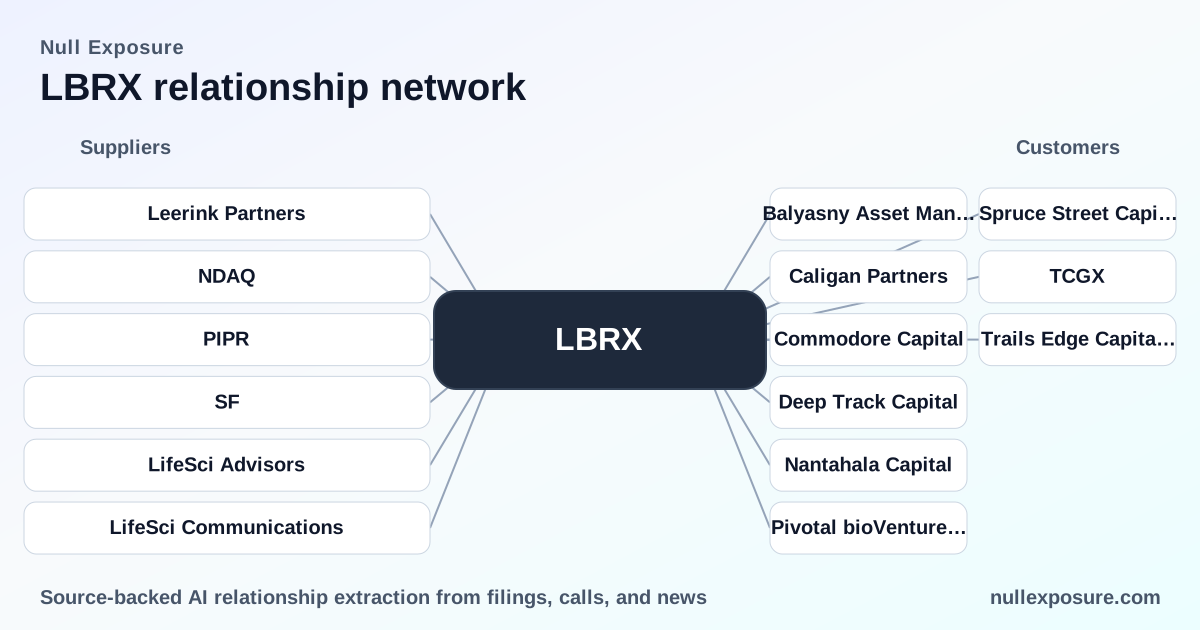
- Balyasny Asset Management L.P. — The GlobeNewswire release lists Balyasny as a participating institutional investor in the $100.0 million private placement. (GlobeNewswire, Feb 5, 2026).
- Caligan Partners — Caligan Partners is named among the institutional participants in the announced private placement. (GlobeNewswire, Feb 5, 2026).
- Commodore Capital — Commodore Capital participated in the financing round as reported in the company’s Feb 5, 2026 announcement. (GlobeNewswire, Feb 5, 2026).
- Deep Track Capital — Deep Track Capital is included on the list of new and existing institutional investors in the $100.0 million placement. (GlobeNewswire, Feb 5, 2026).
- Nantahala Capital — Nantahala Capital is reported as a participant in the private placement. (GlobeNewswire, Feb 5, 2026).
- Pivotal bioVenture Partners — Pivotal bioVenture Partners is named among investors in the financing disclosed by LB Pharmaceuticals. (GlobeNewswire, Feb 5, 2026).
- Spruce Street Capital — Spruce Street Capital is listed as a participating institutional investor in the transaction; the same roster is repeated on a Sahm Capital page. (GlobeNewswire, Feb 5, 2026; Sahm Capital post, Feb 2026).
- TCGX — TCGX is named as one of the institutional participants in the announced private placement. (GlobeNewswire, Feb 5, 2026).
- Trails Edge Capital Partners — Trails Edge Capital Partners is included on the placement participant list; the roster is also mirrored on an alternate news post. (GlobeNewswire, Feb 5, 2026; Sahm Capital post, Feb 2026).
Each listed firm is documented in the same GlobeNewswire press release announcing the $100.0 million placement; secondary reposting of the release appears on Sahm Capital’s news page and repeats the participant roster.
How these relationships change the risk and opportunity profile
These investor relationships change valuation drivers in specific ways:
- Risk mitigation through diversified institutional support: The presence of multiple institutional participants reduces single‑investor concentration risk relative to a one‑investor bridge financing. That lowers execution risk for near‑term program funding, but does not eliminate clinical risk.
- Governance and expectations: With institutional holders controlling roughly 97% of shares, board and management decisions will be strongly influenced by institutional investment theses, increasing the likelihood that strategic outcomes (partnerships, out‑licensing, or accelerated exits) align with investor timelines.
- Funding dependence remains central: A $100 million raise materially extends runway, but the company remains pre‑revenue and EBITDA negative; future trial spend, regulatory readouts, and partnering cadence will continue to dictate financing frequency.
Operating‑model constraints and company‑level signals
No explicit contractual constraints were captured in the relationship scan; present signals are therefore company level:
- Pre‑revenue clinical maturity: LBRX is a clinical‑stage biotech with zero reported trailing revenue and negative operating performance, so capital raises are a core operational lever. (Company filings / market snapshot FY2025).
- High institutional ownership: Institutional holders account for 97% of float, signalling concentrated professional oversight and limited retail trading influence. (Company public metrics).
- Capital markets dependence: The February 2026 private placement confirms the company’s reliance on institutional capital to finance development rather than revenue inflows.
Bottom line for investors and operators
LB Pharmaceuticals is capital‑driven: clinical progress and the institutional investor base determine trajectory, not product revenue today. The February 2026 $100 million private placement and its roster of institutional participants provide both runway and governance pressure—supporting near‑term program continuity while aligning outcomes with professional investors’ timelines.
For research teams and portfolio managers, the key tasks are: monitor upcoming clinical milestones tied to capital consumption, track investor communications for changes in governance or strategic intent, and model additional financing scenarios if trial timelines shift. For deal teams and business development officers at potential partners, the transaction signals readiness to engage on licensing and collaboration discussions with an institutional backing profile.
Explore further relationship intelligence and source citations at https://nullexposure.com/ to see how LBRX’s investor roster evolves relative to clinical milestones and capital needs.