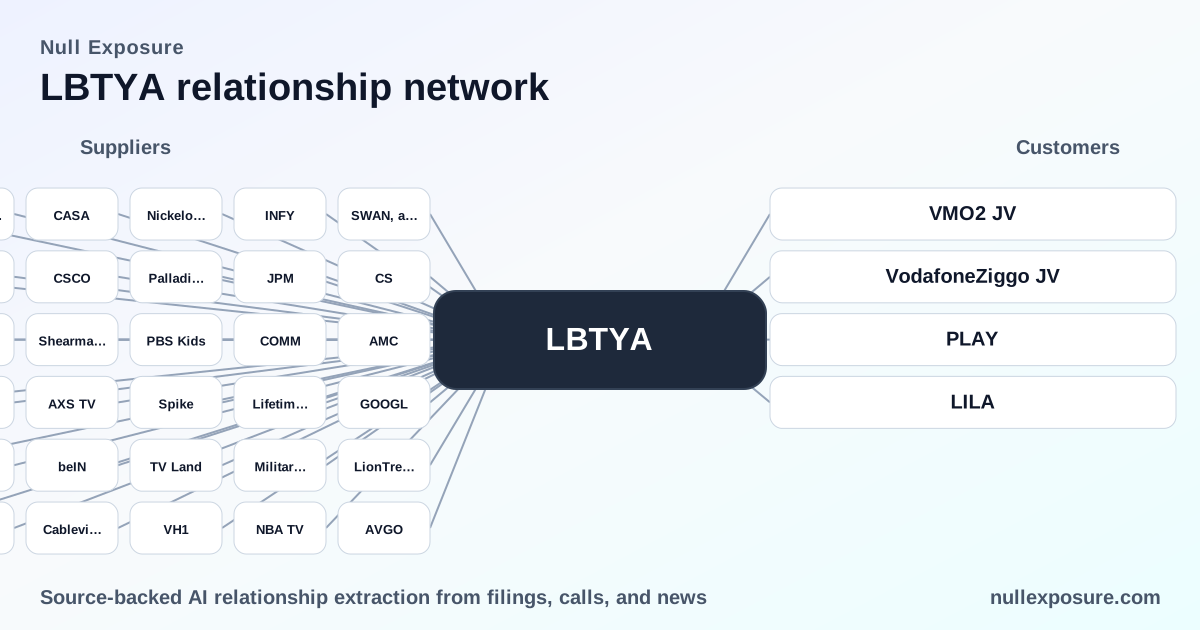
Liberty Global (LBTYA) — the customer map that drives European connectivity revenue
Liberty Global operates as a pan‑European communications provider that monetizes through recurring subscription fees for broadband, video, telephony and mobile services, supplemented by B2B contracts and periodic asset sales. The company’s business model is subscription‑led with a seller posture in core markets, and its cash flow profile is driven by household and small‑to‑large enterprise customer bases across EMEA while management selectively crystallizes value through strategic divestitures.
If you want a concise signal feed on counterparties and commercial posture, see NullExposure for an integrated view: https://nullexposure.com/
What the customer relationships tell you about the operating model
Liberty Global’s public disclosures and recent commentary reveal four practical operating characteristics investors should treat as core to the company:
- Contracting posture: The firm operates with a mix of subscription billing for consumers and long‑term individual agreements for medium and large business clients, which creates predictable recurring revenue alongside bespoke, longer‑duration B2B deals (as disclosed in the FY2024 10‑K).
- Counterparty breadth and concentration: Revenue derives predominantly from residential customers and SOHOs, but the company also contracts with mid‑market and large enterprises for mobile and business services — a breadth that reduces single‑counterparty concentration but introduces segmentation complexity.
- Geographic concentration and FX exposure: Substantially all reported revenue is sourced from Euro‑based subsidiaries, anchoring commercial risk in EMEA and exposing results to euro movements (FY2024 filings).
- Role and segment focus: Liberty Global serves as a seller of communications services (internet, video, telephony, mobile) and is comfortable executing strategic asset sales to reallocate capital, a behavior visible in prior disposals.
Together these signals indicate an operator with stable subscription cash flow, enterprise contract durability, regional concentration in Europe, and an active approach to portfolio optimization.
Explore more structured relationship signals at NullExposure: https://nullexposure.com/
Counterparty roll call — who Liberty Global names in filings and press
Below are the named relationships disclosed in the available documents. Each entry is a 1–2 sentence plain‑English summary with the source noted.
VMO2 JV
Liberty Global owns 50% of the VMO2 joint venture, which provides integrated broadband, mobile, video and fixed telephony services to residential and business customers in the U.K., making it a material strategic platform in the company’s telecom portfolio. This ownership stake is disclosed in Liberty Global’s FY2024 Form 10‑K.
VodafoneZiggo JV
Liberty Global owns 50% of the VodafoneZiggo joint venture, the leading Dutch telco that bundles fixed, mobile, video and integrated entertainment services to consumers and businesses in the Netherlands. The FY2024 10‑K explicitly lists this JV as a core Liberty Telecom platform.
PLAY (ticker reported as PLAY)
Liberty Global agreed to sell its UPC Poland operations to Play for $1.8 billion, a transaction reported in connection with the company’s prior portfolio rationalization and cited in press coverage of the UPC Poland sale. Coverage of the transaction appeared in NextTV and related press reporting covering the 2021 sale.
Sky
Sky is identified as a wholesale fiber customer in Liberty Global’s investor commentary, representing one of the external buyers that access Liberty Global’s fiber network and help drive utilization of the company’s wholesale capacity. This detail comes from Liberty Global’s Q2 2025 earnings call transcript reported on Investing.com.
Play (duplicate listing)
Independent press coverage also lists the UPC Poland sale to Play as the buyer of the Polish operations for $1.8 billion, reinforcing that Liberty Global executed a strategic disposal in that market to reallocate capital. See NextTV coverage of the UPC Poland transaction tied to FY2021 disclosures.
Liberty Latin America (LILA)
Liberty Latin America completed a split‑off from Liberty Global, after which LILA continued to benefit from shared services and expertise in products, technology and procurement pursuant to the separation terms; the corporate split and transitional relationships are described in Liberty Global and LILA press notices. Liberty Global’s press release and Globenewswire noted these post‑split service relationships dating to 2018.
Vodafone
Vodafone is listed as a wholesale fiber customer in markets where Liberty Global is building wholesale fiber, and together with Sky and other wholesale partners contributes to early utilization rates on newly deployed fiber networks. This arrangement was discussed during Liberty Global’s Q2 2025 earnings commentary reported on Investing.com.
Liberty Latin America Ltd. (press repeat)
A Globenewswire release and Liberty Global communications documented the completion of the split‑off that formed Liberty Latin America Ltd., and the announcement emphasized ongoing access to shared services and capabilities as part of the separation framework. The press release is dated around the 2018 split‑off.
LILA (ticker variant)
Public communications referencing LILA reiterate that the spun‑off company retains operational and procurement linkages to Liberty Global heritage, a point repeated in multiple press items documenting the 2018 corporate separation. See Liberty Global’s and Globenewswire’s historical releases on the split.
Proximus
Proximus is named in investor commentary as a migration/wireline partner for rural homes (roughly 700,000 homes referenced) that will be transitioned onto Liberty Global’s existing hybrid‑fiber coaxial (HFC) network, reflecting commercial coordination on customer migration in certain markets. This note appears in Liberty Global Q2 2025 earnings call reporting on network utilization and wholesale strategy.
How these relationships translate to investor risk and opportunity
- Predictable base, variable upside: The subscription billing model produces recurring cash flow, while wholesale fiber customers (Sky, Vodafone, Proximus) and JV stakes (VMO2, VodafoneZiggo) provide modular upside through capacity sales and joint governance of assets.
- Regional exposure is a double‑edged sword: EMEA concentration gives Liberty Global scale and regulatory familiarity, but it creates meaningful FX and macro sensitivity tied to the euro and local telecom cycles (company disclosures).
- Asset optimization is part of the playbook: Recent and historical asset sales (UPC Poland to Play) demonstrate management’s willingness to monetize non‑core markets to strengthen the balance sheet or invest in fiber rollouts.
- Counterparty mix reduces single‑counterparty risk but raises execution complexity across consumer, SOHO, SMB and enterprise segments; long‑term B2B agreements anchor revenue but require focused commercial execution.
Key takeaway: Liberty Global’s customer relationships are anchored in subscription revenue and strategic JVs, supplemented by selective wholesale deals and divestitures — a business model that delivers baseline predictability with episodic portfolio optimization events.
If you want an operational map of Liberty Global’s counterparties and contract signals, review the full relationship feed at NullExposure: https://nullexposure.com/