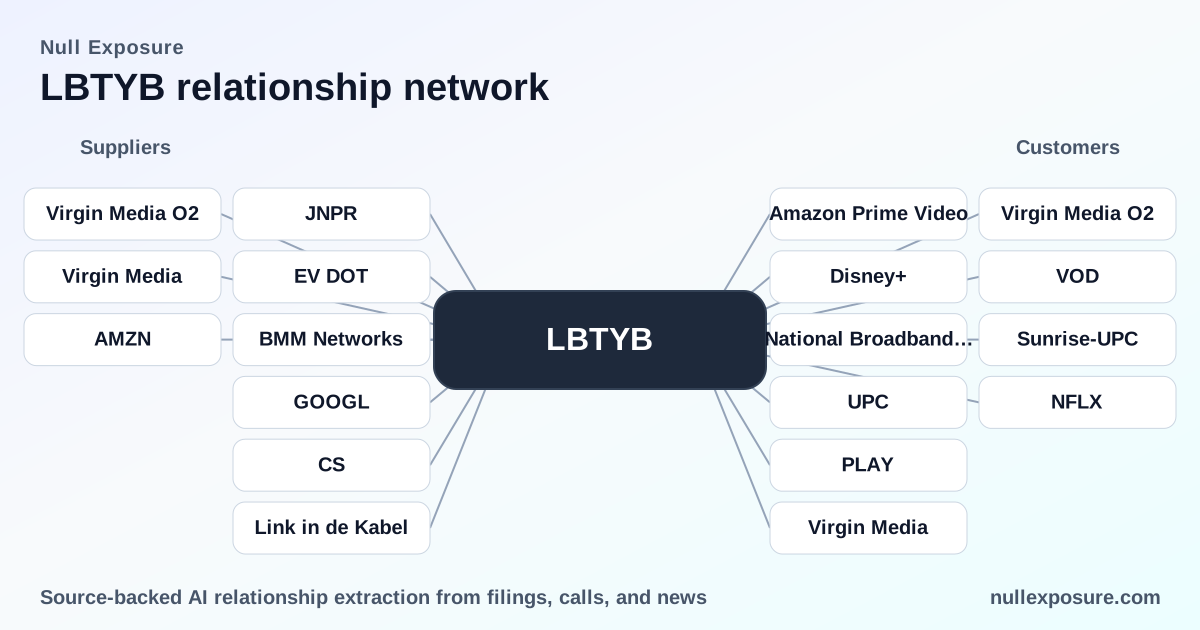
Liberty Global (LBTYB) — customer map and what it means for investors
Liberty Global operates as a European-focused broadband and converged-communications platform that monetizes through recurring residential and B2B subscription revenue, hardware sales and strategic wholesale/JV arrangements that anchor capacity and spread capital costs. The company combines consumer-facing services (broadband, video, telephony, mobile) with wholesale fiber and data-center partnerships to extract margin from installed networks and platform services. For a concise platform-level view and relationship signals, visit https://nullexposure.com/.
Why customers and partners define the risk/reward here
Liberty Global’s growth trajectory is driven less by one-off sales and more by contracted subscription economics, anchor wholesale tenancies and joint-venture arrangements that unlock monetization of network assets. The relationships below capture that blended revenue model: consumer streaming integrations that support customer retention, municipal or national broadband footprints that expand addressable homes, and wholesale anchors that underpin capital returns on fiber and edge infrastructure.
What the filings and press releases show — one entry per recorded relationship
Amazon Prime Video (FY2024)
Liberty Global’s Stream box aggregates third‑party OTT services, giving customers bundled access to Amazon Prime Video as part of its consumer entertainment interface. This is documented in Liberty Global’s FY2024 Form 10‑K describing the Stream product offering.
Disney+ (FY2024)
Disney+ is another major streaming service aggregated into Liberty Global’s Stream offering, helping the company to retain subscribers through content bundling. This is described in the FY2024 Form 10‑K.
National Broadband Ireland (FY2024)
VM Ireland entered into an agreement with National Broadband Ireland in 2024 to offer Liberty Global broadband and video products on NBI’s footprint, expanding Liberty’s residential and business reach in Ireland. This arrangement is disclosed in the FY2024 Form 10‑K.
UPC (AtlasEdge anchor tenancies, FY2021)
Liberty Global committed anchor tenancies from its operating companies including UPC to support AtlasEdge, a JV to develop edge data centres across Europe—demonstrating the company’s strategy to monetize infrastructure through captive tenancy. See Liberty Global press release on the AtlasEdge JV (2021).
PLAY / Play (sale of UPC Poland, FY2021)
Liberty Global announced definitive agreements to sell its Poland operations to iliad’s Polish mobile subsidiary Play, reflecting ongoing portfolio optimization and monetization of non-core assets. See Liberty Global press release on the UPC Poland sale (2021).
(Note: the sale is recorded in two related releases that reference Play/PLAY in FY2021.)
Sky (wholesale fiber customer, FY2025)
Liberty Global’s Q2 2025 earnings commentary notes Sky as a wholesale fiber customer, increasing utilization of its fiber network and validating the company’s wholesale FTTH strategy. See the Q2 2025 earnings call transcript (Investing.com).
Virgin Media O2 (VMO2 JV anchor, FY2022)
The Telefónica-Liberty Global JV for UK fibre development positions Virgin Media O2 as the anchor client for FTTH wholesale access agreements, cementing Liberty’s role as both operator and wholesale supplier in the UK. See the JV announcement (Telefonica press release, 2022).
Sunrise‑UPC (AtlasEdge anchor tenancy, FY2021)
Sunrise‑UPC is listed among the Liberty Global operating companies that committed anchor tenancy to the AtlasEdge edge data‑centre JV, reinforcing cross‑market infrastructure reuse. See the AtlasEdge JV press release (2021).
Virgin Media (AtlasEdge anchor tenancy, FY2021)
Virgin Media (UK/Ireland) is named as an anchor tenant for AtlasEdge, supporting the company’s strategy to internalize demand for edge capacity from its consumer platforms. Reference: AtlasEdge JV announcement (Liberty Global, 2021).
VOD / Vodafone (commentary, FY2023)
Industry reporting in 2023 highlighted Liberty Global’s opportunistic stake and the potential for Vodafone to become a wholesale partner for Virgin Media O2, indicating competitive and partnership dynamics in the UK wholesale market. See LightReading coverage (2023).
Vodafone (wholesale fiber customer, FY2025)
Liberty Global’s Q2 2025 remarks also list Vodafone as a wholesale fiber customer in certain markets, contributing to a growing wholesale revenue stream that leverages existing fiber assets. See Q2 2025 earnings call transcript (Investing.com).
Proximus (network migration commentary, FY2025)
Liberty Global reported that Proximus will migrate rural customers to Liberty’s HFC network for 700,000 homes, indicating cooperative commercial arrangements that drive incremental utilization of fixed networks. See Q2 2025 earnings call transcript (Investing.com).
NFLX / Netflix (FY2024)
Liberty Global’s Stream offering aggregates Netflix for customers, reinforcing the company’s retention strategy through bundled OTT access as disclosed in the FY2024 Form 10‑K. (The filing references Netflix under different name variants.)
Operating constraints and what they signal for investors
The filings produce a coherent set of company‑level operating signals:
- Contracting posture: a mix of long‑term and subscription revenue. Residential subscribers are typically on monthly or 1–2 year plans; medium/large enterprise agreements generally run at least one year. This creates a predictable recurring revenue base with measurable churn dynamics.
- Contract tenure diversity: Liberty recognizes revenue over varied contract terms (residential 12 months typical; mobile 1–3 years; B2B 1–5 years), giving a laddered cash flow profile across customer segments.
- Counterparty breadth: Customers span individuals, SOHOs, small and medium businesses, and large enterprises, so Liberty’s revenue is broadly distributed across consumer and enterprise segments rather than concentrated in a single customer.
- Geographic concentration in EMEA: The business derives the vast majority of revenue from European markets, which concentrates regulatory and macro risk but also allows scale effects across adjacent markets.
- Role as service provider and hardware/software supplier: Liberty supplies CPE hardware and essential software via its Technology & Innovation function and bills internal and external customers for those services—this creates internal transfer pricing and cross‑segment revenue recognition.
- Relationship maturity and activity: The company reports active, ongoing commercial arrangements and JV anchor tenancies, indicating an operational focus on monetizing existing network assets through third‑party demand.
These constraints translate into predictable subscription cash flows, meaningful wholesale upside as utilization increases, and regulatory/geographic concentration risk that investors need to price.
Investment implications — what to watch next
- Revenue quality is subscription‑heavy and asset‑anchored. The business model converts network investment into recurring revenue via retail subscriptions and wholesale tenancies; that supports stable EBITDA but requires continued capex discipline.
- Wholesale and JV strategies de‑risk capex and scale returns. Anchor tenancies (AtlasEdge, VMO2 JV, wholesale fiber customers such as Sky/Vodafone) materially improve utilization and capital efficiency across fiber and edge assets.
- Regulatory and country‑level execution matter. EMEA concentration concentrates exposure to national regulators, wholesale rules and national broadband initiatives—monitor policy changes and NBI rollouts closely.
- Balance‑sheet and market signals warrant attention. Liberty Global reports negative EPS and slim profit margins against meaningful revenue and EBITDA; management’s asset sales and JV monetizations will determine deleveraging trajectory.
For a consolidated view of relationship intelligence and commercial signals that matter for underwriting or portfolio due diligence, explore more at https://nullexposure.com/.
Bold takeaway: Liberty Global’s customer map is a hybrid of recurring retail subscriptions and strategic wholesale/JV contracts that together drive network monetization — investors should underwrite both steady subscription cash flow and upside from wholesale utilization while pricing regulatory and country concentration risk.